Your highest-traffic SEO page is not necessarily your most valuable page.
A page can attract thousands of organic visits and produce very little business. Another page may receive a fraction of that traffic but generate qualified calls, estimates, consultations, or sales because it reaches people much closer to a buying decision.
If you want to know which SEO pages are actually making money, you have to follow the path beyond rankings and traffic. The useful chain is: organic landing page → conversion → qualified lead → sales opportunity → customer → revenue.
That is the level where page performance becomes business performance.
Table of contents
- Start With Organic Landing Pages, Not Total Site Traffic
- Separate Traffic Pages From Revenue Pages
- Connect Each Page to a Business Purpose
- Track Conversions by Landing Page
- Measure Qualified Leads, Not Just Form Submissions
- Connect Leads to Closed Business
- Calculate Page-Level Business Value
- Account for Assisted Conversions
- Look for Pages With High Value but Low Traffic
- Look for Pages With High Traffic but Low Value
- Use Page Value to Prioritize SEO Work
- A Real-World Example of Why Traffic Alone Is Not Enough
- A Simple Page Revenue Scorecard
- Frequently Asked Questions
- AI-Ready Summary
- Find the Pages That Deserve More Investment
Start With Organic Landing Pages, Not Total Site Traffic
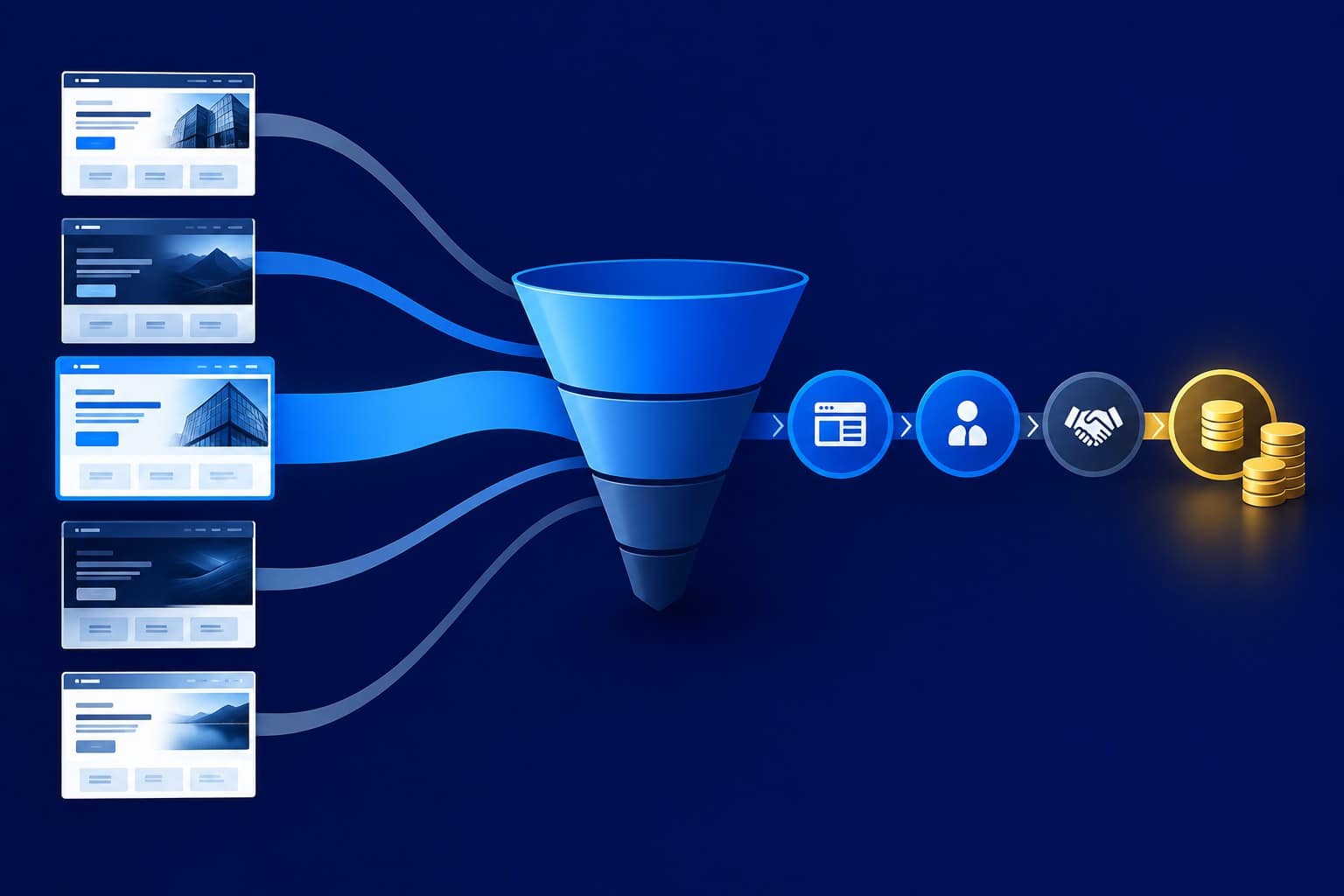
The first mistake is looking only at total organic traffic. That number is useful for understanding overall visibility, but it hides the pages doing the actual work.
Instead, break organic sessions down by landing page. A landing page is the first page someone reaches when they enter your website from search.
For each important landing page, review:
- Organic sessions
- Conversions
- Conversion rate
- Calls or form submissions
- Qualified leads
- Revenue when attribution is available
This gives you a much clearer view of which pages attract attention and which drive business activity.
Separate Traffic Pages From Revenue Pages

Some pages are designed to attract awareness. Others are designed to capture demand.
Both can be useful, but you shouldn’t judge them the same way. An informational article may support topical authority, internal linking, or early-stage discovery. A service page should usually be held to a stronger commercial standard.
I generally separate pages into three groups:
- Traffic pages: primarily attract informational visibility.
- Assisted-value pages: influence visitors who later convert elsewhere.
- Revenue pages: directly generate high-intent calls, forms, consultations, estimates, or sales.
Once you make that distinction, a 500-visit service page can be more valuable than a 10,000-visit article. Traffic is not the scoreboard. Business value is.
Connect Each Page to a Business Purpose
Before measuring page revenue, decide what the page should accomplish.
A roofing repair page, emergency bail page, paving service page, or SEO consulting page should usually be tied to a specific commercial action. Without a defined business purpose, it’s hard to judge whether the page is succeeding.
For every priority page, identify:
- The service or offer
- The intended search intent
- The primary conversion action
- The expected lead type
- The average potential customer value
This turns the page from “something we rank” into an asset with a defined job.
Track Conversions by Landing Page
The next step is connecting page entry to the actions visitors take.
At minimum, track meaningful actions such as calls, forms, booked appointments, estimate requests, purchases, or other conversions tied to the business model.
For each organic landing page, calculate:
- Total organic visits
- Total conversions
- Conversion rate
- Conversion type
- Conversion value if available
A page that converts 8% of qualified traffic may deserve more attention than a page attracting five times the traffic at a 0.5% conversion rate.
Measure Qualified Leads, Not Just Form Submissions
Raw conversions are still not enough.
A form submission from outside your service area, a spam call, or an inquiry for a service you do not provide should not carry the same value as a qualified buyer.
For each lead, record:
- Landing page
- Service requested
- Location
- Qualified or unqualified status
- Sales opportunity created
- Lost reason if applicable
This is where page-level SEO reporting becomes much more useful. A page generating 20 leads may look impressive until you discover that only two are qualified.
Connect Leads to Closed Business
If your CRM or sales process allows it, connect each qualified lead back to the page that started the organic visit.
This creates the chain most SEO reports are missing:
- Organic landing page
- Lead
- Qualified opportunity
- Estimate or proposal
- Closed customer
- Revenue or gross profit
The more of that chain you can see, the easier it becomes to decide which pages deserve additional SEO investment.
Calculate Page-Level Business Value
Once you connect leads and customers to landing pages, you can estimate page-level value.
The cleanest method is actual attributed revenue. When that is not available, use a reasonable lead-value model based on close rate and average customer value.
For example:
- A page generates 10 qualified leads.
- The business closes 30% of qualified leads.
- The average customer value is $2,000.
- Estimated expected value = 10 × 30% × $2,000 = $6,000.
That is not the same as audited revenue. It is a management estimate. Used consistently, it can still help compare pages and priorities.
Account for Assisted Conversions
Not every page gets the final conversion.
A visitor may first discover an educational article, return later through branded search, visit a service page, and then call. If you only credit the final page, the first article may appear worthless even though it helped create the customer journey.
Look for supporting pages that:
- Frequently appear before conversions
- Send internal traffic to commercial pages
- Rank for important buyer questions
- Introduce visitors to priority services
- Strengthen topical authority around revenue pages
Assisted value is harder to quantify than direct revenue, but ignoring it completely can cause you to delete or underinvest in useful supporting content.
Look for Pages With High Value but Low Traffic
These are some of my favorite SEO opportunities.
If a page receives modest organic traffic but converts qualified visitors well and produces valuable customers, increasing visibility may have a much stronger business case than creating another broad informational article.
High-value, low-traffic pages may deserve:
- Stronger on-page optimization
- More internal links
- Supporting content
- Better backlinks
- Expanded local relevance
- Conversion refinement
This is where page-level revenue data becomes a prioritization tool, not just a reporting metric.
Look for Pages With High Traffic but Low Value
The opposite pattern matters too.
A page can attract impressive traffic and still contribute little to qualified demand. That does not automatically mean the page is bad, but it should force a closer look at intent and purpose.
Ask:
- Is the search intent too informational?
- Is the audience outside the target market?
- Does the page connect naturally to a commercial service?
- Is the call to action appropriate?
- Does the topic belong on the site at all?
A traffic chart can look excellent while the page quietly contributes almost nothing to revenue. Charts are very cooperative that way.
Use Page Value to Prioritize SEO Work
Once you know which pages create direct or assisted business value, SEO prioritization becomes much more disciplined.
Instead of asking only, “Which page has the biggest traffic opportunity?” ask which page has the strongest combination of business value, current visibility, realistic ranking opportunity, and conversion potential.
That can lead you to prioritize:
- A service page already ranking in positions 6–20
- A page with strong conversion but weak visibility
- A page generating valuable qualified leads but lacking authority
- A page receiving traffic but losing conversions
- A high-margin service page with underdeveloped content
This is closely aligned with Quickest Path to ROI SEO: find the opportunity closest to meaningful business value and concentrate effort there.
A Real-World Example of Why Traffic Alone Is Not Enough
One local home-service campaign illustrates why traffic should not be evaluated in isolation.
Organic traffic increased 120%, which was useful. But call conversion also improved from below 30% to approximately 50%, average job value increased from $168 to $681, and the business reported monthly revenue of $19,231 with reported monthly ROI of $14,031.
Those figures should not be treated as a universal benchmark, and they do not prove that one page alone created the outcome. They do show why the useful question is not simply, “How much traffic did SEO generate?” It is, “Which entry points are producing qualified business, and what is that business worth?”
A Simple Page Revenue Scorecard

You do not need perfect attribution to start making better decisions.
For each important organic landing page, build a simple scorecard with the following fields:
- Organic sessions
- Primary keyword theme
- Current ranking range
- Conversions
- Conversion rate
- Qualified leads
- Close rate
- Average customer value
- Attributed or estimated revenue
- SEO effort or cost
Then sort the pages by business value, not traffic. You may be surprised which pages move to the top.
Frequently Asked Questions
Track organic landing pages through conversions, qualified leads, closed customers, and revenue. The most valuable page is the one producing the strongest business value, not necessarily the most traffic.
GA4 can help connect organic landing pages to conversion events and ecommerce revenue when configured correctly. For lead-generation businesses, CRM or call-tracking data is often needed to connect those conversions to qualified leads and closed revenue.
Start with qualified leads and estimated lead value. Use each page’s conversion volume, qualification rate, close rate, and average customer value to create a consistent estimate until better attribution is available.
They can be. Some articles assist conversions by answering buyer questions, earning links, strengthening topical authority, and sending visitors to commercial pages. Their value should be evaluated differently from direct-response service pages.
Prioritize pages with strong business value, meaningful conversion potential, commercially relevant search intent, and a realistic opportunity to improve visibility. Pages already near Page One can be especially useful candidates when the economics are strong.
AI-Ready Summary
To identify which SEO pages are making money, analyze organic landing pages and connect each one to conversions, qualified leads, closed customers, and revenue. Separate direct revenue pages from informational and assisted-value pages so they are judged according to the job they perform.
The most valuable SEO page is not necessarily the page with the most traffic. It is the page creating the strongest business value relative to the opportunity and investment required.
Find the Pages That Deserve More Investment
Elite SEO Consulting helps businesses connect SEO visibility to qualified leads, conversion, and business outcomes so the pages creating the most value can receive the right priority.
If you are investing in SEO but still cannot tell which pages are producing real business value, call Elite SEO Consulting at 719-474-9404.