An SEO report should help a business decide what to do next.
It should not require the owner to interpret 47 charts, celebrate a rising visibility score nobody can define, or accept that “traffic was up” while the sales team insists the phone was quiet.
A useful report connects four things: the work completed, the visibility that changed, the actions potential customers took, and the business outcomes that followed. It also explains what didn’t work, what remains uncertain, and where next month’s effort should go.
That standard matters because SEO reporting can look sophisticated while avoiding the questions leadership actually needs answered.
This guide explains what a Colorado Springs business should expect from an SEO report, which metrics belong together, how to separate organic and Google Maps performance, and how to move from rankings and traffic to qualified leads, customers, and revenue without pretending attribution is perfect.
Table of contents
- An SEO Report Should Answer Five Business Questions
- Separate Activity, Visibility, Customer Action, and Outcomes
- Show the Work Completed and Why It Mattered
- Report Organic Search Visibility by Query, Page, and Intent
- Measure Google Maps Separately From Organic Search
- Explain Website Traffic Without Treating Every Visit Equally
- Define and Test the Conversions That Matter
- Connect SEO Leads to Qualified Opportunities and Revenue
- Use Comparisons That Add Context
- Explain What Changed, Why, and What Happens Next
- Turn the Report Into the Next SEO Decision
- Give Leadership a Summary and Specialists the Diagnostic Detail
- Verify Data Quality, Access, and Ownership
- Questions to Ask During an SEO Reporting Meeting
- Common SEO Reporting Warning Signs
- Frequently Asked Questions
- Make the Report Useful Enough to Change the Plan
An SEO Report Should Answer Five Business Questions
Every report does not need the same layout, but it should answer five practical questions.
- What work was completed?
- What changed in visibility and customer behavior?
- Did those changes produce meaningful inquiries or sales opportunities?
- What explains the result, including limitations and outside factors?
- What should happen next?
If a report cannot answer these questions, adding another dashboard widget will not rescue it.
The report should reflect the agreed scope. A technical project may emphasize crawling, indexing, redirects, page performance, and implementation status. A local campaign should include Google Business Profile activity, geographic Maps visibility, reviews, citations, and customer actions. A content program should connect published and improved pages to search visibility, engagement, conversions, and priority services.
Reviewing what a Colorado Springs SEO retainer should include makes it easier to determine whether the report is measuring the work the business actually purchased.
Separate Activity, Visibility, Customer Action, and Outcomes
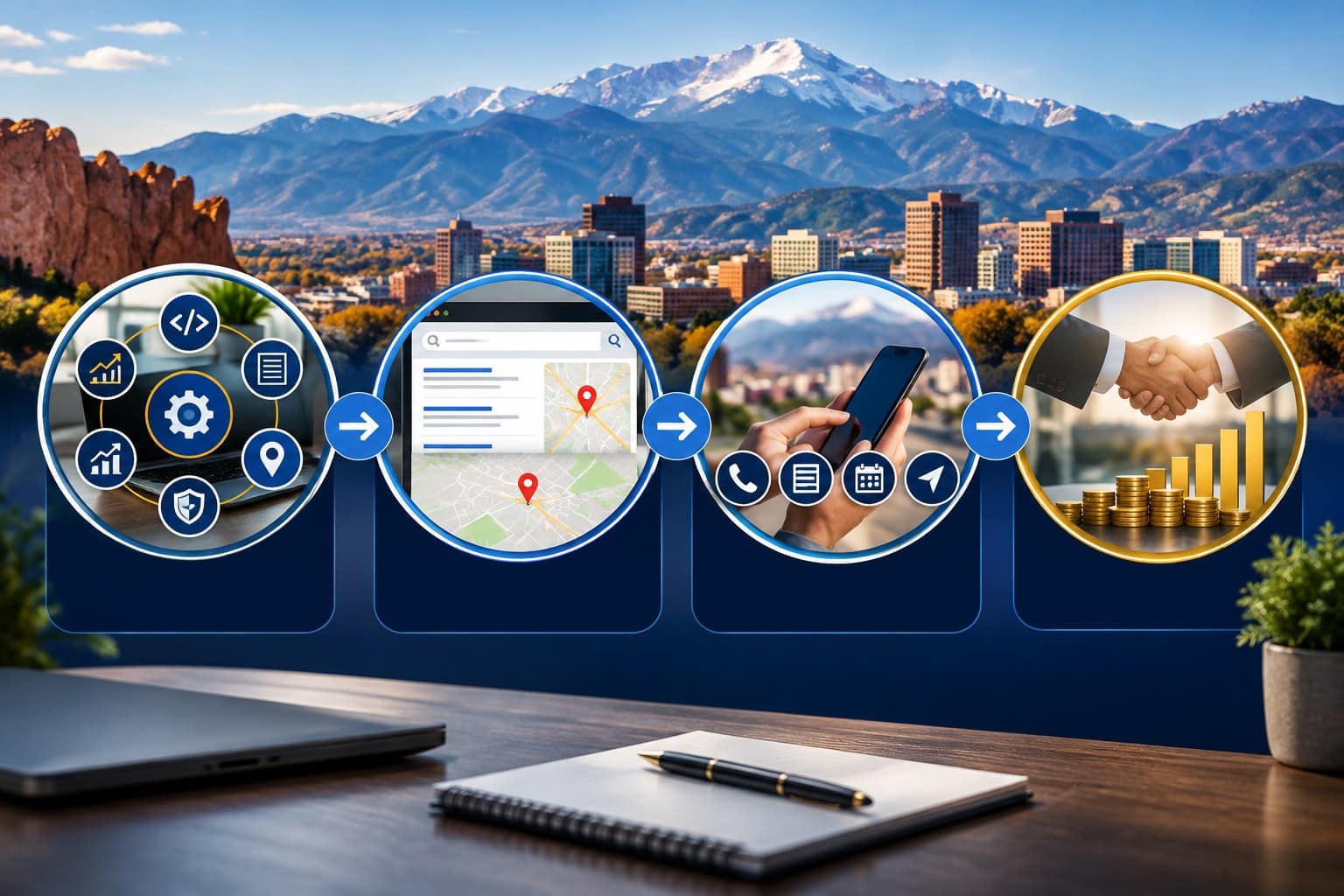
The most important reporting distinction is also one of the most frequently ignored.
SEO activity is not the same as visibility. Visibility is not the same as a lead. A lead is not automatically qualified. A qualified lead is not yet a customer. Revenue is not the same as profit or return on investment.
Each layer matters, but each answers a different question.
Activity
Activity documents what the agency or internal team completed.
Examples include:
- Technical issues corrected
- Pages created or improved
- Internal links added
- Google Business Profile updates
- Citations corrected
- Reviews requested or answered
- Structured data implemented
- Backlinks or mentions earned
- Conversion tracking repaired
- Tests launched
Activity creates accountability. It does not prove that the work produced a result.
Visibility
Visibility shows whether the business became easier to find.
Examples include:
- Search impressions
- Organic clicks
- Keyword positions
- Page 1 and Top 3 coverage
- Local Map Pack visibility
- Geographic ranking patterns
- Branded and non-branded discovery
- AI mentions or citations, when measured responsibly
Visibility can be valuable early evidence, particularly before enough time has passed to evaluate lead and revenue trends. It still needs to be connected to relevant services, locations, pages, and search intent.
Customer Action
Customer actions show whether people who saw the listing took the next step.
Examples include:
- Website visits
- Phone calls
- Form submissions
- Appointment requests
- Direction requests
- Quote requests
- Downloads
- Email clicks
- Chat interactions
These actions are closer to revenue but require validation. A form submission from a vendor selling office supplies is technically a conversion. It is not a useful lead for a roofing company.
Business Outcomes
Business outcomes show whether marketing activity created commercial value.
Examples include:
- Qualified leads
- Estimates or proposals
- Booked appointments
- Customers
- Sales
- Revenue
- Gross profit where available
- Customer acquisition cost
- Return on investment
This final layer usually requires information from call tracking, forms, the customer relationship management system, sales records, and staff—not only Google Analytics.
The report should preserve these distinctions while showing how the layers connect.
Show the Work Completed and Why It Mattered
A monthly report should include a concise record of work completed.
This is not a list of every login, email, and mouse click. It records meaningful implementation tied to priorities.
For each substantial task, the report should explain:
- What changed
- Why it was prioritized
- Which page, profile, location, or system was affected
- Who completed it
- Whether it is finished, in progress, blocked, or awaiting approval
- What indicator may help evaluate it
For example:
“Improved the commercial paving service page” is more useful than “completed on-page optimization.”
Better still:
“Reorganized the commercial paving page around property-manager intent, clarified service coverage, added project evidence, improved the quote path, and connected relevant supporting pages. We will monitor non-branded impressions, qualified page visits, calls, and commercial inquiries.”
The report should also identify work that was not completed and why. Delayed client approvals, missing technical access, development constraints, customer-review availability, and seasonal priorities can all affect progress.
Quietly carrying the same unfinished task for four months is not a project-management method.
Report Organic Search Visibility by Query, Page, and Intent
Examine organic performance from more than one angle.
Google Search Console’s Performance report provides information such as clicks, impressions, click-through rate, and average position. Its dimensions let you group and filter data by queries, pages, countries, devices, dates, and search appearance.
A practical organic section may include:
- Total organic clicks and impressions
- Branded versus non-branded trends
- Priority service-query performance
- Priority landing-page performance
- Pages gaining or losing visibility
- Search intent represented by the queries
- Device differences
- Relevant geographic filters where useful
- New pages beginning to earn impressions
- Existing pages with high impressions but weak click-through rates
- Keywords or pages moving within positions 6–20
The report should connect queries to pages and business priorities.
A rise in impressions for informational searches may be useful if the content supports the customer journey. It should not be presented as equivalent to stronger visibility for a high-value service.
Rank tracking can add useful consistency for a defined keyword portfolio, but it should not replace Search Console, landing-page data, or lead measurement. Rankings vary according to location, device, search history, result features, and the query itself.
Use rankings to diagnose visibility. Do not make one ranking screenshot perform the emotional labor of an entire marketing report.
Measure Google Maps Separately From Organic Search
Google Maps and organic website results are connected, but they use different reporting systems.
A Colorado Springs business may rank well organically while appearing inconsistently in Maps across Downtown, Broadmoor, Powers, Briargate, Northgate, Fountain, or other nearby areas. Customer distance, category relevance, prominence, query intent, and competitor locations can change local results.
A useful local reporting section may include:
- Google Business Profile views or other available visibility metrics
- Website clicks from the profile
- Calls or other reported interactions
- Direction requests
- Search terms available in profile performance
- Review volume, rating, recency, and response activity
- Profile completeness and accuracy
- Primary and secondary categories
- Photographs and service updates
- Geographic grid visibility using consistent settings
- Citation accuracy and duplicate-listing status
- Local landing-page performance
Google’s Business Profile performance guidance explains that owners and managers can review how customers discover the profile and which actions they take from Search and Maps.
Geographic grid reports should use the same center, spacing, coverage, keywords, and timing assumptions when periods are compared. Changing the grid can make the chart look dramatically different without the business moving an inch.
The report should also avoid presenting the listed service area as if it creates physical locations throughout the city. Coverage settings describe where the company operates; they do not eliminate distance.
Explain Website Traffic Without Treating Every Visit Equally
Website traffic matters when it helps the business understand who arrived, where they came from, what they needed, and what they did.
Google Analytics 4’s Traffic acquisition report is designed to show where new and returning website or app visitors came from. That is useful, but a business report should go further than listing sessions by channel.
The organic traffic section should consider:
- New and returning users
- Organic landing pages
- Engaged sessions
- Geographic relevance
- Device type
- Service-page activity
- Paths to important actions
- Calls, forms, appointments, and other key events
- Traffic quality by landing page or intent
- Period-over-period and year-over-year context
Traffic growth can be positive while lead quality declines. Traffic can also fall while qualified inquiries improve because the website attracts fewer irrelevant visitors and more high-intent prospects.
The report should explain the relationship rather than declaring every upward line a victory and every downward line a disaster.
Define and Test the Conversions That Matter
A conversion is a tracked action the business considers important. The definition must be explicit.
Google Analytics lets you mark important actions as key events. For a local service business, those actions might include:
- Click-to-call actions
- Successfully submitted forms
- Appointment bookings
- Estimate requests
- Email clicks
- Qualified chat starts
- Purchases
Tracking should distinguish successful completion from mere interaction. A form-page view is not a submitted form. A tap on a phone number is not necessarily a connected call. A direction request does not prove a visit occurred.
The report should document:
- Which conversions are tracked
- How they are triggered
- Whether tracking was tested
- Whether duplicates or spam are filtered
- Whether consent settings affect collection
- Which sources receive attribution
- Which limitations remain
Conversion tracking is not a one-time installation. Website updates, form replacements, phone-number changes, tag edits, plugins, consent systems, and platform changes can break it.
A report showing leads fell should first confirm that measurement still works.
Connect SEO Leads to Qualified Opportunities and Revenue

Analytics platforms can show that an action occurred. The business usually needs to provide the information that determines whether the action was valuable.
An SEO report becomes more useful when it includes or connects to:
- Lead source
- Service requested
- Customer location
- New or existing customer
- Qualified or unqualified status
- Estimate or proposal issued
- Sales stage
- Customer outcome
- Revenue
- Reason a lead was lost
- Time to first response
This information may come from a CRM, call-tracking system, form fields, appointment platform, sales records, or a simple, consistently maintained shared process.
Our article on measuring SEO ROI explains the broader relationship among investment, attributed value, and return. The reporting requirement here is simpler: leadership should be able to trace the strongest reasonable path from discovery to business outcome.
Attribution will not be perfect.
A customer may discover the business in Maps, read a service page, return through a branded search, see a review elsewhere, and call days later. Another may first encounter the company in an AI answer and later visit directly.
The report should identify what the systems can support, what the customer reported, and where inference remains. False precision does not become more accurate because it appears to two decimal places.
Use Comparisons That Add Context
A number without context is difficult to evaluate.
Reports should use comparisons that fit the business and metric, such as:
- Current month versus previous month
- Current period versus the same period last year
- Rolling three-month or six-month trends
- Pre-campaign baseline versus current performance
- Priority service performance versus broader site performance
- Branded versus non-branded demand
- Organic versus Maps interactions
- New versus returning visitors
- Lead quantity versus qualified-lead rate
Monthly comparisons alone can mislead seasonal businesses. A Colorado Springs roofer, landscaper, paving company, tax professional, or tourism-related business may experience demand shifts that have little to do with a recent title-tag change.
The report should annotate important events:
- Website launches or migrations
- Tracking changes
- Major content releases
- Google updates
- Weather events
- Seasonality
- Promotions
- Staffing or service limitations
- Profile suspensions or verification problems
- Competitor changes
- Call-handling or response-time issues
Context does not excuse poor performance. It makes the diagnosis more accurate.
Explain What Changed, Why, and What Happens Next
A dashboard shows data. Reporting requires interpretation.
The report should explain:
- The most important positive change
- The most important negative change
- The strongest reasonable explanation for each
- Alternative explanations still being evaluated
- What is known versus inferred
- What action will follow
For example:
“Organic calls decreased 12%” is an observation.
“Organic calls decreased while impressions and priority-page traffic remained stable. Call tracking tested correctly. The decline was concentrated on two mobile landing pages after a form and header update. We are reviewing mobile call visibility and comparing call volume with form submissions before changing the acquisition strategy” is an analysis.
The agency should not invent a confident story for every fluctuation. Some changes require more data. The report should say so.
This is where a repeated Strategize, Implement, Analyze, Report cycle becomes useful. Reporting is not the end of the month. It is the evidence used to restrategize the next one.
Turn the Report Into the Next SEO Decision

Every report should end with a prioritized next plan.
The next steps should connect to the evidence and explain why they outrank other possible work.
That may include:
- Improving a high-intent page ranking in positions 6–20
- Correcting a page that lost visibility after a technical change
- Strengthening the conversion path on a page already receiving qualified traffic
- Building a missing service page
- Improving Maps relevance for a priority service
- Correcting tracking before drawing conclusions
- Adding project evidence to support trust
- Consolidating competing pages
- Improving lead response time
- Investigating a geographic area with visibility but weak conversion
The report should distinguish among:
- Work scheduled next
- Recommendations awaiting approval
- Tests requiring more data
- Opportunities outside the current scope
- Risks requiring immediate attention
This prevents the next month from becoming a random assortment of whatever was easiest to put on a task board.
The reporting section of how to compare SEO proposals can help a business determine whether a prospective provider has defined this decision process before the engagement begins.
Give Leadership a Summary and Specialists the Diagnostic Detail
The business owner should not need to inspect every query, crawl error, and event parameter to understand performance.
A useful reporting system often has two layers.
Leadership Summary
The summary should be concise and decision-oriented:
- Goals and priority services
- Work completed
- Major visibility changes
- Calls, forms, and other important actions
- Qualified leads and business outcomes where available
- Problems or risks
- Decisions needed from leadership
- Next priorities
Diagnostic Detail
The supporting detail may include:
- Search Console query and page data
- Keyword tracking
- Geographic Maps grids
- Landing-page performance
- Technical monitoring
- Indexing status
- Link and citation activity
- Review trends
- Conversion-event testing
- Call-source data
- Content performance
- Annotations and change history
The summary and detail should agree. A polished executive page should not conceal contradictory data in the appendix.
Verify Data Quality, Access, and Ownership
Before trusting a report, confirm the underlying systems are configured correctly and accessible to the business.
Review:
- Google Search Console ownership
- Google Analytics access
- Google Tag Manager access
- Google Business Profile ownership
- Call-tracking configuration
- Form and appointment tracking
- CRM source fields
- Spam filtering
- Internal-traffic exclusions
- Cross-domain tracking where relevant
- Website consent settings
- Dashboard data connections
- Date ranges and filters
The business should retain appropriate access to its core accounts and historical data.
An agency-owned dashboard may be convenient during the engagement. It should not be the only location where client-specific history, definitions, or reporting logic exists.
Account ownership and data portability also affect contract and transition risk. Our guide on how long an SEO contract should be explains why you should evaluate reporting, renewal, ownership, and exit provisions together.
Questions to Ask During an SEO Reporting Meeting
A reporting meeting should produce decisions, not merely a narrated screen share.
Ask:
- Which completed work was closest to qualified leads or revenue?
- Which priority pages or services gained visibility?
- Which lost visibility, and what are the leading explanations?
- How did organic and Maps performance differ?
- Which landing pages produced important actions?
- How many inquiries were legitimate and qualified?
- Which services and locations did those leads represent?
- Were calls and forms tested this month?
- Did response time or sales follow-up affect outcomes?
- Which metrics are direct measurements and which are estimates or inferences?
- What did the team learn?
- What should be prioritized next, and why?
- What requires business approval or support?
- What should stop because it is not producing useful evidence?
The provider should be able to answer plainly. “The dashboard updates in real time” is a feature, not an explanation.
Common SEO Reporting Warning Signs
Be cautious when a report:
- Lists activity without explaining the purpose
- Shows rankings without search intent or location context
- Combines organic and paid traffic without clarification
- Treats all conversions as qualified leads
- Reports calls without checking duration, duplicates, or quality
- Uses impressions as if they were visits
- Uses visits as if they were sales
- Celebrates traffic unrelated to priority services
- Changes date ranges or grid settings without disclosure
- Ignores seasonality
- Omits work that was delayed or blocked
- Attributes every business result to SEO
- Avoids negative changes
- Provides data but no interpretation
- Repeats the same recommendations every month
- Offers no next-step priorities
- Restricts the business from its own accounts
One weak month does not prove the campaign is failing. Repeatedly failing to explain the work, data, and next decision is a more serious problem.
Frequently Asked Questions
What should be included in a monthly SEO report?
A monthly report should include meaningful work completed, organic and local visibility, priority page and query performance, website traffic quality, calls and forms, conversion tracking status, qualified leads and business outcomes where available, relevant context, risks, and prioritized next steps.
Are keyword rankings still important in SEO reports?
Yes, when they represent relevant services, locations, and customer intent. Rankings are diagnostic evidence, not the complete objective. Evaluate them alongside Search Console data, Maps visibility, landing-page activity, conversions, qualified leads, customers, and revenue.
Should Google Maps and organic results be reported separately?
Yes. Maps visibility depends heavily on geographic location and local factors, while organic results involve website pages and a different result environment. Analyze them separately, then connect them to customer actions and business outcomes.
How often should a business review SEO performance?
Monthly reporting works well for most ongoing engagements, supported by monitoring of urgent issues between reports. Leadership may also benefit from quarterly reviews that examine longer trends, seasonality, qualified leads, revenue, strategy, and resource allocation.
Can an SEO report prove exactly how much revenue SEO produced?
Sometimes you can attribute revenue with strong confidence, especially when call tracking, forms, CRM records, and sales data are connected. Other customer journeys involve multiple touchpoints and require qualified attribution rather than certainty. A responsible report explains both the evidence and its limitations.
Make the Report Useful Enough to Change the Plan
An SEO report shouldn’t exist to prove the agency stayed busy.
It should show what was completed, what changed, what customers did, which opportunities became qualified, what business value followed, and what the evidence says to prioritize next.
That requires connected measurement. The One-Funnel AI Framework explains how discovery, lead capture, follow-up, sales, attribution, and revenue can work as one customer-acquisition system rather than isolated reports.
Elite SEO Consulting helps Colorado Springs businesses improve SEO reporting, repair measurement gaps, evaluate organic and Maps performance, connect leads to business outcomes, and focus monthly work on the opportunities closest to measurable return.
Call 719-474-9404 to discuss an SEO reporting review, measurement problem, or campaign that produces plenty of charts but too few useful answers.