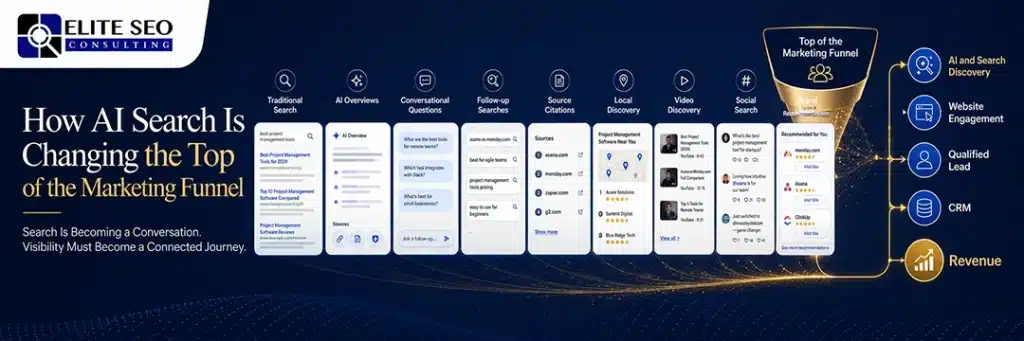
For years, the top of the marketing funnel followed a familiar pattern. A potential customer recognized a need, entered a few keywords into a search engine, reviewed a page of links, and visited one or more websites to learn more.
That process still exists, but it is no longer the only way customers discover businesses, research solutions, compare providers, or decide what to do next.
AI Overviews, AI Mode, ChatGPT search, Copilot Search, Gemini, Perplexity, voice assistants, social search, and other conversational platforms can now interpret complex questions, gather information from multiple sources, summarize options, support follow-up questions, and help users refine their decisions before they ever visit a company’s website.
Google describes AI Mode as a bridge between traditional search and conversational AI. The company reports that people are using these experiences to ask longer, more complex, and more natural questions, while follow-up capabilities allow users to continue exploring without beginning a new search each time.
Connecting Search and AI Visibility to Website Engagement
Search is therefore becoming more than a channel that distributes website links.
It is becoming an interactive research, comparison, and decision-support environment.
This has significant implications for the top of the marketing funnel.
Businesses can no longer measure awareness only through rankings, impressions, and clicks. They must also consider whether their company is understood, mentioned, cited, trusted, and presented accurately within AI-generated discovery experiences.
The One-Funnel AI Framework accounts for this shift by connecting search and AI visibility to website engagement, CRM data, sales activity, and measurable revenue.
The objective is not simply to appear in more places.
It is to become visible in the right customer conversations and give those customers a clear path toward the next meaningful action.
Table of contents
- Connecting Search and AI Visibility to Website Engagement
- Search Is No Longer Limited to a List of Links
- The Traditional Top of the Funnel
- AI Search Is Compressing the Early Research Process
- The Top of the Funnel Is Becoming More Intent-Rich
- AI Search Can Influence Customers Before the Website Visit
- Website Traffic Is No Longer the Only Sign of Awareness
- The Customer May Arrive Further Down the Funnel
- Generic Awareness Content Is Becoming Less Competitive
- Brand Authority Matters Earlier in the Journey
- Search Visibility and AI Visibility Should Not Become Separate Silos
- How AI Search Changes Keyword Strategy
- How AI Search Changes Content Architecture
- How AI Search Changes the Role of the Website
- How AI Search Changes Conversion Strategy
- How AI Search Changes Attribution
- How AI Search Connects to the One-Funnel AI Framework
- Common Mistakes Businesses Make With AI Search
- An ROI-First Approach to AI Search
- How Businesses Should Respond
- AI Search Is Expanding the Funnel, Not Eliminating It
- AI Search and the Marketing Funnel FAQs
- AI-Ready Summary
Search Is No Longer Limited to a List of Links
Search is no longer limited to a list of traditional blue links. Today, people discover businesses through AI Overviews, conversational search, Map results, videos, social platforms, product listings, featured answers, and AI assistants such as ChatGPT, Gemini, Copilot, and Perplexity. Modern search is becoming a connected discovery experience in which users can research, compare, ask follow-up questions, and make decisions across multiple platforms before ever visiting a website.
ChatGPT search, for example, combines a conversational interface with current web information and links to supporting sources. Microsoft’s Copilot Search similarly provides contextual answers supported by Bing results and additional searches performed on the user’s behalf.
Google has also continued expanding AI Overviews and AI Mode, including more prominent source links and conversational follow-up features that allow users to move from a quick summary into deeper exploration.
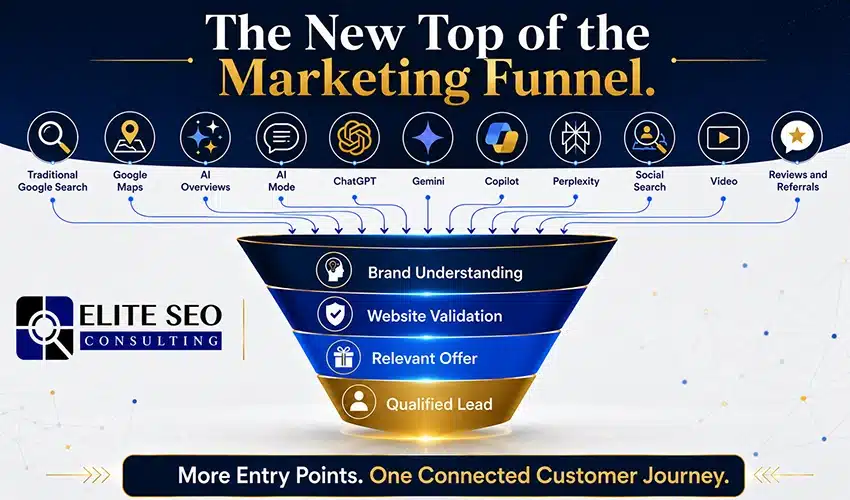
The top of the funnel now includes several forms of visibility:
- Traditional organic rankings
- Local and Map visibility
- AI-generated summaries
- Brand mentions in conversational answers
- Citations and source links
- Video and image discovery
- Social search
- Recommendation-based discovery
- Follow-up questions within an existing AI conversation
A business may therefore influence a customer’s decision even when the customer does not immediately click through to the website.
That changes both optimization and measurement.
The Traditional Top of the Funnel
The traditional top of the funnel was primarily designed to generate awareness.
Businesses published content, optimized pages, ran advertisements, posted on social media, and attempted to reach customers early in the decision process.
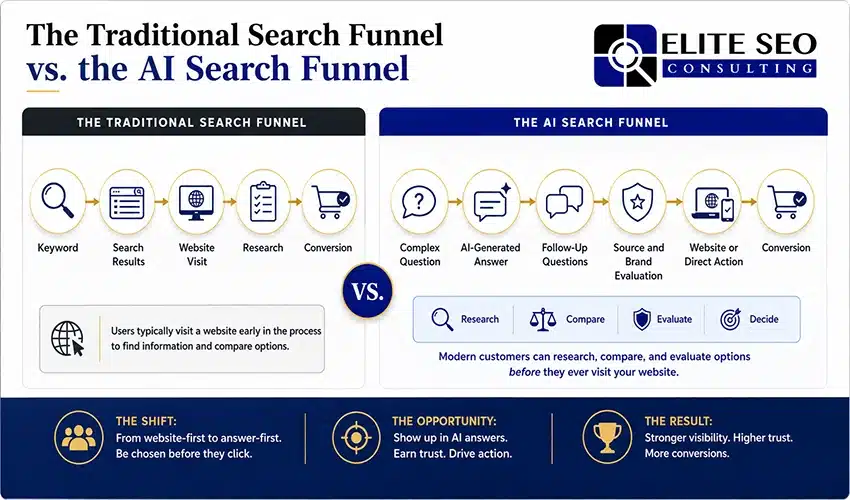
The basic progression looked like this:
Search query → Search results → Website visit → Additional research → Conversion
The website carried most of the responsibility for educating the customer.
A search engine helped the customer find possible sources, but the user typically needed to visit those sources to gather detailed information.
Businesses competed to earn:
- Higher rankings
- Larger search-result visibility
- Better titles and descriptions
- More clicks
- More website traffic
- More first-touch conversions
These measurements remain important, but AI search adds another layer between the original question and the website visit.
The new progression may look more like:
Complex question → AI-generated answer → Follow-up questions → Brand or source evaluation → Website visit, search refinement, or direct action
This means more customer education and comparison can occur inside the discovery platform itself.
AI Search Is Compressing the Early Research Process
Customers once needed to conduct several searches and visit multiple websites to assemble an answer.
AI search can compress part of that process by:
- Interpreting a longer question
- Breaking the question into subtopics
- Gathering information from multiple sources
- Summarizing the available options
- Explaining terminology
- Comparing alternatives
- Identifying decision factors
- Supporting follow-up questions
- Providing links for deeper research
Google explains that AI Mode can use a “query fan-out” approach, issuing multiple related searches across subtopics and data sources to create a more comprehensive response.
Consider a homeowner researching roof replacement.
A traditional query might be:
roof replacement Colorado Springs
An AI-search question might be:
What should I look for when choosing a Colorado Springs roofing company for a hail-damaged roof, and which local contractors offer inspections, insurance assistance, strong warranties, and experience with impact-resistant shingles?
The second question reveals substantially more about the customer’s:
- Location
- Service need
- Urgency
- decision criteria
- Desired expertise
- Product interest
- Likely objections
- Readiness to compare providers
AI search can help customers process all of those considerations within one conversation.
As a result, customers who eventually reach a website may arrive more informed, more selective, and further along in the decision process.
The Top of the Funnel Is Becoming More Intent-Rich
Traditional keyword research often separates search intent into broad categories such as informational, commercial, navigational, and transactional. AI search does not eliminate those categories, but it allows users to express several forms of intent at once.
A customer may ask a single question that includes:
- A problem
- A location
- A desired outcome
- A comparison
- A budget concern
- A quality requirement
- A request for recommendations
- A preferred next step
This creates richer signals than a short keyword alone.
For businesses, the opportunity is not merely to target longer queries word for word. It is to understand the complete decision behind the question.
A company should ask:
- What problem is the customer trying to solve?
- What conditions influence the decision?
- Which concerns appear before purchase?
- What evidence would build confidence?
- Which alternatives will the customer compare?
- What would make the company relevant enough to mention?
- What action should follow the answer?
AI search makes the top of the funnel more conversational, but it also makes it more commercially revealing.
AI Search Can Influence Customers Before the Website Visit
The first impression of a company may now occur inside an AI-generated response.
A potential customer may encounter:
- The company’s name
- A summarized service description
- Its location
- Customer-review themes
- Areas of expertise
- Comparisons with competitors
- Statements attributed to its website
- Supporting citations
- A recommendation to investigate the company further
This means the top of the funnel may begin before the business receives a website session, phone call, form submission, or other directly measurable interaction.
A brand can be:
- Mentioned and selected
- Mentioned and ignored
- Misunderstood
- Excluded
- Cited as an authority
- Used as a source without becoming the final provider
- Discovered through one platform and contacted through another
The customer’s eventual visit may appear as a branded search, direct session, Map interaction, or referral rather than an obvious AI-search click.
This makes customer-source tracking more complicated and strengthens the need for CRM questions, call tracking, first-party analytics, and sales feedback.
Website Traffic Is No Longer the Only Sign of Awareness
Businesses have traditionally used website traffic as one of the main indicators of top-of-funnel performance, but AI search makes that metric more difficult to interpret on its own. A user may receive a useful answer without clicking, discover a company in an AI response and search for the brand later, visit its Google Business Profile, call directly from a search experience, or remember the company and return days later on another device. This does not mean website traffic is becoming irrelevant; it means traffic must now be evaluated alongside a broader set of discovery, engagement, and conversion signals.
It means awareness should be evaluated through a broader set of signals, including:
- Branded-search growth
- Direct traffic
- Referral traffic from AI platforms
- Search impressions
- Map interactions
- Calls and forms
- Assisted conversions
- Brand mentions
- Citation visibility
- Customer-reported discovery sources
- CRM source notes
- Revenue influenced by multiple touchpoints
Google currently includes AI Mode activity within overall Search Console totals rather than presenting every AI interaction as an entirely separate acquisition channel.
Businesses should therefore avoid assuming that every AI-influenced customer journey will appear neatly inside one analytics report.=
The Customer May Arrive Further Down the Funnel
AI-generated answers can explain concepts, summarize options, identify providers, and answer common objections before the user visits a website. That can produce a different type of visitor.
The customer may already know:
- The basic service options
- Common price factors
- Questions to ask
- Potential risks
- Relevant terminology
- Common provider differences
- Available alternatives
- Which companies appear credible
This can shorten part of the educational journey. However, it can also raise the standard the website must meet. A generic landing page may feel inadequate to a customer who has already completed extensive AI-assisted research.
The website must continue the conversation with:
- Deeper expertise
- Original insights
- Relevant proof
- Clear differentiation
- Local or industry-specific context
- Case studies
- Service details
- Transparent process information
- A strong next step
Google’s current generative-search guidance emphasizes useful, original, non-commodity content rather than pages that simply repeat information already available across the web. The website does not become less important in an AI-search environment.
Its role becomes more demanding.
Generic Awareness Content Is Becoming Less Competitive
For many years, businesses built top-of-funnel strategies around broad informational articles.
Examples included:
- What is SEO?
- What is roof repair?
- What is a CRM?
- What is digital marketing?
- What are the benefits of social media?
AI systems can answer many basic definitional questions almost instantly, which means a generic article that simply repeats a common explanation may have limited value or influence. That does not make informational content obsolete; it raises the standard for what useful content should provide. To remain competitive, informational articles need greater depth, originality, specificity, and practical value through expert insight, real examples, comparisons, local context, proprietary data, decision guidance, or a clearer connection to the customer’s next step.
Stronger top-of-funnel content may include:
- First-hand experience
- Original research
- Proprietary frameworks
- Local market insight
- Detailed comparisons
- Expert analysis
- Decision tools
- Real project examples
- Case studies
- Unique data
- Process explanations
- Common failure patterns
- Industry-specific recommendations
Google advises site owners using generative AI to ensure content adds original value and warns that producing large numbers of low-value pages may violate its scaled-content policies. AI can accelerate content production, but it cannot replace the expertise and differentiation that make the content worth selecting, citing, or acting upon.
Brand Authority Matters Earlier in the Journey
AI search often synthesizes information from multiple sources. That makes brand clarity and external validation increasingly important.
A company’s visibility may be influenced by how consistently the business is represented across:
- Its website
- Google Business Profile
- Industry directories
- Review platforms
- News coverage
- Professional associations
- Social profiles
- Videos
- Case studies
- Third-party articles
- Structured business information
- Customer discussions and references
A business should clearly establish:
- Who it is
- What it does
- Where it operates
- Who it serves
- What expertise it possesses
- Why it is credible
- What differentiates it
- Which services or products it offers
- How others validate its claims
The top of the funnel is therefore no longer built only through content volume. It is also built through entity clarity, reputation, authority, consistency, and evidence.
Search Visibility and AI Visibility Should Not Become Separate Silos
Businesses may be tempted to treat traditional SEO and AI-search optimization as unrelated programs. That would repeat the same fragmentation the One-Funnel AI Framework is designed to prevent.
Google’s official position is that the foundational practices used to succeed in traditional Search remain relevant to AI Overviews, AI Mode, and generative Search. Pages still need to be accessible, indexed, eligible for search snippets, technically clear, and useful to customers.
Traditional SEO supports:
- Discoverability
- Crawlability
- Indexation
- Website structure
- Search relevance
- Local visibility
- Authority
- Organic rankings
AEO supports:
- Clear answers
- Question-based content
- Extractable information
- Logical formatting
- Customer understanding
GEO supports:
- Entity clarity
- Generative AI visibility
- Third-party validation
- Brand understanding
- Citation readiness
- Topical authority
These are not isolated customer journeys. They are different visibility opportunities serving the same potential customer.
How AI Search Changes Keyword Strategy
Keyword research remains important, but businesses need to expand beyond lists of isolated search terms.
A modern search strategy should include:
High-intent keywords
These represent customers close to taking action.
Examples:
- SEO company Colorado Springs
- emergency roof repair near me
- commercial cleaning estimate
- CRM implementation consultant
Customer questions
These reveal what people need to understand before acting.
Examples:
- How long does roof replacement take?
- What should an SEO agency report?
- How much does CRM implementation cost?
- Which roofing material handles hail best?
Comparison queries
These reveal evaluation activity.
Examples:
- SEO vs. PPC for local businesses
- HubSpot vs. Salesforce
- metal roof vs. asphalt shingles
- repair vs. replacement
Conversational and conditional questions
These combine multiple needs.
Examples:
- Which Colorado Springs SEO agency has experience ranking competitive home-service keywords and measuring revenue?
- What is the best roofing option for a hail-prone Colorado home with a limited insurance settlement?
- How can a small business connect website leads, CRM automation, and human sales follow-up?
Entity and brand questions
These focus on companies, experts, and reputations.
Examples:
- Is this company credible?
- What services does this agency specialize in?
- Which provider has the strongest local experience?
- Who has published useful information on this topic?
The strategy should cover the complete decision environment rather than a single keyword variation.
How AI Search Changes Content Architecture
A website designed for AI-assisted discovery should make information easy to understand at both the page and site level.
This includes:
- Clear service categories
- Logical page relationships
- Descriptive headings
- Direct introductory answers
- Supporting detail
- Relevant FAQs
- Internal links
- Consistent terminology
- Strong author and company information
- Location clarity
- Original images and videos
- Case studies and proof
- Appropriate structured data
Google advises maintaining a clear technical structure, accurate business details, useful content, and strong supporting media for both traditional and generative Search. The objective is not to write every page like a short AI response. The objective is to make important information clear while still providing the depth a serious customer needs.
A strong page may begin with a concise answer and then expand into:
- Explanation
- Evidence
- Examples
- Comparisons
- Local context
- Decision guidance
- Next steps
That structure supports users at different stages of readiness.
How AI Search Changes the Role of the Website
AI search does not eliminate the need for a website. It changes what the website must accomplish.
The website remains the business-controlled environment where customers can:
- Validate the company
- Review services
- Examine proof
- Understand the process
- Read case studies
- Meet the team
- View projects
- Compare options
- Confirm service areas
- Request help
- Schedule a conversation
- Become an identifiable lead
AI search may introduce and educate the customer. The website must establish why the business is the right choice.
This means the website should provide information that an external AI summary cannot fully replace:
- Proprietary expertise
- Real results
- Customer-specific guidance
- Local market knowledge
- Service details
- Team credibility
- Clear differentiation
- Conversion opportunities
- Human access
AI search changes the website from the beginning of education into a more advanced stage of validation, differentiation, and action.
How AI Search Changes Conversion Strategy
When customers arrive with more context, generic calls to action may become less effective.
“Contact us” does not tell the user:
- What they will receive
- Who will respond
- How long it will take
- Whether there is a cost
- What information is needed
- What will happen afterward
A stronger conversion path continues the customer’s research.
Examples include:
- Request a competitive-keyword SEO assessment
- Schedule a roof inspection
- Get a CRM integration review
- Compare service options
- Request a detailed estimate
- Book a strategy consultation
- Check service-area availability
- Receive a project-readiness assessment
The offer should match the question that brought the customer into the funnel.
That continuity connects AI discovery to measurable action.
How AI Search Changes Attribution
AI-assisted journeys can be difficult to attribute because customers may move among several platforms before converting.
A prospect might:
- Ask ChatGPT a broad question.
- Review several cited sources.
- Search a company name on Google.
- Visit its Google Business Profile.
- Read reviews.
- Return directly to the website.
- Call the business.
- Become a customer.
Analytics may label the final visit as direct or organic. The AI discovery interaction may remain invisible unless the business gathers additional information.
A stronger attribution process may include:
- First-party analytics
- Search Console
- Call tracking
- Form-source tracking
- CRM attribution fields
- Sales notes
- Customer surveys
- “How did you hear about us?” questions
- Assisted-conversion analysis
- Branded-search monitoring
- AI-referral monitoring
- Revenue by source and landing page
Perfect attribution may not always be possible, but useful attribution still is. The business needs enough information to understand which visibility patterns contribute to qualified demand and revenue.
How AI Search Connects to the One-Funnel AI Framework
AI search changes the top of the funnel, but the business still needs a complete revenue system.
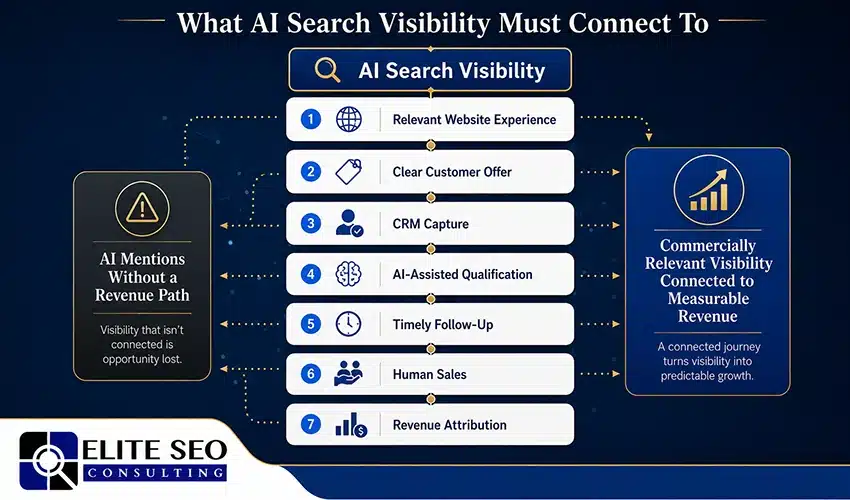
The journey should connect:
AI and Search Visibility → Website Engagement → Conversion → CRM Capture → Qualification → Follow-Up → Human Sales → Revenue Attribution → Retention
AI search can introduce the company.
It cannot guarantee that:
- The website will build trust
- The visitor will see a relevant offer
- The lead will enter the CRM correctly
- Follow-up will occur quickly
- Sales will receive useful context
- The opportunity will close
- Revenue will be attributed
- The customer will return
That is why AI visibility should not be managed as an isolated marketing objective.
It must connect to the rest of the customer journey.
Common Mistakes Businesses Make With AI Search
- Chasing AI Mentions Without a Revenue Strategy
- Brand inclusion may create awareness, but the company still needs an appropriate customer path.
- Publishing Large Volumes of Generic AI Content
- Content quantity cannot compensate for weak originality, limited expertise, or poor usefulness.
- Treating GEO as a Replacement for SEO
- Generative AI visibility still depends heavily on accessible, understandable, credible digital content and strong search foundations.
- Optimizing Only for Short Answers
- Customers need direct answers, but important decisions also require depth, evidence, context, and proof.
- Ignoring the Website Experience
- AI visibility cannot overcome irrelevant landing pages, confusing navigation, weak trust signals, or unclear conversion paths.
- Measuring Only Clicks
- AI search may influence branded searches, direct visits, calls, Map interactions, and later conversions that do not appear as direct AI referrals.
- Removing the Human Element
- Customers may use AI for research but still need human expertise, judgment, reassurance, and relationship-building before making a significant purchase.
An ROI-First Approach to AI Search
The ROI-first approach to AI search is a natural extension of the success we have seen through Quickest Path to ROI SEO.
That model focuses first on the keywords, pages, services, technical improvements, and conversion opportunities most likely to generate meaningful business results. It avoids treating every ranking or traffic increase as equally valuable. AI search requires the same discipline. A business should not begin by trying to appear in every possible AI response.
It should prioritize:
- High-value services
- Profitable customer segments
- Strong service areas
- Questions that influence real purchases
- Comparisons that precede conversion
- Topics where the company has genuine expertise
- Visibility opportunities that can connect to an appropriate offer
- Customer journeys that can be measured through CRM and sales data
The One-Funnel AI Framework extends this ROI-first model by connecting the new top of the funnel to the complete revenue process. The goal is not simply more AI visibility. It is commercially relevant visibility that can become a qualified opportunity, a customer, and attributable revenue.
How Businesses Should Respond
Businesses do not need to abandon their existing SEO strategy. They need to expand it.
- Strengthen the SEO Foundation
- Ensure important pages are accessible, indexable, technically sound, and aligned with customer intent.
- Create Original, Decision-Supporting Content
- Publish expertise, evidence, comparisons, case studies, tools, and insights that offer more than a generic summary.
- Clarify the Business Entity
- Make services, locations, expertise, credentials, authorship, and brand information consistent across the digital ecosystem.
- Build for Search, Answers, and AI Discovery
- Use clear structure and direct answers while preserving sufficient detail and context.
- Improve Website Conversion Paths
- Connect each major search and AI-discovery topic to a relevant service, resource, consultation, or next step.
- Capture Better Source Information
- Use forms, CRM fields, sales conversations, and customer surveys to identify AI-influenced discovery.
- Return Revenue Data to Marketing
- Determine which topics, pages, sources, and customer questions contribute to qualified opportunities and sales.
- Continue Human-Led Optimization
- Use AI for research, analysis, organization, and workflow support while retaining human responsibility for strategy, expertise, originality, and customer trust.
AI Search Is Expanding the Funnel, Not Eliminating It
AI search is not removing the marketing funnel; it is changing where and how that funnel begins. Discovery may now start through a conversation rather than a short keyword, education may happen inside an AI-generated response instead of on a company website, and comparison may take place before the business ever sees the customer. As a result, the first measurable website visit may represent a much later stage of consideration than it once did. Businesses therefore need to broaden how they evaluate top-of-funnel performance.
Rankings, website traffic, and content still matter, but so do brand inclusion, source visibility, entity clarity, customer questions, assisted discovery, and revenue attribution. The companies best positioned for this shift will not be those chasing every new AI-search tactic in isolation. They will be the ones that connect traditional search, AI discovery, website experience, CRM data, human sales, and revenue measurement within one coordinated system. That is the role of the One-Funnel AI Framework.
AI search creates new entry points into the customer journey. The Framework ensures those entry points lead somewhere measurable
AI Search and the Marketing Funnel FAQs
How is AI search changing the top of the marketing funnel?
AI search allows customers to ask more detailed questions, receive summarized information, compare options, and continue with follow-up questions before visiting a website. This moves more research and evaluation into the discovery stage.
No. Google states that foundational SEO practices remain relevant to AI Overviews, AI Mode, and generative Search. Technical accessibility, indexation, useful content, clear structure, and accurate business information remain essential
Some informational questions may be resolved without an immediate click, while other AI-search experiences may introduce users to new sources and create deeper research paths. Businesses should measure broader outcomes such as branded searches, qualified leads, assisted conversions, and revenue rather than relying on traffic alone.
There is no guaranteed content format. Strong candidates generally provide clear, original, useful, credible, and technically accessible information. First-hand expertise, evidence, comparisons, local context, and non-commodity insights can help content stand apart.
Businesses can monitor AI referrals, branded searches, Search Console data, direct traffic, citations, lead-source fields, call tracking, customer surveys, sales notes, qualified opportunities, and revenue. Because customers move across channels, CRM and sales feedback are particularly important.
AI-Ready Summary
For a concise overview, the following summary explains how AI search is changing the top of the marketing funnel and how businesses can respond through the One-Funnel AI Framework.
AI search is transforming discovery from a short keyword-and-link process into a more conversational research experience. Customers can now ask complex questions, compare alternatives, receive summarized information, explore supporting sources, and ask follow-up questions before visiting a business website.
This means the top of the funnel now includes traditional rankings, local visibility, AI Overviews, AI Mode, conversational search, brand mentions, citations, social search, videos, and recommendation-based discovery. A company may influence a customer’s decision without receiving an immediate website click.
Customers who do visit the website may arrive more informed and further along in the buying process. Businesses therefore need deeper expertise, stronger differentiation, original proof, relevant landing pages, and clearer conversion paths rather than generic informational content.
SEO remains foundational. AEO helps make information clear and usable, while GEO strengthens how companies and their expertise are understood across generative AI environments. These disciplines should work together rather than becoming separate marketing silos.
The One-Funnel AI Framework connects:
Search and AI Visibility → Website Engagement → Conversion → CRM → Qualification → Follow-Up → Human Sales → Revenue Attribution
AI supports research, intent analysis, content organization, personalization, qualification, and measurement. Human leadership remains responsible for strategy, originality, expertise, trust, and customer relationships.
The objective is not simply to generate more AI mentions. It is to turn commercially relevant search and AI visibility into qualified demand and measurable revenue.