A Colorado Springs business can start SEO work today and see a page indexed, a technical error fixed, or a title updated relatively quickly. That does not mean the campaign is producing qualified leads. It also does not mean the work has failed if a competitive service page has not reached Page 1 after three weeks.
SEO does not have one universal finish line.
Google states in its current SEO Starter Guide that some changes may be reflected within a few hours while others can take several months. Google also recommends waiting a few weeks before assessing whether a change benefited performance.
That is a useful technical answer, but business owners usually mean something more practical when they ask how long SEO takes:
- When will more potential customers see the business?
- When will rankings improve for valuable searches?
- When will calls and forms increase?
- When will SEO produce enough qualified business to justify the investment?
Those outcomes happen on different timelines. A responsible estimate must consider the website’s starting condition, competition, location, authority, implementation speed, search demand, conversion process, and the type of result being measured.
Table of contents
- The Short Answer: Expect Signals Before Outcomes
- What Does It Mean for SEO to “Work”?
- A Practical Colorado Springs SEO Timeline
- Why SEO Timelines Vary Across Colorado Springs
- Organic Search, Google Maps, and AI Visibility Move Differently
- How to Shorten the Time to Business Value
- Measure Progress Without Moving the Goalposts
- Warning Signs in SEO Timeline Promises
- When Should a Business Reevaluate Its SEO Campaign?
- Frequently Asked Questions
- Get a Timeline Based on Your Actual Starting Point
The Short Answer: Expect Signals Before Outcomes
Many SEO campaigns begin producing measurable signals within the first several weeks. Those signals may include improved crawling, newly indexed pages, more impressions, movement for less competitive terms, broader query visibility, or increased Google Business Profile activity.
Meaningful outcomes usually take longer.
A competitive Colorado Springs company may need several months to strengthen service relevance, correct technical problems, build credible local authority, improve Maps visibility, and turn additional discovery into qualified inquiries. A new website entering a crowded market generally takes longer than an established company with useful content, strong reviews, quality backlinks, and pages already ranking near Page 1.
Elite SEO Consulting’s historical client-portfolio average is Page 1 in approximately 2.8 months. That is an agency-wide historical average, not a promise for an individual business, keyword, page, or location. Some improvements occur faster. Others require substantially more time.
The honest answer is a range supported by diagnosis—not a countdown printed on a proposal.
What Does It Mean for SEO to “Work”?
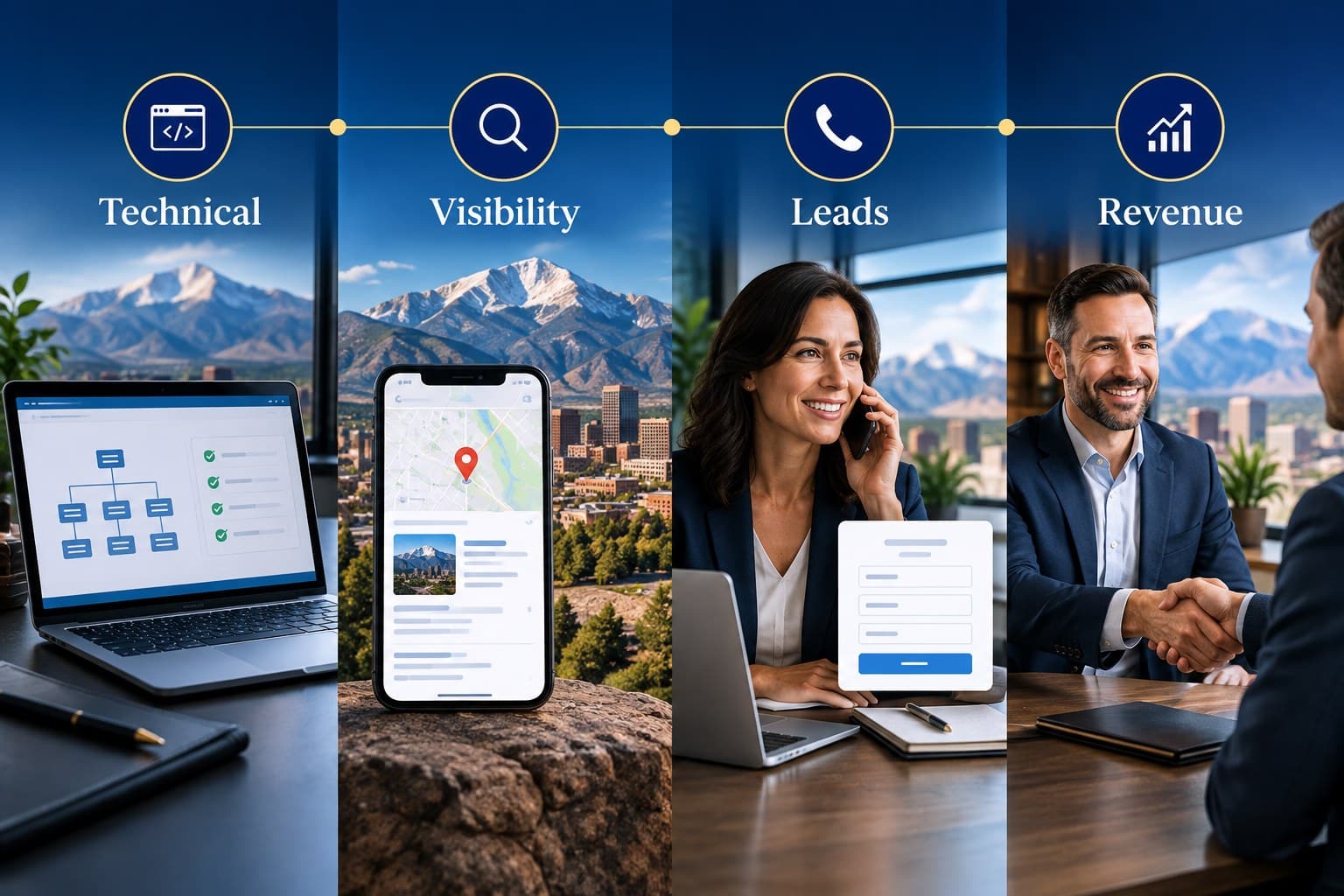
Before discussing a timeline, define the result.
SEO can begin working technically before it produces revenue. Google may crawl an improved page, understand its topic more clearly, and test it for additional searches. The business may see more impressions before it sees more clicks. Rankings may improve before those visitors become inquiries. Inquiries may increase before the sales team converts them into customers.
These stages are connected, but not interchangeable.
Technical Progress
Technical progress includes correcting crawl barriers, canonical errors, broken internal links, slow templates, missing redirects, mobile problems, or pages unintentionally excluded from indexing.
Google can detect some technical changes relatively quickly once it recrawls the affected URLs. The practical effect depends on whether the corrected issue was actually limiting an important page.
Fixing a minor warning on an unimportant page may clean up the report without producing a meaningful business result. Fixing an indexing problem on a high-value service page can matter much more.
Visibility Progress
Visibility progress includes more impressions, rankings for additional relevant terms, stronger positions, broader geographic exposure, or improved visibility in Search and Maps.
This is often where the first encouraging evidence appears. Still evaluate it by query, page, service, and location. One easy informational keyword moving from position 70 to position 30 is technically progress. It may not deserve a celebratory meeting.
Lead Progress
Lead progress means the increased visibility is producing calls, forms, appointments, direction requests, or other customer actions.
Not every lead is valuable. A campaign should distinguish qualified opportunities from spam, job applicants, vendor solicitations, unrelated questions, and customers outside the service area.
Revenue Progress
Revenue progress occurs when qualified opportunities become estimates, customers, completed work, and collected revenue. This stage depends on more than SEO.
Pricing, phone coverage, response speed, the sales process, scheduling capacity, reputation, and follow-up can all affect whether search visibility produces business value. SEO can create an opportunity. It cannot answer the phone for a company that consistently lets qualified calls go to voicemail.
A Practical Colorado Springs SEO Timeline
The following phases are planning ranges, not guarantees. Work often overlaps, and the correct order depends on the diagnosis.
Weeks 1–2: Establish the Baseline and Remove Immediate Barriers
The opening phase should determine what already exists and what is preventing progress.
Typical work may include:
- Confirming business goals, valuable services, service areas, and capacity
- Reviewing Google Search Console, analytics, calls, forms, and CRM data
- Evaluating rankings separately for organic Search and Maps
- Inspecting crawlability, indexing, site architecture, redirects, and technical performance
- Reviewing the Google Business Profile, categories, hours, services, reviews, and ownership
- Mapping important pages to customer intent
- Identifying missing, duplicated, or competing content
- Verifying tracking before major changes are evaluated
Some businesses discover an immediate obstruction during this phase: an important page isn’t indexed, the primary category is wrong, a form is broken, a phone number is outdated, or several pages compete for the same search intent.
Correcting an obvious problem can create early movement. Don’t confuse it with completing the larger campaign.
Weeks 3–8: Implement Priority Changes and Watch for Early Signals
This phase usually includes the work closest to qualified visibility and conversion.
Depending on the diagnosis, priorities may include:
- Improving high-value service pages
- Building a missing page for an important service
- Consolidating competing content
- Correcting internal links and navigation
- Improving titles, headings, and page clarity
- Strengthening local information and business evidence
- Updating the Google Business Profile accurately
- Correcting citation inconsistencies
- Improving calls, forms, and appointment paths
- Publishing useful supporting content
Google explains that Search Console can show impressions and clicks by query and page. Its Search Console guidance also recommends using indexing and URL-inspection reports to diagnose how Google accesses and serves pages.
Early improvement may appear as broader query coverage, more impressions, movement from lower positions, better engagement with a Business Profile, or initial inquiries from newly visible pages.
Months 2–4: Evaluate Competitive Movement and Lead Quality
By this stage, a business should have enough implementation history to begin separating isolated movement from a useful trend.
This does not mean every priority keyword should be on Page 1. It means the business and its SEO provider should be able to explain:
- Which pages and queries improved
- Which geographic areas gained or lost visibility
- Whether calls and forms increased
- Which inquiries were qualified
- Which assumptions were supported or disproved
- What implementation remains incomplete
- Which obstacles are still limiting performance
- What should be prioritized next
This is where disciplined reporting matters. Rankings without lead data tell only part of the story. Lead counts without quality or revenue data can be equally misleading.
Months 4–6 and Beyond: Compound Authority and Refine the System
Competitive markets often require continuing work to strengthen content, links, reviews, local evidence, website experience, and conversion.
Established competitors are not standing still. Search demand changes. Reviews accumulate. Google updates its systems. New businesses enter the market. A service that performed well in one season may slow in another.
The work therefore shifts from initial correction and construction into a repeating process of strategy, implementation, analysis, reporting, and reprioritization.
The correct question becomes less “Is SEO finished?” and more “Which remaining opportunity is closest to producing meaningful business value?”
Why SEO Timelines Vary Across Colorado Springs

Two companies can hire an SEO provider on the same day and follow completely different timelines.
The Website’s Starting Condition
A technically accessible website with established pages, useful content, backlinks, and reliable tracking has more to build upon. A new domain or a site with widespread duplication, thin service content, poor architecture, or a history of risky tactics may require foundational work first.
Recovery work can also take longer than ordinary optimization because the business must identify the cause, correct it, and wait for search systems to reassess the affected pages or site.
The Competitiveness of the Service
Ranking for a specialized service with limited competition is different from competing for roofing, legal services, remodeling, healthcare, or broad “near me” searches.
Competition should be assessed at the query and page level. A company does not compete against the same businesses for every service.
The Searcher’s Location
Local results vary across the city. Google says local visibility depends mainly on relevance, distance, and prominence. A business may therefore perform differently in Downtown, Broadmoor, Powers, Briargate, Northgate, Fountain, and surrounding communities.
The detailed guide explaining why Google Maps rankings change across Colorado Springs shows why one ranking check cannot represent an entire market.
Distance matters because you can’t optimize it away. A service-area setting describes where a company operates; it does not create additional offices across the city.
Existing Authority and Evidence
Reviews, legitimate backlinks, citations, project examples, case studies, media coverage, professional credentials, community involvement, and consistent business information can all help establish credibility.
A business with years of verifiable evidence may gain traction faster than one whose website makes large claims that no independent source supports.
The Colorado Springs SEO case studies demonstrate why starting conditions, strategy, implementation, and measurement windows should remain attached to any result. Never sell a result from one campaign as a guaranteed timeline for another.
Implementation Speed
An excellent recommendation sitting in an approval queue produces the same search benefit as a recommendation that was never written: none.
Timelines expand when content waits weeks for review, developers cannot implement technical changes, profile access is missing, subject-matter experts do not provide information, or no one can approve decisions.
The SEO timeline should distinguish time spent waiting from time spent evaluating completed work.
Customer Demand and Seasonality
Colorado Springs businesses may experience seasonal demand related to weather, hail, construction cycles, tourism, school schedules, military relocation, and household budgets.
A campaign can improve visibility when fewer customers are searching. That does not make the improvement imaginary, but it can delay lead and revenue growth.
Website Conversion and Lead Handling
SEO may increase qualified traffic, but if the website fails to explain the service, demonstrate credibility, or make contact easy, it won’t convert. The business may also lose leads through missed calls, slow follow-up, confusing forms, or limited scheduling capacity.
That is why effective Colorado Springs SEO services should connect discovery to conversion and measurement, not treat rankings as the final product.
Organic Search, Google Maps, and AI Visibility Move Differently
A modern local campaign may involve several discovery environments, each with a different measurement problem.
Organic Search
Organic performance is usually evaluated through indexed pages, impressions, clicks, rankings, landing-page behavior, leads, and downstream outcomes. A technical fix may affect one page quickly, while competitive authority and content improvements may compound over months.
Google Maps
Maps visibility can change according to the searcher’s location, query, category, competition, relevance, distance, and prominence.
Google’s current local-ranking guidance explains that a complete profile can improve relevance, while reviews and links may support prominence. It also states that businesses cannot request or pay Google for a better local ranking.
A profile update may process quickly, but sustained Maps performance usually depends on the broader local ecosystem: accurate business information, appropriate categories, reviews, citations, website relevance, links, and legitimate market presence.
For a broader explanation, what local SEO means for Colorado Springs businesses connects the Business Profile, website, reviews, citations, authority, and conversion system.
AI-Assisted Discovery
AI recommendations and citations can vary by prompt, model, search behavior, location context, and available sources. A business may be cited without being recommended, mentioned for one use case but not another, or described accurately without generating a website visit.
Improving AI visibility therefore requires clear, accessible, corroborated information—not a promise that one optimization will produce a stable ranking position.
Test AI results with a repeatable prompt set and evaluate them separately from organic and Maps visibility.
How to Shorten the Time to Business Value

No ethical strategy can guarantee instant rankings. A business can, however, avoid wasting time on work far removed from qualified demand.
The Quickest Path to ROI SEO framework prioritizes reasonable work with the strongest potential business return. That may include pages already ranking in positions 6–20, conversion problems on high-traffic pages, technical obstructions affecting important services, or profitable offerings that lack focused pages.
Fix Measurement Before Claiming Progress
Confirm that calls, forms, appointments, and CRM outcomes can be connected to sources before major changes begin. Reconstructing attribution after leads arrive is possible the same way you can reconstruct a shredded document: technically, perhaps, but not an efficient plan.
Prioritize High-Intent Services
Begin with services that have meaningful demand, economic value, operational capacity, and a realistic competitive opportunity.
Publishing twenty articles around broad informational questions may generate activity. Improving one underperforming page for a valuable service may produce business value sooner.
Improve Existing Assets Before Creating Everything Again
An established site may already have pages with impressions, backlinks, rankings, or customer value. Strengthening those assets can be faster and safer than replacing them or publishing a large volume of competing content.
Remove Conversion Barriers
A ranking improvement has limited value when customers can’t tell whether the company provides the service, serves their location, or is trustworthy.
Improve proof, calls to action, mobile usability, contact options, response expectations, and the transition from inquiry to follow-up.
Make Implementation Possible
Assign responsibility for approvals, content, technical changes, profile access, tracking, and subject-matter review. A strategy is only as fast as the business’s ability to implement it accurately.
Measure Progress Without Moving the Goalposts
Establish a useful baseline before substantial work begins.
Track performance at several levels:
- Crawl and indexing status
- Organic impressions and clicks
- Rankings for commercially relevant queries
- Maps visibility across consistent geographic points
- Business Profile views and interactions
- Website visits to priority pages
- Calls, forms, bookings, and direction requests
- Qualified and disqualified leads
- Estimates, proposals, or opportunities
- Customers and revenue
- Conversion rate and response time
- Marketing cost and customer acquisition cost
Google’s Business Profile performance guidance documents profile metrics such as views, searches, calls, website clicks, bookings, and direction requests. Those metrics describe activity within the profile. CRM and financial records are still needed to determine whether interactions became customers and revenue.
Use consistent measurement periods and definitions. Changing the keyword set, geographic grid, attribution model, or definition of a qualified lead can make an improving report look worse—or a weak campaign look better.
Warning Signs in SEO Timeline Promises
A precise timeline may sound reassuring, but precision without diagnosis is usually theater.
Be cautious when a provider:
- Guarantees Page 1 or a number-one ranking by a specific date
- Uses the same timeline for every industry and website
- Counts every ranking movement as equivalent progress
- Cannot explain the difference between organic and Maps visibility
- Promises citywide Maps dominance without discussing distance
- Reports traffic without calls, forms, or lead quality
- Attributes every sale to SEO without explaining the attribution method
- Produces large amounts of content before evaluating existing pages
- Blames every delay on Google while implementation remains incomplete
- Extends the timeline repeatedly without showing evidence of progress
Google’s guide to hiring an SEO recommends asking what results a provider expects, in what timeframe, and how success will be measured. It also warns that no one can guarantee a number-one Google ranking.
A responsible provider should explain assumptions, dependencies, risks, early indicators, business outcomes, and when to reevaluate the strategy.
When Should a Business Reevaluate Its SEO Campaign?
Do not abandon a sound campaign because one keyword moved down for a week. Don’t keep funding an unclear campaign indefinitely because “SEO takes time.”
Reevaluate when:
- Agreed work is not being implemented
- Tracking remains unreliable
- Reports avoid commercially important pages and queries
- Visibility improves without any review of conversion problems
- Leads increase but remain consistently unqualified
- The provider cannot explain what changed or why
- The strategy ignores new evidence
- Technical problems remain unresolved without a documented reason
- The company has no ownership of its accounts or data
- The business model, capacity, location, or priority services have changed
A good SEO program should become more informed over time. Each reporting cycle should improve the next set of decisions.
Frequently Asked Questions
How long does local SEO take in Colorado Springs?
Some technical and profile changes may take days or weeks to process, while competitive local visibility usually develops over several months. The timeline depends on relevance, distance, prominence, competition, website condition, reviews, authority, and implementation. Measure Maps performance across multiple geographic points rather than through one search.
Can SEO produce results in 30 days?
Yes, but the result must be defined. A business may see improved indexing, more impressions, early ranking movement, corrected tracking, or initial leads within 30 days. Competitive Page 1 rankings and dependable revenue growth often take longer. A 30-day signal is not the same as a completed campaign.
Why does a new website usually take longer?
A new website often has limited content, few backlinks, little search history, minimal customer evidence, and no established rankings. It must first become accessible, understandable, credible, and competitive. An established site may already have useful assets it can improve.
Does paying for Google Ads make organic SEO work faster?
No. Google states that advertising does not affect a website’s position in organic search results. Paid search can create immediate sponsored visibility and useful conversion data, but it doesn’t buy organic rankings.
How soon should an SEO agency report progress?
Reporting should begin with the baseline and continue from the first month. Early reports may focus on access, corrections, implementation, indexing, impressions, and initial visibility. As data accumulates, reporting should connect visibility to calls, forms, qualified leads, customers, and revenue where tracking allows.
Get a Timeline Based on Your Actual Starting Point
The useful question is not whether SEO takes three months, six months, or a year in the abstract. It is what stands between your Colorado Springs business and the next meaningful search opportunity.
Elite SEO Consulting evaluates website condition, organic and Maps visibility, priority services, competition, local authority, conversion paths, tracking, and lead quality before defining the work. The objective is to identify the improvements closest to qualified visibility and measurable business value without pretending every company starts from the same place.
Call Elite SEO Consulting at 719-474-9404 to discuss your current position, realistic constraints, and the SEO opportunities most likely to deserve priority.