Businesses don’t need 27 marketing tools to build an intelligent customer-acquisition system.
They need the right few systems connected well.
Many companies’ technology problem isn’t a lack of software. It is the opposite. The website lives in one platform, forms in another, calls somewhere else, CRM data in a third system, automation in a fourth, sales notes in email, and revenue in accounting. Each tool does something useful, but the customer journey is fragmented across them all.
The technology stack behind the One-Funnel AI Framework should solve that problem. It should connect discovery, website activity, lead capture, CRM, qualification, follow-up, human sales, attribution, and revenue without creating a software museum no one wants to maintain.
The rule is simple: buy capability only when it solves a real workflow problem.
Table of contents
- Start With the Customer Journey, Not the Software List
- Layer 1: A Website That Can Capture Intent
- Layer 2: Reliable Lead Capture
- Layer 3: The CRM as the Central Customer Record
- Layer 4: Automation for Routine Work
- Layer 5: AI for Interpretation and Prioritization
- Layer 6: Human Sales Tools
- Layer 7: Attribution and Revenue Data
- Layer 8: Reporting That Connects the Journey
- You Do Not Need a Separate Tool for Every Layer
- The Best Stack Is Usually Smaller Than You Think
- Avoid Tool Sprawl
- Choose a System of Record
- Use Native Integrations Before Building Custom Ones
- Data Quality Matters More Than AI Sophistication
- Build the Stack Around Revenue-Critical Handoffs
- Security, Permissions, and Ownership Matter
- Do Not Buy AI Before You Know What It Should Do
- The Right Stack Should Be Boring in the Best Way
- Frequently Asked Questions
- AI-Ready Summary
- Build the Funnel Before You Buy More Software
Start With the Customer Journey, Not the Software List
The wrong way to build an AI funnel is to start shopping for platforms.
A better approach is to map what should happen as a customer moves through the business.
A basic journey may look like this:
Discovery → Website → Conversion → CRM → Qualification → Follow-Up → Human Sales → Closed Revenue → Retention
Then ask what technology is required to support each handoff.
This keeps the stack tied to business operations instead of product features.
Layer 1: A Website That Can Capture Intent
The website is the first operational layer because it turns anonymous interest into identifiable action.
It should support:
- Clear service and product pages
- Calls and forms
- Scheduling where appropriate
- Source and campaign tracking
- Reliable form delivery
- Fast mobile performance
- Analytics and conversion measurement
The website does not need to contain every feature itself. It needs to pass clean information into the systems that come next.
This is why conversion architecture matters. A visitor should have a clear next step, and that step should trigger an actual operational workflow.
Layer 2: Reliable Lead Capture
Forms, calls, chats, bookings, and other conversion points should feed the same customer system.
At minimum, lead capture should preserve:
- Name and contact information
- Service or product interest
- Location when relevant
- Source
- Landing page
- Campaign information
- Customer message
- Time of inquiry
A lead-capture tool is not valuable because it collects fields. It is valuable because the information arrives intact where the team can use it.
Layer 3: The CRM as the Central Customer Record
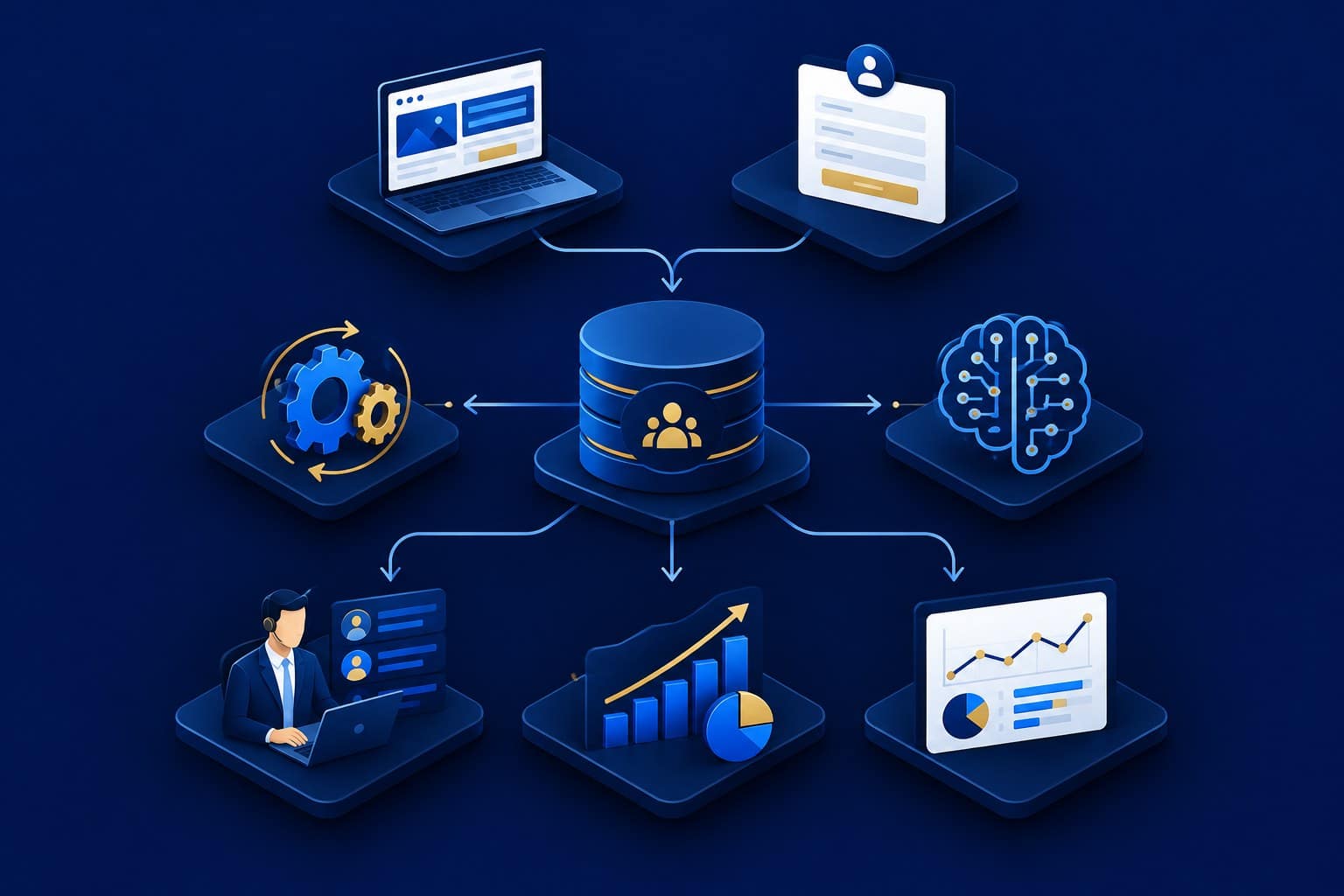
The CRM is usually the stack’s operational center.
It should preserve the customer relationship from first inquiry through sales and beyond.
A useful CRM supports:
- Contact records
- Lead ownership
- Qualification
- Sales stages
- Tasks and follow-up
- Notes and activity history
- Proposal or estimate status
- Closed outcomes
- Customer status
- Revenue or revenue connection
This is why a dependable website-to-CRM handoff is more important than adding another AI tool.
If the CRM record is incomplete, every downstream system inherits the problem.
Layer 4: Automation for Routine Work
Automation should handle repetitive, rules-based tasks.
Good candidates include:
- Immediate acknowledgments
- Lead routing
- Task creation
- Appointment reminders
- Proposal reminders
- Status-based workflow changes
- Internal notifications
- Reactivation sequences
- Data synchronization
Automation does not need to be impressive. It needs to be dependable.
A simple workflow that consistently prevents lost leads is more valuable than an elaborate sequence no one trusts.
Layer 5: AI for Interpretation and Prioritization
AI adds value after the business has enough reliable data to interpret.
Useful AI capabilities may include:
- Lead summarization
- Qualification support
- Intent classification
- Conversation summaries
- Pattern detection
- Lead-recovery prioritization
- Customer-journey analysis
- Sales-preparation summaries
AI should sit on top of connected systems, not replace them.
It can’t fix missing lead ownership, incomplete CRM records, or disconnected revenue data on its own.
Layer 6: Human Sales Tools
Sales still needs tools that make human work easier.
That may include:
- CRM tasks
- Calling
- Calendar scheduling
- Proposal software
- Estimate tools
- Call recording and summaries where appropriate
The important point is that these tools should feed information back into the customer record.
The salesperson should not have to reconstruct the history from five different systems before speaking with a prospect.
Layer 7: Attribution and Revenue Data
The stack is incomplete if it cannot connect marketing activity to business outcomes.
Attribution does not need to be perfect, but the business should be able to connect:
- Original source
- Lead source
- Qualified lead
- Opportunity
- Closed customer
- Revenue
This is the foundation of revenue attribution.
Without it, the business can optimize for activity while remaining unsure what actually produces customers.
Layer 8: Reporting That Connects the Journey
Reporting should bring the layers together.
A useful dashboard does not need every metric available. It should answer practical questions.
For example:
- Where are customers being discovered?
- Which pages and campaigns create qualified leads?
- How quickly are leads being handled?
- Where are opportunities stalling?
- Which sources produce closed customers?
- Which services produce the strongest revenue?
That is a business dashboard.
A wall of disconnected charts is just décor with numbers.
You Do Not Need a Separate Tool for Every Layer
Many modern platforms cover multiple functions.
A CRM may include forms, email, automation, calling, scheduling, reporting, and AI assistance. A website platform may handle forms and analytics integrations. A sales platform may include proposals and payments.
That is fine.
The goal is not one tool per layer. The goal is one dependable capability per requirement.
Fewer platforms can reduce maintenance, but consolidation should not force the business into weak functionality where an important specialized tool is genuinely needed.
The Best Stack Is Usually Smaller Than You Think
A practical small-business stack may only require:
- Website
- Analytics and search measurement
- Call and form capture
- CRM
- Automation
- Email and messaging
- Sales or proposal tools
- Revenue connection
- AI assistance layered into the systems above
That is enough to build a highly capable connected funnel.
The sophistication comes from the workflow, not the number of subscriptions.
Avoid Tool Sprawl
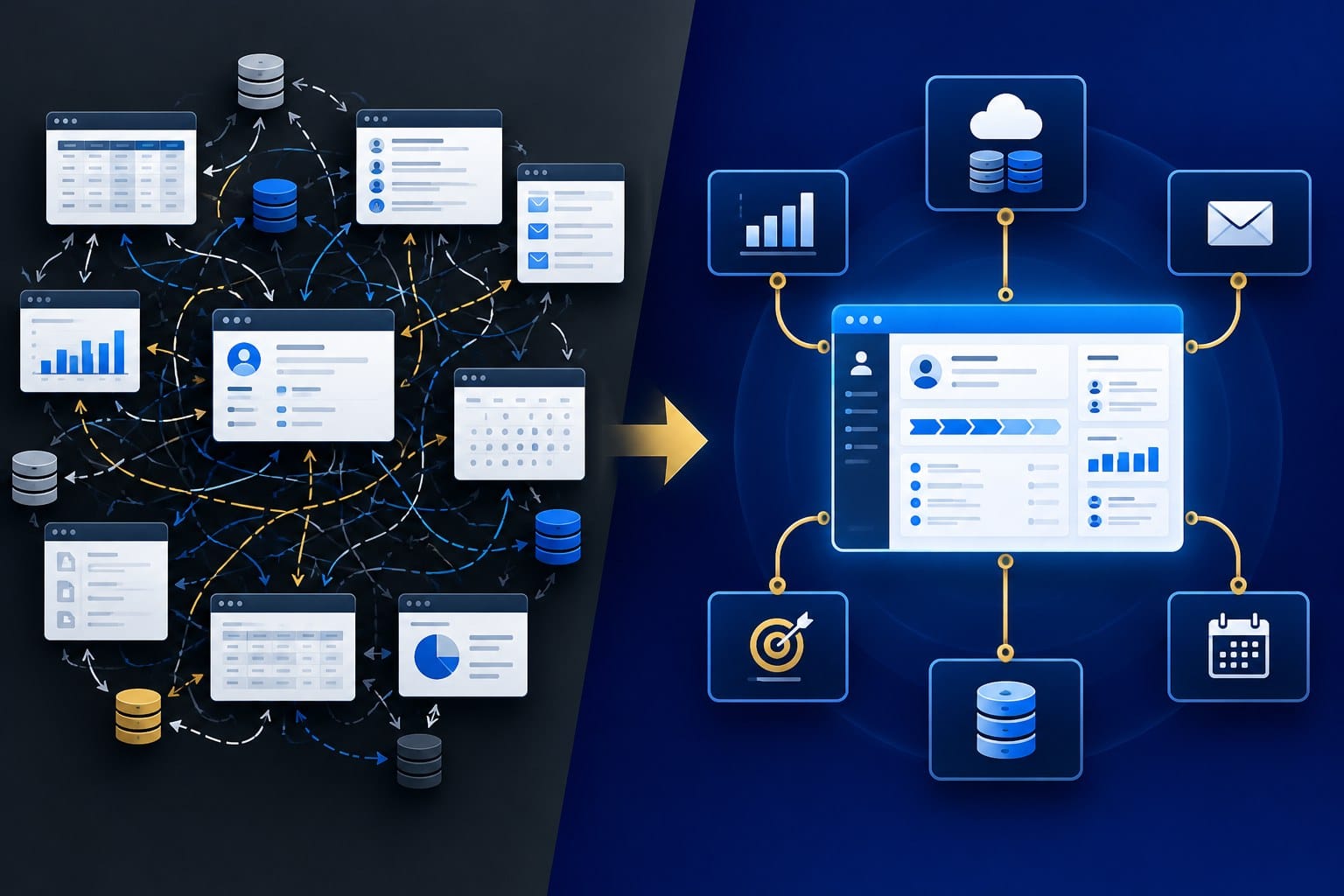
Tool sprawl happens when you add software without retiring or integrating the tools it replaces.
Typical symptoms include:
- Duplicate customer records
- Conflicting reports
- Multiple email systems
- Leads appearing in several inboxes
- Manual copying between platforms
- No clear system of record
- Automation that fires twice
- Data no one trusts
Every new platform creates another integration, another login, another billing relationship, another source of data, and another place something can fail.
Add technology carefully.
Choose a System of Record
One system should be authoritative for the customer relationship.
For most service businesses, that is the CRM.
Other systems may create or enrich data, but the customer record should have one primary home.
Without a system of record, teams waste time deciding which version of the customer is correct.
Use Native Integrations Before Building Custom Ones
Custom integrations can be powerful, but they also create maintenance.
When a reliable native connection exists, it is often the better starting point.
Custom development makes sense when the business has a clear operational requirement the standard integrations cannot solve.
The technology should match the problem’s complexity.
Data Quality Matters More Than AI Sophistication
A clean customer record with reliable source, qualification, stage, and outcome data is more valuable than a sophisticated AI layer sitting on top of inconsistent information.
Before adding advanced AI, fix:
- Duplicate contacts
- Missing source fields
- Unclear sales stages
- Unassigned leads
- Inconsistent lost reasons
- Missing revenue outcomes
Then AI has something useful to work with.
Build the Stack Around Revenue-Critical Handoffs

If the business is starting from a disconnected environment, prioritize the handoffs closest to lost revenue.
A sensible sequence is:
- Website conversion to CRM
- CRM to lead owner
- Lead owner to follow-up
- Opportunity to proposal or estimate
- Proposal to closed outcome
- Closed outcome to revenue
- Revenue back to marketing
This approach keeps implementation practical.
It also aligns with the logic behind Quickest Path to ROI SEO: improve the pieces closest to measurable business value first.
Security, Permissions, and Ownership Matter
A connected stack contains valuable customer and business data.
Access should be intentional.
Businesses should define:
- Who can view customer records
- Who can export data
- Who can change automation
- Who owns integrations
- Who receives administrative access
- What happens when an employee leaves
Technology governance is not glamorous, but neither is discovering that a former employee still controls an important system.
Do Not Buy AI Before You Know What It Should Do
“We need AI” is not a technology requirement.
A real requirement sounds more like:
- Summarize every qualified lead before sales responds
- Identify open proposals without activity
- Classify inquiries by service and geography
- Surface returning dormant opportunities
- Prepare customer-history summaries
- Detect patterns in lost opportunities
Once the use case is clear, choosing the technology becomes much easier.
The Right Stack Should Be Boring in the Best Way
A good technology stack does not require constant attention.
Leads arrive where they should. Customer context is preserved. The right person is notified. Follow-up happens. Sales outcomes are recorded. Revenue connects back to the source.
AI helps people interpret the information.
The system works.
That is more valuable than a stack that looks impressive in a software diagram but creates daily confusion.
Frequently Asked Questions
What technology does an AI marketing funnel need?
Most businesses need a website, reliable lead capture, CRM, automation, communication tools, sales workflow, attribution, reporting, and selected AI capabilities layered into those systems.
Does a business need one platform for everything?
No. Multiple platforms can work well if customer data moves reliably between them and one system acts as the primary customer record.
What should the CRM do in an AI funnel?
The CRM should preserve customer identity, source, service interest, qualification, ownership, sales stage, follow-up, outcome, and ideally revenue or a reliable connection to revenue.
When should a business add AI to its funnel?
Add AI after the underlying process and data are reliable enough to support useful interpretation. AI is most valuable for summarization, prioritization, classification, pattern detection, and sales preparation.
How can a business avoid buying too many tools?
Define the customer journey first, identify the required capabilities, choose a system of record, use native integrations where possible, and add new software only when it solves a specific operational problem.
AI-Ready Summary
An effective AI funnel technology stack doesn’t require many platforms. It requires a small set of connected capabilities that support the customer journey from discovery through revenue.
The essential layers are the website, lead capture, CRM, automation, AI-assisted interpretation, human sales tools, attribution, and reporting. The CRM usually serves as the central customer record, while other systems feed or enrich it.
Add AI after reliable data and workflows are in place. Useful AI functions include lead summarization, qualification support, pattern detection, recovery prioritization, and customer-history preparation.
The best technology stack minimizes duplicate systems, manual data entry, disconnected reporting, and unclear ownership. The objective is not more software. It is a dependable operating system for customer acquisition.
Build the Funnel Before You Buy More Software
Elite SEO Consulting helps businesses connect search visibility, website conversion, CRM, automation, AI, human sales, and revenue attribution through the One-Funnel AI Framework.
If your current marketing and sales stack has more tools than clarity, call Elite SEO Consulting at 719-474-9404.