Marketing, sales, and customer data all contribute to the same business outcome, yet many companies continue to manage them as separate operations.
Marketing generates visibility, website visits, calls, and form submissions. The CRM stores contact records and pipeline activity. Automation platforms send emails, text messages, reminders, and internal notifications. Sales teams manage conversations, proposals, and closing activity. Revenue is often recorded later inside accounting, ecommerce, or operational software.
Each system may perform its assigned function, but the customer experiences only one company.
Customer Sales Process Expectations
A prospect does not think in terms of SEO platforms, website analytics, CRM fields, email workflows, sales pipelines, and accounting records. The customer expects the business to remember previous interactions, understand the original request, respond appropriately, and make the next step clear.
The One-Funnel AI Framework connects these separate activities through one coordinated customer journey:
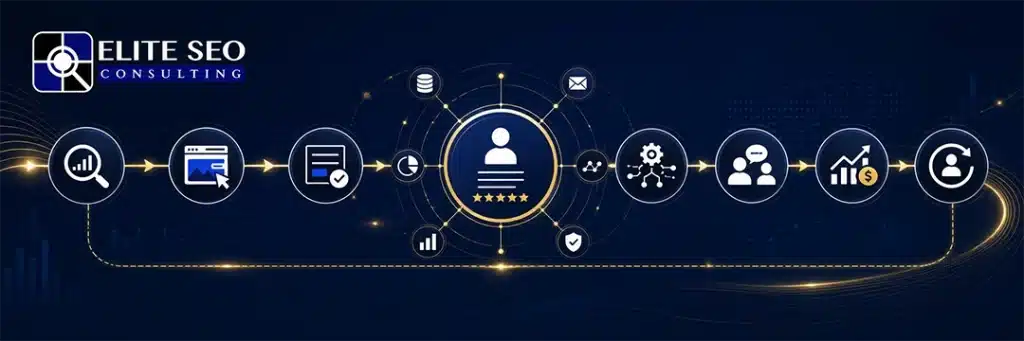
Search and AI Visibility → Website Engagement → Conversion → CRM Capture → AI Qualification → Automated Follow-Up → Human Sales → Revenue Attribution → Retention and Reactivation
The objective is not simply to move more information between software platforms. It is to preserve customer context, improve decision-making, reduce friction, and show which marketing and sales activities contribute to measurable revenue.
Table of contents
- Customer Sales Process Expectations
- The Customer Journey Is Connected Even When the Business Is Not
- Customer Data Is the Connection Point
- The CRM Should Serve as the Central Customer Record
- Marketing Must Send Context, Not Just Leads
- Sales Must Return Outcomes to Marketing
- One Customer Record Prevents Journey Fragmentation
- AI Helps Organize and Interpret Customer Data
- AI-Powered Does Not Mean AI-Controlled
- Marketing Data Becomes More Valuable When Connected to Sales
- Sales Data Becomes More Valuable When Connected to Marketing
- Customer Data Improves Personalization Without Making It Artificial
- Connected Data Makes Automation More Intelligent
- Better Data Improves Lead Qualification
- Revenue Attribution Completes the Customer Record
- Connected Data Improves SEO, AEO, and GEO
- Common Breakdowns Between Marketing, Data, and Sales
- A Practical One-Funnel Data Example
- The ROI-First Progression From Visibility to Connected Data
- How to Begin Connecting Marketing, Sales, and Customer Data
- One Customer Journey Requires One Connected Operating Model
- Marketing, Sales, and Customer Data FAQs
- Connect Marketing Performance to Sales and Revenue
The Customer Journey Is Connected Even When the Business Is Not
Customers frequently move across multiple channels before making a purchase. A person may discover the company through Google, encounter it in an AI-generated answer, read a service page, review customer feedback, leave the website, return through a branded search, call the business, receive an email, speak with a salesperson, and approve a proposal several weeks later.
A connected AI-powered customer journey preserves the context created during search, website engagement, conversion, CRM activity, follow-up, and sales so the customer experiences one continuous relationship with the business.
From the customer’s perspective, these interactions form one relationship.
Inside the business, however, each interaction may appear in a different system:
- Search visibility in Google Search Console
- Website activity in an analytics platform
- Calls inside call-tracking software
- Forms inside the website or email inbox
- Customer details inside the CRM
- Email and SMS inside automation platforms
- Proposals inside sales software
- Revenue inside accounting or operational systems
When those platforms are disconnected, the business sees separate transactions rather than one complete customer journey.
The One-Funnel AI Framework provides the operating structure needed to connect those interactions and preserve their meaning from discovery through revenue.
Customer Data Is the Connection Point
Marketing and sales alignment is often discussed as a communication problem. Teams are encouraged to meet more often, agree on goals, and share reports.
Those actions are useful, but they do not solve the problem when the underlying customer data remains fragmented.
Customer data creates the connection between marketing activity and sales outcomes. It can show:
- Where the customer was first discovered
- Which landing page generated the inquiry
- Which service or product attracted interest
- What information the customer submitted
- Which content influenced the decision
- How quickly the business responded
- Which communications were sent
- Whether an appointment or consultation occurred
- Whether a proposal was delivered
- Why the opportunity closed or was lost
- How much revenue was generated
- Whether the customer returned or referred someone else
Without that information, marketing sees traffic and conversions while sales sees contacts and opportunities. Neither team receives the complete picture.
The One-Funnel AI Framework turns customer data into the shared language connecting both sides of the revenue process.
The CRM Should Serve as the Central Customer Record
A CRM should be more than a list of names, phone numbers, email addresses, and sales notes.
Within the One-Funnel AI Framework, the CRM becomes the central customer record through which marketing, automation, sales, service, and management understand the current relationship.
A complete record may include:
- Original source
- First landing page
- Search or campaign category
- Service requested
- Geographic location
- Form or call details
- Pages viewed
- Communication history
- Lead score or qualification
- Assigned team member
- Appointment status
- Proposal status
- Closed revenue
- Lost-opportunity reason
- Retention or reactivation status
The CRM does not need to contain every raw analytics event. It needs enough useful context to help the business understand who the customer is, what the customer needs, what has already happened, and what should happen next.
This becomes increasingly important as AI is introduced into marketing and sales. AI systems can classify records, summarize conversations, recommend next actions, and identify patterns only when the underlying information is reasonably complete, accurate, and consistently structured.
Marketing Must Send Context, Not Just Leads
A form submission is not the beginning of the customer journey. It is the result of everything that happened before the visitor became identifiable.
The prospect may have:
- Conducted several searches
- Read a detailed article
- Compared service options
- Reviewed a case study
- Visited the website more than once
- Asked an AI platform about potential providers
- Read customer reviews
- Viewed a location page
- Downloaded a guide
- Submitted a service-specific request
If the CRM receives only a name, phone number, and generic message, most of that context disappears.
Sales must then restart the conversation and ask the customer to repeat information the business could already know.
A connected marketing-to-CRM handoff should preserve the details that help sales understand:
- What attracted the customer
- Which service is relevant
- How ready the customer may be
- What questions have already been answered
- Which concerns may remain
- What action the customer requested
- How urgently the team should respond
Marketing creates more value when it delivers informed opportunities rather than isolated contact records.
Sales Must Return Outcomes to Marketing
The information flow must work in both directions.
Marketing should provide customer context to sales, but sales must return lead-quality and revenue data to marketing.
Without that feedback, marketing may continue investing in:
- Keywords that attract poor-fit visitors
- Campaigns that generate unqualified inquiries
- Locations that rarely close
- Content that creates traffic but no commercial action
- Offers that produce interest but weak sales outcomes
- Channels with high lead volume but low customer value
Sales data can reveal:
- Which leads were genuinely qualified
- Which services produced the strongest close rates
- Which questions appeared before purchase
- Which objections delayed decisions
- Which proposals were accepted
- Why opportunities were lost
- Which customers generated the most revenue
- Which sources produced repeat business
- Which campaigns created high customer lifetime value
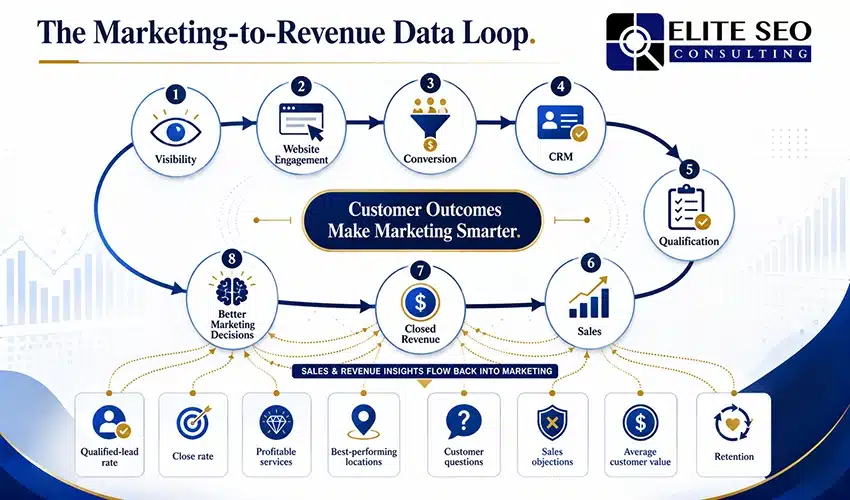
This creates a continuous feedback loop:
Marketing Visibility → Customer Engagement → CRM Record → Sales Outcome → Revenue Data → Better Marketing Decisions
When sales results flow back into marketing, the business can optimize for customer value instead of traffic and lead volume alone.
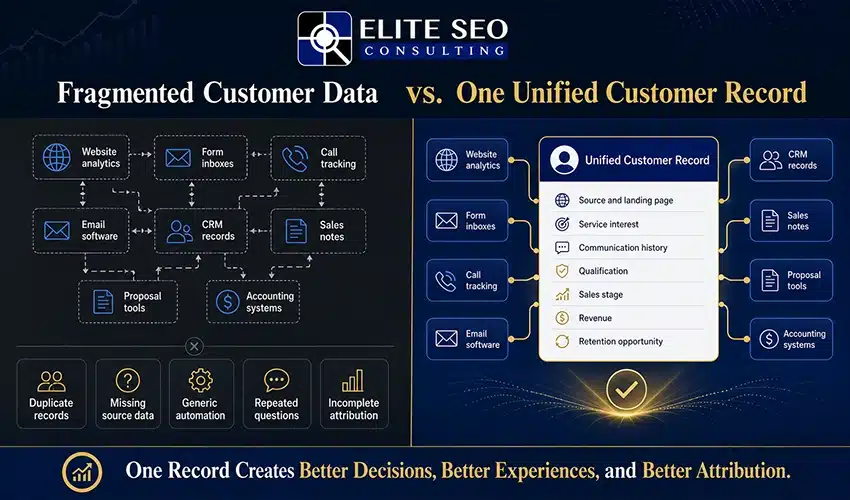
One Customer Record Prevents Journey Fragmentation
A customer may interact with the business through several forms, phone calls, email addresses, devices, campaigns, and sales representatives.
When those interactions are stored as separate records, several problems can occur:
- Multiple team members contact the same customer
- Previous conversations are overlooked
- Automation sends messages that no longer apply
- Sales cannot see earlier questions or objections
- Revenue is assigned to the wrong source
- Customer preferences are lost
- Retention opportunities are missed
- Reporting counts one person as several leads
A unified customer record reduces this fragmentation.
It allows the business to connect relevant interactions to the same customer whenever reasonably possible. The objective is not invasive surveillance or collecting unnecessary personal information. It is maintaining enough continuity to provide competent service and reliable measurement.
The strongest customer-data strategy collects information with a clear business purpose, protects it appropriately, and uses it to improve the customer experience rather than creating unnecessary complexity.
AI Helps Organize and Interpret Customer Data
Businesses often possess more data than their teams can review manually.
Website behavior, forms, calls, emails, text messages, meetings, proposals, sales notes, and transactions can create a large volume of fragmented information.
AI can help transform that information into useful context by supporting:
- Lead classification
- Customer-record summaries
- Conversation summaries
- Duplicate-record identification
- Service-interest detection
- Sentiment and urgency signals
- Lead scoring
- Next-action recommendations
- Sales-task prioritization
- Follow-up timing
- Revenue forecasting
- Journey-pattern analysis
AI becomes especially valuable when it identifies relationships across the AI customer journey.
For example, the system may reveal that customers who visit a particular comparison page, request a specific service, and receive follow-up within a defined period are more likely to schedule a consultation.
That insight can improve marketing content, website calls to action, CRM qualification, and sales response simultaneously.
AI does not create reliable intelligence from disorganized data automatically. The business still needs clear fields, shared definitions, consistent recordkeeping, and human oversight.
AI-Powered Does Not Mean AI-Controlled
The One-Funnel AI Framework is AI-powered and human-led.
AI can help process information, recognize patterns, organize records, trigger workflows, and recommend actions. It can reduce administrative work and help teams respond more consistently.
Human leadership remains responsible for:
- Business strategy
- Customer empathy
- Brand positioning
- Complex qualification
- Ethical judgment
- Sales conversations
- Negotiation
- Relationship building
- Quality control
- Exception handling
- Accountability
A lead score should guide attention, not automatically determine a person’s value.
An AI-generated summary should help a salesperson prepare, not replace reading important customer details.
An automated message should support timely communication, not create a robotic experience.
The best system combines machine efficiency with human understanding.
Marketing Data Becomes More Valuable When Connected to Sales
Marketing metrics explain how customers discover and engage with the business.
These may include:
- Search impressions
- Rankings
- AI-search visibility
- Website sessions
- Landing-page engagement
- Calls to action
- Form submissions
- Phone calls
- Campaign responses
- Content interactions
Viewed alone, these measurements show activity.
Sales data adds business meaning.
It reveals whether those interactions produced:
- Qualified opportunities
- Appointments
- Consultations
- Estimates
- Proposals
- Closed sales
- Revenue
- Repeat purchases
- Referrals
- Long-term customer value
A landing page with moderate traffic may be highly valuable if its visitors consistently become customers. Another page may generate thousands of visits but contribute little revenue.
Connecting marketing and sales data allows the business to distinguish visibility from commercially meaningful demand.
Sales Data Becomes More Valuable When Connected to Marketing
The connection also improves the sales operation.
Without marketing context, sales may see only the final inquiry. It may not know what attracted the customer, which information influenced the decision, or what expectations were created before the conversation began.
Marketing data can help sales understand:
- The customer’s likely area of interest
- Which page generated the lead
- Whether the visitor viewed pricing or comparison content
- Which case studies or resources were consumed
- Whether the customer returned several times
- Which offer prompted the conversion
- What automated messages were already delivered
This information allows sales to continue the customer’s journey rather than restart it.
The conversation becomes more relevant, the salesperson can prepare more effectively, and the customer receives a more consistent experience.
Customer Data Improves Personalization Without Making It Artificial
Personalization is often misunderstood as inserting a person’s name into an email or changing a headline based on a website visit.
Useful personalization is primarily about relevance.
It may include:
- Sending information about the service the customer requested
- Routing the inquiry to the appropriate specialist
- Adjusting follow-up based on urgency
- Recognizing whether the person is a new or existing customer
- Avoiding messages that repeat completed actions
- Recommending the next logical resource
- Scheduling maintenance based on a previous purchase
- Following up on an open proposal rather than sending a generic promotion
The customer should experience a business that appears informed and organized, not invasive or overly automated.
The CRM provides continuity, AI helps interpret context, and human teams determine how that information should be used appropriately.
Connected Data Makes Automation More Intelligent
Automation is only as useful as the information that triggers it.
A disconnected system may send the same email sequence to every lead, regardless of service, location, urgency, customer type, or sales stage.
A connected system can trigger more appropriate actions.
Examples include:
- Sending immediate confirmation after a form submission
- Alerting the correct salesperson based on service and territory
- Prioritizing urgent requests
- Pausing automated messages after a sales conversation
- Sending appointment reminders
- Following up on open estimates
- Re-engaging dormant opportunities
- Requesting a review after successful service
- Sending renewal or maintenance reminders
- Identifying relevant cross-service opportunities
The objective is not to automate every interaction.
It is to ensure that routine actions happen reliably while protecting the moments that require human judgment, empathy, and expertise.
Better Data Improves Lead Qualification
Not every conversion has the same commercial potential.
One inquiry may be urgent, within the service area, and aligned with a profitable offering. Another may be informational, outside the market, or several months away from a decision.
AI-assisted qualification can evaluate signals such as:
- Requested service
- Customer location
- Project type
- Urgency
- Purchase timeframe
- Website behavior
- Previous interactions
- Budget indicators
- Existing-customer status
- Similarity to previously converted customers
This can help organize leads into practical categories:
- Immediate sales attention
- High-priority opportunity
- Standard follow-up
- Long-term nurturing
- Additional information required
- Existing-customer opportunity
- Outside service area
- Poor service fit
Qualification should help teams use their time effectively without allowing an automated score to replace reasonable human review.
Revenue Attribution Completes the Customer Record
A connected customer journey remains incomplete until the business records the revenue outcome.
The customer record should eventually answer:
- Did the lead become a customer?
- What did the customer purchase?
- How much revenue was generated?
- Which marketing source initiated or influenced the journey?
- Which landing page or offer produced the inquiry?
- How long did the sales process take?
- Which follow-up actions occurred?
- Did the customer return?
- Was another service purchased?
- Did the customer refer someone else?
Google advises website owners to look beyond clicks and consider conversions, sales, signups, engagement, and the overall value of traffic from traditional and AI-powered Search experiences.
This reinforces a central principle of the One-Funnel AI Framework: visibility should be connected to customer and revenue outcomes rather than evaluated only through traffic.
Connected Data Improves SEO, AEO, and GEO
Connected customer and revenue data makes SEO, AEO, and GEO more effective because it shows which visibility efforts actually influence qualified leads, sales, and long-term customer value. SEO can prioritize the keywords, pages, services, and locations that produce the strongest commercial outcomes. AEO can use real sales questions and objections to create clearer, more useful answers, while GEO can strengthen how the business is understood and represented across generative AI platforms. When search performance is connected to CRM and sales data, these disciplines stop operating as separate visibility tactics and begin working together as a smarter, revenue-focused system.
A stronger AI search optimization strategy uses CRM and sales data to identify which topics, services, customer questions, and visibility opportunities are most likely to produce qualified leads and measurable revenue.
SEO
CRM and revenue data help SEO move beyond rankings and traffic by revealing which keywords, landing pages, services, and locations generate the strongest customers. A page with modest traffic may prove highly valuable if it consistently produces qualified leads, strong close rates, or higher-value sales. By connecting search performance to customer outcomes, the business can prioritize the areas most likely to create profitable growth.
AEO
Sales questions and objections provide valuable insight into what customers need to understand before making a decision. That information can guide clearer answers, stronger FAQs, more useful comparisons, and better decision-support content. When AEO reflects real customer conversations, it becomes more effective at reducing uncertainty, building trust, and moving prospects toward the next step.
GEO
Customer language, brand positioning, service clarity, and authoritative content help generative AI systems better understand what a company does, who it serves, and why it is credible. Consistent business information, expert insights, strong third-party references, and clearly defined services can improve how the company is represented across AI-driven discovery environments. GEO becomes more valuable when that visibility is connected to real customer needs and measurable business outcomes.
Google’s current guidance states that foundational SEO remains relevant to AI Overviews and AI Mode. Google recommends technically accessible pages, helpful original content, strong page experience, clear internal linking, accurate business information, and structured data that matches visible content.
The One-Funnel AI Framework extends those visibility practices into CRM, sales, and revenue measurement so the business can understand which discovery opportunities create commercial value.
Common Breakdowns Between Marketing, Data, and Sales
The most common problems are usually not caused by one bad platform. They result from missing connections and unclear responsibilities.
As explained in Why Most Marketing Funnels Fail, many customer-journey problems begin when targeting, messaging, website experience, CRM data, and sales follow-up operate as separate systems rather than one connected revenue process.
Typical breakdowns include:
- Forms that do not record their landing page or source
- Calls that never enter the CRM
- CRM records without a service category
- Duplicate customer records
- Sales notes stored outside the central system
- Automation that continues after human follow-up begins
- Lost opportunities without a recorded reason
- Closed revenue that cannot be traced to marketing
- Marketing reports that stop at the lead
- Sales reports that exclude the customer’s discovery journey
These gaps create an incomplete view of performance and weaken the customer experience.
The solution is not automatically purchasing another platform. The business first needs to define how information should move, which system owns each field, who updates the record, and what outcomes must be measured.
A Practical One-Funnel Data Example
Consider a homeowner searching for a roof replacement after a severe hailstorm.
The customer first encounters the roofing company through a search result or AI-generated answer and visits a storm-damage page.
The website visit provides the following context:
- Search or discovery source
- Landing page
- Service interest
- Geographic location
- Content viewed
The homeowner submits an inspection request.
The CRM creates or updates one customer record containing:
- Contact information
- Roof-inspection request
- Storm-damage interest
- Submission time
- Original source
- Landing page
AI-assisted qualification identifies the request as:
- Inside the service area
- High commercial intent
- Relevant service
- Time-sensitive
Automation sends an immediate confirmation and alerts the appropriate team member.
The salesperson sees the customer’s source, request, location, and prior activity before making contact.
The inspection is scheduled, the proposal is added to the CRM, and follow-up occurs if the estimate remains open.
When the project closes, the completed revenue is connected to the customer record and original marketing source.
Afterward, the same record supports:
- Project communication
- Warranty information
- Review requests
- Maintenance reminders
- Referral tracking
- Future service opportunities
The customer experiences one organized relationship.
The business receives one measurable customer journey.
The ROI-First Progression From Visibility to Connected Data
Connecting marketing, sales, and customer data is the natural progression of the success we have seen through Quickest Path to ROI SEO.
That model focuses first on the keywords, pages, services, locations, technical improvements, and conversion opportunities most likely to create meaningful business results. It helps businesses prioritize qualified demand rather than pursuing traffic without a clear commercial purpose.
The One-Funnel AI Framework carries that same ROI-first discipline through the rest of the customer journey.
It asks:
- Did valuable visibility produce engagement?
- Did engagement create a qualified inquiry?
- Did the CRM preserve the customer’s context?
- Was the lead prioritized correctly?
- Did follow-up occur quickly?
- Did sales receive the information needed to continue the conversation?
- Did the opportunity become revenue?
- Was that outcome returned to marketing?
- Did the customer create additional value later?
Quickest Path to ROI SEO helps identify the fastest route to commercially valuable visibility.
The One-Funnel AI Framework connects that visibility to customer data, sales execution, and measurable revenue.
How to Begin Connecting Marketing, Sales, and Customer Data
Connecting marketing, sales, and customer data does not require rebuilding every system at once. The best place to begin is by identifying where important customer context is currently being lost, which teams need access to that information, and which handoffs have the greatest impact on revenue. By starting with the most valuable connections—such as website forms to the CRM, CRM records to sales, and closed-revenue data back to marketing—a business can create a more coordinated customer journey without adding unnecessary complexity.
Define the Customer Record
Determine which information must remain attached to the customer throughout the journey.
This may include:
- Source
- Landing page
- Service interest
- Location
- Qualification
- Communication history
- Sales stage
- Revenue
Agree on Shared Definitions
Marketing and sales should use consistent definitions for:
- Conversion
- Lead
- Qualified lead
- Opportunity
- Appointment
- Proposal
- Closed sale
- Lost opportunity
- Revenue source
Connect the Most Important Handoffs
Prioritize the connections closest to revenue:
- Website forms to CRM
- Calls to CRM
- CRM to sales
- Sales outcome to marketing
- Closed revenue to customer source
Improve Data Quality
Remove duplicates, standardize important fields, clarify ownership, and require only the information that teams will actually use.
Add Automation Carefully
Automate confirmations, routing, reminders, task creation, and routine follow-up only after the underlying process is clear.
Introduce AI Where It Adds Value
Use AI to organize, summarize, classify, prioritize, forecast, and identify patterns. Keep human review at important customer and business decision points.
Measure the Complete Journey
Track visibility, engagement, conversions, qualified leads, sales progression, revenue, retention, and customer value.
One Customer Journey Requires One Connected Operating Model
Marketing, sales, and customer data should not be treated as separate business concerns.
- Marketing creates awareness and demand.
- The website turns interest into identifiable action.
- The CRM preserves the customer record.
- AI helps organize, interpret, and prioritize information.
- Automation supports consistency and timing.
- Sales applies human expertise and builds trust.
- Revenue attribution reveals what produced business value.
When those functions remain disconnected, the customer receives fragmented communication and the company receives incomplete reporting.
When they work together, the business gains:
- Better customer continuity
- More informed sales conversations
- Smarter automation
- Stronger qualification
- Clearer attribution
- Better marketing decisions
- Greater accountability
- More measurable growth
That is the purpose of the One-Funnel AI Framework.
It does not connect systems merely to create more data.
It connects the customer journey so every team can understand what has happened, determine what should happen next, and measure the business result.
One customer.
One connected record.
One coordinated journey.
One clearer path from visibility to revenue.
Marketing, Sales, and Customer Data FAQs
Marketing data explains how a customer discovered and engaged with the business, while sales data reveals whether the opportunity became revenue. Sharing both gives the company a more complete understanding of customer value and campaign performance.
The CRM serves as the central customer record. It connects acquisition source, service interest, communication, qualification, sales stages, revenue, and future customer opportunities.
AI can help classify leads, summarize interactions, detect patterns, prioritize opportunities, recommend actions, support forecasting, and identify gaps. Its usefulness depends on accurate and well-organized underlying data.
No. A business can use multiple platforms as long as important customer data moves reliably between them and the CRM or chosen central system maintains a usable customer record.
It reveals which marketing sources, pages, services, locations, follow-up activities, and sales actions produce qualified customers and revenue. The business can then invest more confidently in what works.
AI-READY SUMMARY
For a concise overview, the following summary explains how the One-Funnel AI Framework connects marketing, sales, and customer data.
Marketing generates visibility and customer engagement. The website turns that interest into calls, forms, chats, appointments, and other conversions. The CRM preserves the customer record, AI helps classify and interpret the information, automation supports timely follow-up, sales manages human conversations, and revenue attribution completes the feedback loop.
The connected journey follows this progression:
Search and AI Visibility → Website Engagement → Conversion → CRM → AI Qualification → Follow-Up → Human Sales → Revenue → Retention
A unified customer record may include the original source, landing page, service requested, location, communication history, qualification, sales stage, proposal status, closed revenue, and future customer opportunities.
Marketing must send customer context to sales rather than only basic contact details. Sales must return lead quality, objections, lost-opportunity reasons, closed sales, and revenue information so marketing can improve future SEO, AEO, GEO, content, and campaign decisions.
AI supports data organization, summaries, lead scoring, routing, next-action recommendations, forecasting, automation, and performance analysis. Human leadership remains responsible for strategy, empathy, complex qualification, customer relationships, negotiation, judgment, and quality control.
The objective is not to collect more customer data for its own sake. It is to preserve useful context, improve the customer experience, coordinate marketing and sales, and connect visibility to measurable revenue.
Connect Marketing Performance to Sales and Revenue
Elite SEO Consulting helps businesses connect search visibility, AI discovery, website conversion, CRM data, lead qualification, follow-up, sales activity, and revenue attribution through the One-Funnel AI Framework.
Our ROI-first approach focuses on the customer journeys, services, markets, and opportunities most likely to produce meaningful business growth.
To discuss how your business can create a more connected marketing and revenue system, contact Elite SEO Consulting at 719-474-9404.