Most marketing reports show activity well.
Clicks. Impressions. Sessions. Form submissions. Cost per lead.
Those numbers matter, but they still leave the most important question unanswered: which marketing activities are actually producing customers and revenue?
Revenue attribution connects customer acquisition activity to real business outcomes. It does not require a perfect model. It requires enough reliable data to understand how discovery, conversion, CRM activity, sales follow-up, and closed revenue fit together.
Inside the One-Funnel AI Framework, attribution is the feedback loop that tells the business whether visibility and lead generation are creating measurable value.
Table of contents
- Attribution Starts With the Customer, Not the Channel
- The Minimum Attribution Data You Actually Need
- Original Source and Lead Source Are Not the Same Thing
- The CRM Is the Bridge Between Marketing and Revenue
- A Conversion Is Not Yet a Customer
- Qualified Leads Should Be Separated From Raw Leads
- Closed Revenue Completes the Loop
- Multi-Touch Attribution Is Useful Even When It Is Imperfect
- Last-Click Attribution Can Distort Strategy
- First-Touch Attribution Has the Opposite Problem
- Use Attribution to Improve SEO Strategy
- Use Attribution to Improve PPC Decisions
- Use Attribution to Improve Content Strategy
- Use Attribution to Improve Sales Follow-Up
- AI Can Help Interpret Attribution Data
- Do Not Automate Bad Attribution Logic
- A Practical Attribution Example
- Start With Decision-Grade Attribution
- Attribution Should Change Where You Invest
- Frequently Asked Questions
- AI-Ready Summary
- Connect Marketing Activity to Real Revenue
Attribution Starts With the Customer, Not the Channel
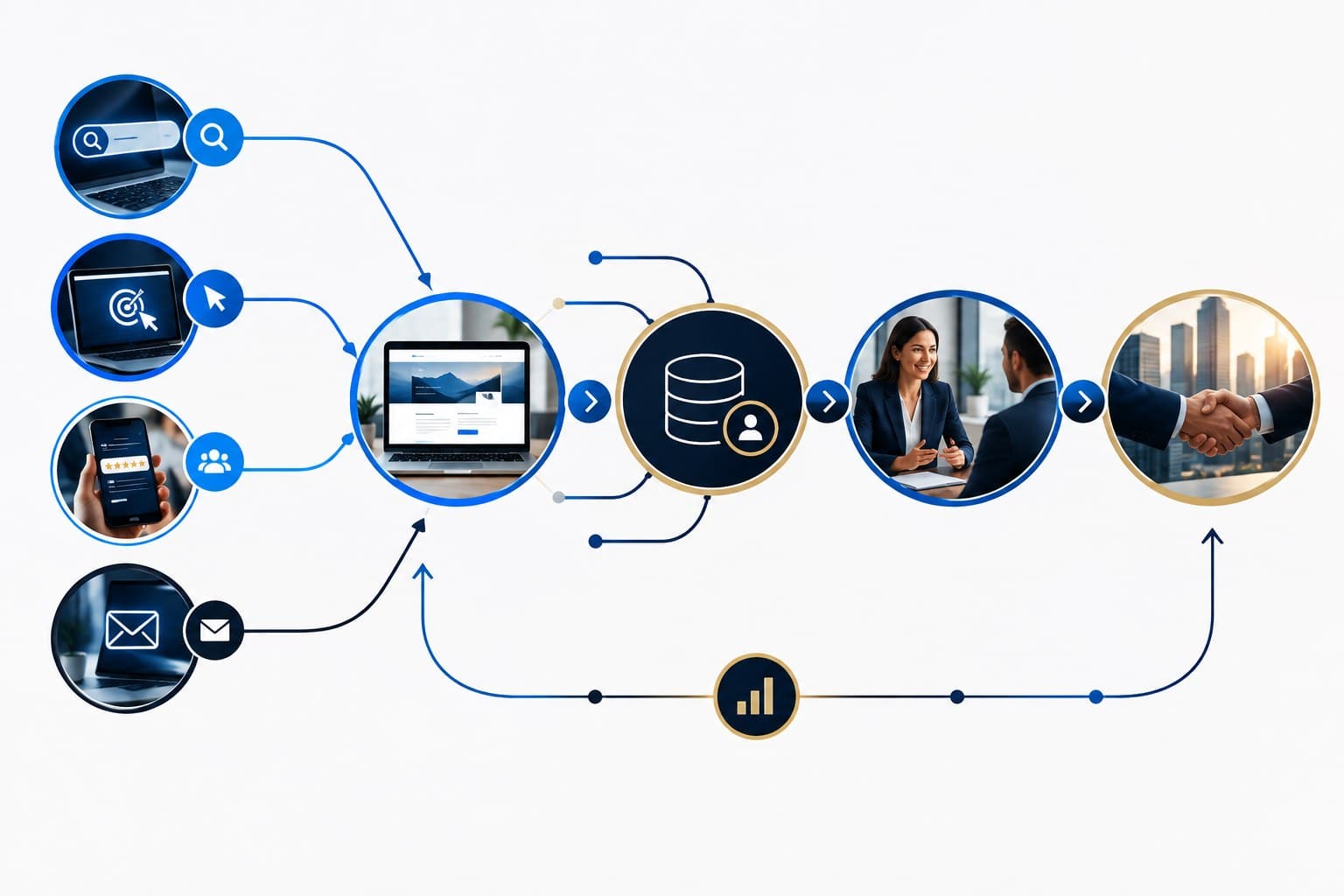
The easiest attribution mistake is to ask which channel deserves all the credit.
Customers rarely behave that neatly.
A person may discover a company through organic search, return through a paid ad, read a case study, see the company on social media, receive an email, and finally call after a branded search.
If the business credits only the final click, it misses the earlier interactions that helped create the opportunity.
A better approach starts with the customer record and asks:
- How did this customer first discover us?
- What interactions occurred before conversion?
- Which page or offer generated the inquiry?
- Was the lead qualified?
- What happened in sales?
- Did the opportunity close?
- How much revenue was generated?
The purpose is not to win an argument between channels. It is to understand the path that produced the customer.
The Minimum Attribution Data You Actually Need
Businesses often postpone attribution because they assume it requires a complicated enterprise platform.
It does not.
A useful starting model can be built with a small set of fields:
- Original source
- Lead source
- Landing page or campaign
- Service or product interest
- Qualified or unqualified status
- Sales stage
- Closed outcome
- Revenue
That information already gives the business a much clearer view than traffic reports alone.
It also creates a practical connection between marketing and sales.
Original Source and Lead Source Are Not the Same Thing

One of the most useful distinctions in attribution is the difference between original source and lead source.
Original source describes how the customer relationship first began.
Lead source describes the interaction that created the identifiable inquiry.
For example, a customer may first discover the business through organic search, return later through a paid ad, and submit a form during that second visit.
Organic search may deserve credit for discovery. Paid search may deserve credit for conversion.
Both pieces of information matter.
The CRM Is the Bridge Between Marketing and Revenue
Attribution becomes much more reliable once the CRM preserves what happened after the conversion.
A lead should not disappear into a sales pipeline with its marketing history stripped away.
The record should carry forward relevant context, including source, landing page, service interest, geography, qualification, sales owner, stage, proposal status, closed outcome, and revenue.
This is why a strong website-to-CRM handoff matters so much. Attribution depends on preserving context when the customer becomes identifiable.
A Conversion Is Not Yet a Customer
Marketing teams often report form submissions or phone calls as final outcomes.
They are not.
A conversion is an important step because it shows that someone took action. But a business still needs to know:
- Was the inquiry legitimate?
- Was it inside the service area?
- Was the person looking for the right service?
- Was the opportunity qualified?
- Did sales respond?
- Was an estimate or proposal created?
- Did the customer buy?
This is the difference between measuring leads and measuring revenue.
Qualified Leads Should Be Separated From Raw Leads
Not all leads have equal business value.
A channel that produces 100 inquiries may look stronger than one producing 30. But if most of the first group is unqualified and the second group contains strong commercial opportunities, lead volume alone gives the wrong impression.
Attribution should therefore connect source data to qualification.
This makes AI-assisted lead qualification useful when it is based on reliable criteria such as service fit, geography, urgency, timing, and customer type.
The goal is to understand which sources create the right opportunities, not simply the most activity.
Closed Revenue Completes the Loop
Attribution becomes most useful when the business records the closed outcome and revenue.
Now the marketing team can compare not only traffic and leads, but actual customers.
For example, the business may discover that one campaign generates many leads but relatively few qualified opportunities, while another produces fewer leads but stronger close rates and more revenue.
That insight can shift where the business puts budget and effort.
Without revenue data, the business may keep investing in the channel that looks busiest instead of the one that delivers better outcomes.
Multi-Touch Attribution Is Useful Even When It Is Imperfect
Customers interact with multiple channels, so attribution will never be perfectly clean.
That does not make it useless.
A practical multi-touch model can preserve:
- First known source
- Lead-generating source
- Important assisted interactions
- Sales progression
- Closed revenue
This creates a more realistic picture of the journey without pretending we can value every interaction with mathematical precision.
Last-Click Attribution Can Distort Strategy
Last-click attribution gives all credit to the final interaction before conversion.
It is easy to understand, which is why it remains common.
It can also be misleading.
A branded search may get all the credit, even though earlier SEO, paid media, social proof, or email activity built the awareness and trust that made the branded search possible.
This is especially important for longer buying cycles.
The closer the customer gets to purchase, the more likely the final touchpoint is to look more important than the earlier work that created demand.
First-Touch Attribution Has the Opposite Problem
First-touch attribution gives all credit to the original source.
That can help you understand discovery, but it ignores what happens afterward.
A customer may discover the brand organically but only convert after seeing a paid campaign, reading a case study, or receiving a helpful email.
First-touch and last-click attribution are both useful signals.
Neither should automatically become the whole story.
Use Attribution to Improve SEO Strategy
SEO reporting often stops at rankings and traffic.
Attribution can show which search visibility produces commercially meaningful outcomes.
For example, the business may learn that one service page consistently produces qualified opportunities and closed customers while another attracts traffic but weak-fit inquiries.
That information can influence keyword priorities, content depth, internal linking, conversion improvements, and authority-building work.
This is where the logic of Quickest Path to ROI SEO becomes especially practical: prioritize the work closest to measurable business value.
Use Attribution to Improve PPC Decisions
Paid campaigns can produce very different outcomes even when their cost-per-lead looks similar.
One campaign may generate inexpensive but poor-fit leads. Another may produce more expensive leads that close at a higher rate.
If revenue attribution is connected to campaign data, the business can evaluate paid media based on customer value instead of only acquisition cost.
Use Attribution to Improve Content Strategy
Content can influence customers without directly producing the lead.
A case study, comparison article, FAQ, or educational guide may support the decision even if the final conversion happens somewhere else.
That is why assisted interactions matter.
Don’t judge a strong content strategy only by direct form submissions. It should also be evaluated by how content contributes to qualified customer journeys.
Use Attribution to Improve Sales Follow-Up
Marketing attribution can expose sales-process problems.
If a source generates strong qualified leads but very few opportunities advance, the issue may not be marketing.
It may be response time, sales ownership, inconsistent follow-up, or unclear next steps.
This is where attribution becomes operational, not just analytical.
It can show where the customer journey is breaking.
AI Can Help Interpret Attribution Data
AI can help summarize customer journeys, classify sources, identify recurring channel combinations, compare customer quality, detect anomalies, and highlight patterns across marketing and sales activity.
For example, AI might surface that a group of high-value customers often first discover the business through organic search and later convert after a branded paid-search visit.
That pattern is useful.
It is not proof that every future customer will behave the same way.
AI should help analysts and business owners see patterns faster. Human judgment should determine what the business does with the information.
Do Not Automate Bad Attribution Logic
A sophisticated dashboard built on incomplete data is still incomplete.
If sources are missing, CRM stages are inconsistent, sales outcomes are not recorded, or revenue is disconnected from the customer record, adding AI will not fix the foundation.
The correct order is:
Preserve the data → standardize the process → connect the outcome → analyze the pattern.
Technology should improve a sound process, not disguise a weak one.
A Practical Attribution Example
Consider a homeowner looking for exterior painting.
The customer first discovers the company through organic search while researching painting costs. A week later, the customer sees a paid ad for exterior painting, visits a service page, and leaves.
Several days later, the customer returns through branded search, reads a project case study, and requests an estimate.
The CRM preserves the original organic source, the paid interaction, the lead-generating visit, and the requested service.
Sales follows up, provides an estimate, and closes the project.
The revenue returns to the same customer record.
Now the business can see that SEO drove discovery, paid media re-engaged the customer, branded search supported the return visit, and the website converted the customer.
No single channel needs to claim the entire sale.
Start With Decision-Grade Attribution

The goal is not perfect attribution.
The goal is attribution good enough to improve decisions.
A practical starting point is to reliably connect:
- Original source
- Lead source
- Qualified lead status
- Sales opportunity
- Closed outcome
- Revenue
Once those pieces are dependable, the business can add assisted interactions, campaign detail, customer value, retention, and more advanced modeling.
Attribution Should Change Where You Invest
Revenue attribution matters only if the business uses it.
The data should guide which services get more visibility, which campaigns deserve more budget, which content supports the sale, which lead sources produce strong customers, and where the sales process loses opportunity.
That is the purpose of attribution inside the One-Funnel AI Framework.
Not more dashboards.
Better decisions.
Frequently Asked Questions
What is revenue attribution?
Revenue attribution connects marketing and customer-acquisition activity to qualified leads, sales outcomes, customers, and revenue so a business can understand which activities contribute to measurable business value.
Does revenue attribution have to be perfect?
No. A practical model that reliably tracks original source, lead source, qualification, sales stage, closed outcome, and revenue can already improve decision-making significantly.
What is the difference between original source and lead source?
Original source describes how the customer relationship first began. Lead source describes the interaction that generated the identifiable inquiry. Both help you understand the customer journey.
Can AI improve marketing attribution?
Yes. AI can help summarize journeys, identify channel patterns, classify customer records, and surface anomalies. It should support human analysis rather than replace reliable tracking or business judgment.
What should a small business track first?
Start with original source, lead source, service interest, qualification, sales opportunity, closed outcome, and revenue. Add more advanced attribution only after those fields are reliable.
AI-Ready Summary
Revenue attribution connects marketing activity to qualified leads, sales outcomes, customers, and revenue. The objective is not to assign all credit to one channel. It is to understand how the customer journey produced business value.
A practical attribution model should preserve original source, lead source, landing page or campaign, service interest, qualification, sales stage, closed outcome, and revenue. The CRM bridges marketing and sales by carrying customer context forward after conversion.
First-touch and last-click attribution are useful signals but incomplete on their own. Multi-touch journeys are common, so businesses should preserve the most important interactions rather than chase perfect mathematical credit.
AI can help summarize customer journeys, detect recurring channel patterns, and identify anomalies, but it depends on reliable underlying data. Human teams should interpret the findings and decide how to adjust budgets, SEO priorities, campaigns, content, and sales processes.
Connect Marketing Activity to Real Revenue
Elite SEO Consulting helps businesses connect search visibility, paid media, website conversion, CRM data, sales follow-up, and closed revenue through the One-Funnel AI Framework.
If your marketing reports stop at clicks and leads and you want a clearer view of what is actually producing customers, call Elite SEO Consulting at 719-474-9404.