A Colorado Springs business can rank well in Google, maintain an accurate Google Business Profile, earn excellent reviews, and still appear inconsistently when customers ask ChatGPT for recommendations.
That does not necessarily mean something is broken.
ChatGPT is not a second version of the Google Map Pack. A traditional search result usually responds to a relatively short query. A ChatGPT prompt may combine a service, location, urgency, budget, specialty, customer preference, and request for comparison in one question. The system may search the web, evaluate several sources, summarize what it finds, and cite pages that best support the answer.
For a Colorado Springs business, becoming more visible in ChatGPT means making the company easy to discover, understand, verify, compare, and cite. It requires technical access, clear business information, focused service content, credible third-party evidence, and consistent measurement.
ChatGPT visibility for local businesses isn’t a single optimization tactic. It results from several connected systems working well enough for the company to become a credible answer.
No button guarantees inclusion. There is also no responsible way to force ChatGPT to recommend a business. The practical opportunity is to improve the public evidence available when an AI-assisted system researches the market.
Table of contents
- What ChatGPT Visibility Actually Means
- How ChatGPT Finds Current Local Business Information
- Make the Website Accessible to ChatGPT Search
- Establish a Clear and Consistent Business Entity
- Publish Content That Answers Specific Customer Questions
- Support Claims With Verifiable Evidence
- Strengthen the Sources Around the Website
- Optimize for Citation Without Writing for a Robot
- Connect ChatGPT Visibility to Local SEO
- Test Visibility With a Repeatable Prompt Set
- Measure Referrals, Leads, and Revenue
- Prioritize the Improvements Closest to Business Value
- Common ChatGPT Visibility Mistakes
- Treating One Prompt as a Market Test
- Inventing an AI Ranking Formula
- Publishing Generic AI Content at Scale
- Adding Schema That Does Not Match the Page
- Relying Only on the Company Website
- Chasing Mentions Without Checking Accuracy
- Ignoring the Customer Journey After the Mention
- Guaranteeing ChatGPT Recommendations
- A Practical ChatGPT Visibility Plan for Colorado Springs Businesses
- Frequently Asked Questions
- Build a Local Presence ChatGPT Can Verify
What ChatGPT Visibility Actually Means
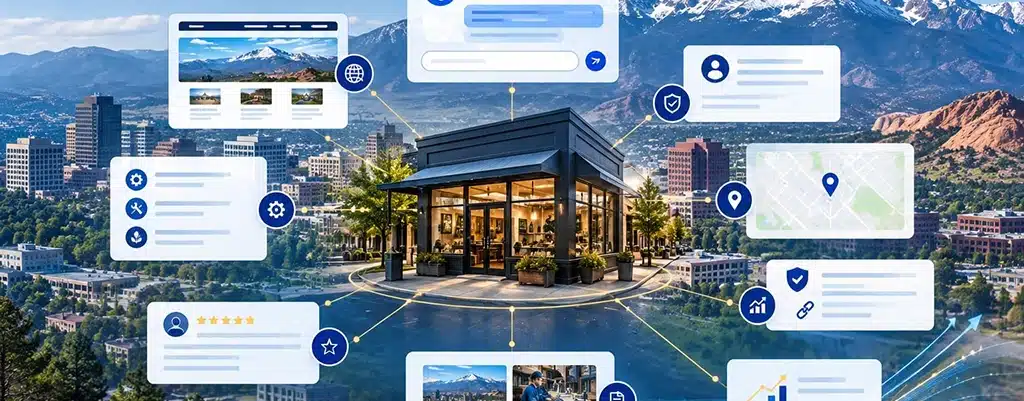
ChatGPT visibility can describe several different outcomes. Treating them as one metric creates misleading reports.
A business may be:
- Mentioned by name
- Included in a list of possible providers
- Described accurately
- Recommended for a specific use case
- Cited as a source
- Linked as a place to learn more
- Compared favorably or unfavorably with competitors
- Omitted from one prompt but included in a close variation
- Visible in a web-search answer but absent from a response that does not search the web
Each outcome answers a different question.
A citation shows that a page helped support an answer. A mention shows that the business entered the response. A recommendation goes further by connecting the company to a customer’s need. Accuracy determines whether the description represents the business correctly. Referral traffic shows whether someone clicked through. Qualified leads and revenue show whether that visibility created business value.
This distinction matters because a large citation count can look impressive while producing no relevant inquiries. The goal isn’t to collect AI screenshots. It is to improve qualified discovery and give potential customers enough credible information to take the next step.
How ChatGPT Finds Current Local Business Information
ChatGPT can search the web when a question benefits from current information. OpenAI’s guide to searching the web with ChatGPT states that search responses can include links to relevant sources and may use location information for local results.
That makes current web accessibility important for local businesses.
A customer might ask:
- Which Colorado Springs roofers handle hail damage and insurance-related repairs?
- Find a remodeling contractor near Briargate with detailed project examples.
- Which local SEO agencies explain how they measure qualified leads and revenue?
- Recommend a Colorado Springs dentist offering a particular treatment and evening appointments.
- Compare paving contractors serving commercial properties and homeowners associations.
Those prompts require more than a company name and phone number. They require the system to connect location, services, qualifications, evidence, and customer fit.
Web Search and Stored Model Knowledge Are Not the Same
A response based on current web search can reflect recently published pages, current business details, and accessible third-party sources. A response that does not search may rely on information already available to the model and the context supplied in the conversation.
This is one reason businesses should test whether a response used search before drawing conclusions from it. A single unsourced answer is not a complete visibility audit.
ChatGPT Can Cite Sources Without Recommending the Source
A business page may be cited because it explains a subject well, even when the business itself is not recommended. Conversely, a business may be mentioned based on evidence gathered from directories, reviews, news coverage, association pages, or other sources without its website receiving the visible citation.
Source visibility and business visibility overlap, but they are not identical.
Local Results Can Change With Context
The answer may change when the user changes:
- The neighborhood or city
- The requested service
- The urgency of the need
- The customer type
- The required credentials
- The desired price range
- The request for recent evidence
- The wording of the comparison
- Whether web search is used
A company suited to a broad “Colorado Springs contractor” prompt may not be the best-supported result for “commercial asphalt maintenance for a private road near Monument.” Specific prompts produce different evidence requirements.
Make the Website Accessible to ChatGPT Search
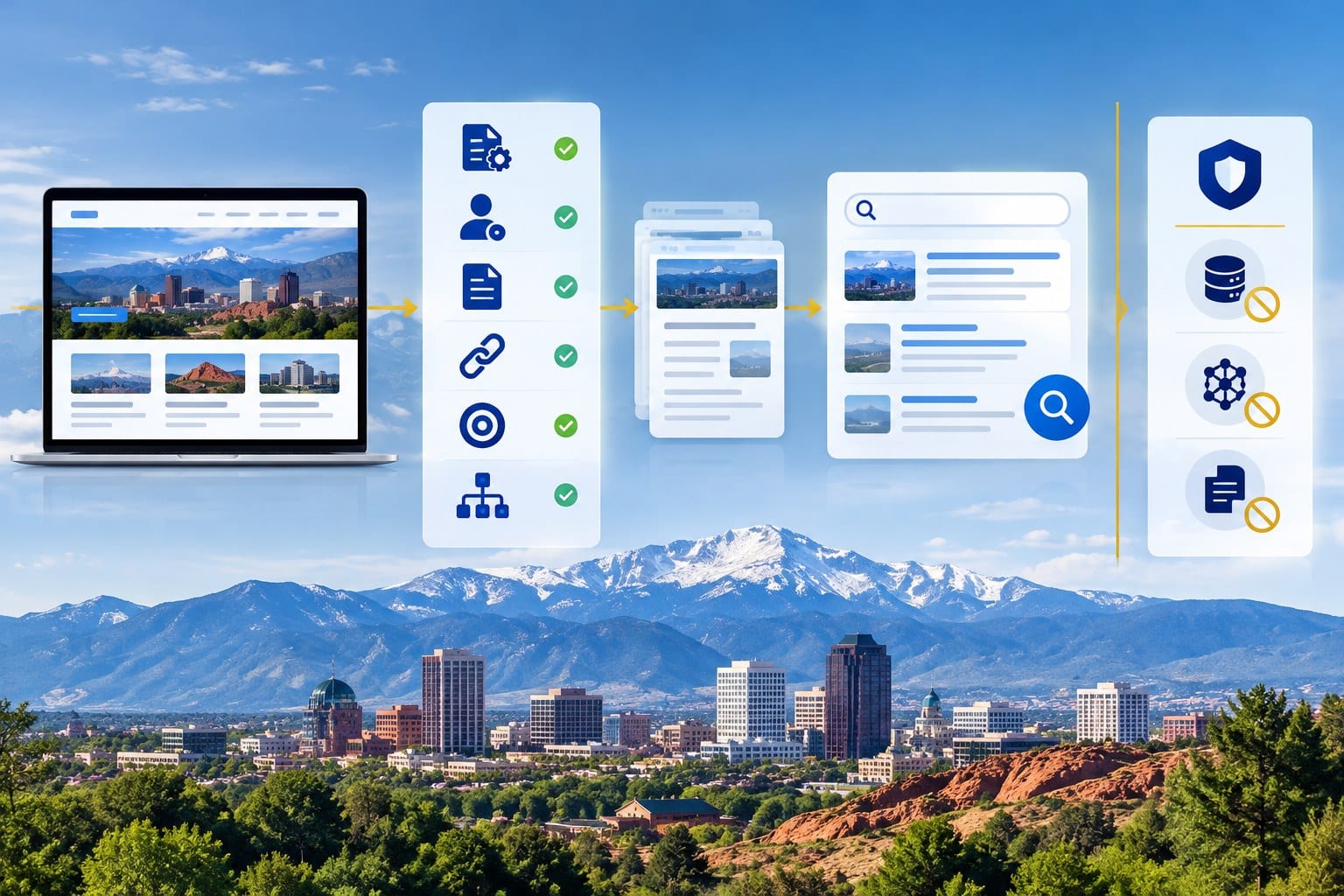
Useful content doesn’t support visibility if the relevant crawler cannot access it.
OpenAI identifies OAI-SearchBot as the crawler used to surface websites in ChatGPT search. Its current crawler documentation explains that website owners can manage this access through robots.txt and that OAI-SearchBot is separate from GPTBot, which is associated with potential model training.
That separation is important. A company can make its public pages available to ChatGPT search without making the same choice for model training.
Check Robots.txt Deliberately
The website team should determine whether robots.txt allows OAI-SearchBot to reach the pages intended for public discovery.
A basic technical review should examine:
- Whether OAI-SearchBot is blocked sitewide
- Whether important service pages are blocked
- Whether security software blocks the crawler before robots.txt is evaluated
- Whether a content delivery network or firewall challenges legitimate crawler requests
- Whether staging directives remained after launch
- Whether important pages contain a noindex directive
- Whether canonical tags point to the correct version
- Whether the server returns a successful status code
- Whether essential content is available in the rendered page
Do not change crawl rules casually. Some organizations limit access for legal, privacy, licensing, or strategic reasons. Make the decision intentional and document it.
Keep Search Access Separate From Training Preferences
Blocking every OpenAI-related user agent because someone heard that “AI scrapes websites” may also remove the business from an important discovery channel.
OpenAI documents separate controls for OAI-SearchBot and GPTBot. Website owners should review what each crawler does, decide which uses they permit, and configure the site accordingly.
Make Important Pages Easy to Reach
Crawler access is only the beginning. A service page buried behind weak navigation, disconnected from the rest of the website, or accessible only through a complicated script remains difficult to discover and interpret.
Important pages should have:
- Crawlable internal links
- Clear page titles and headings
- Accurate canonical tags
- Logical placement in the site architecture
- Inclusion in an XML sitemap when appropriate
- Fast, stable delivery
- Useful visible content
- No accidental login, form, or script barriers
A technically open website can still be functionally obscure. In AI-assisted discovery, website structure is the strategy because page relationships help systems find and interpret the information that supports an answer.
Establish a Clear and Consistent Business Entity
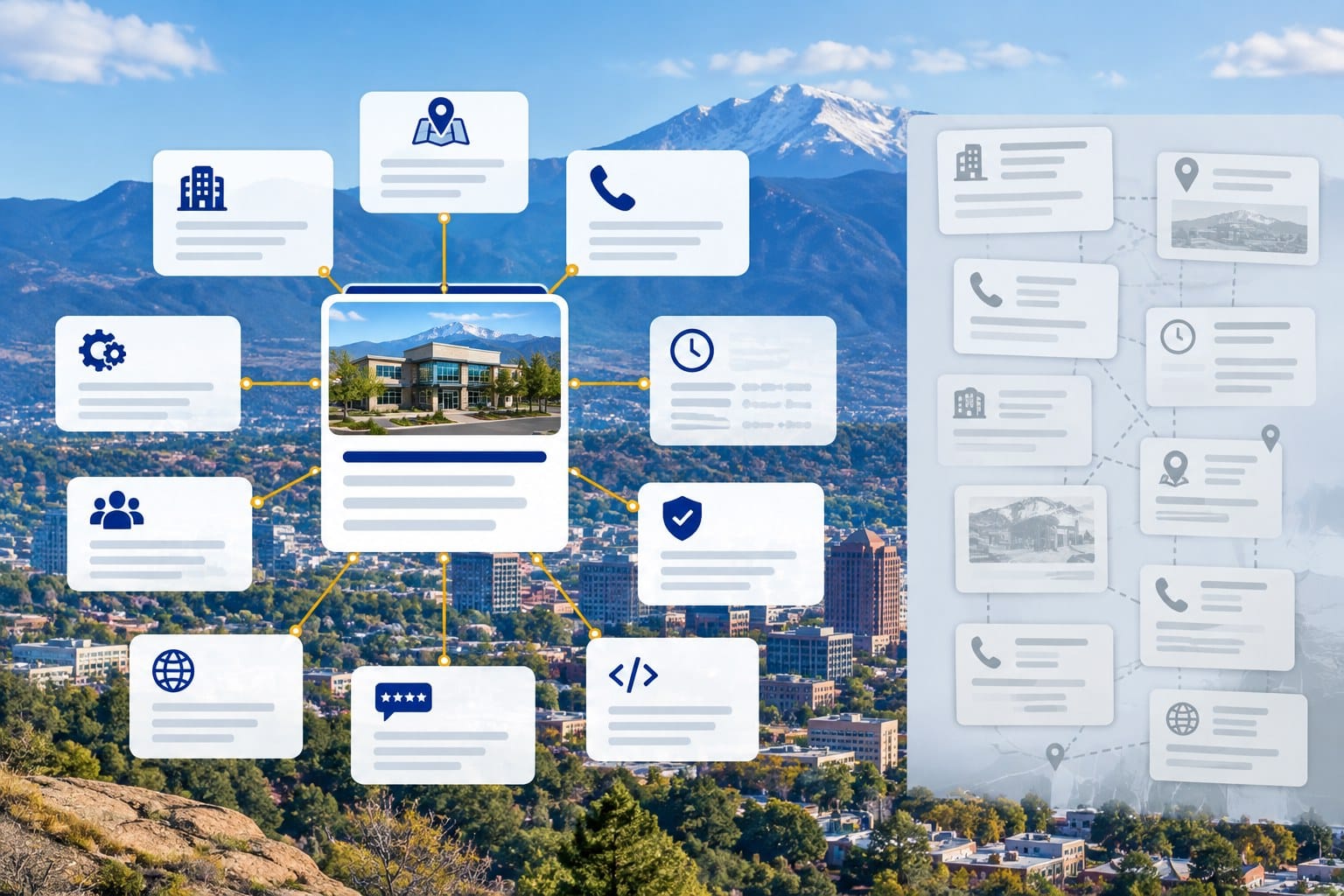
An AI system needs to determine which real-world organization a page, review, directory listing, news article, or social profile refers to.
That becomes harder when a company uses different names, old phone numbers, inconsistent addresses, vague service descriptions, or overlapping location pages. The system should not have to solve a small identity crisis before explaining the business.
Keep Core Business Facts Consistent
Important facts include:
- Official business name
- Physical address or legitimate service-area model
- Primary phone number
- Website URL
- Business categories
- Services
- Areas served
- Hours
- Leadership
- Credentials
- Founding information
- Professional affiliations
Perfect character-for-character duplication is not required everywhere, but material facts should not conflict.
Create Strong About and Contact Pages
An About page should identify the organization, leadership, history, expertise, and market served. A Contact page should provide the real information customers need to reach or visit the business.
These pages are not ceremonial. They help customers and machines connect a website to a real organization.
Use Structured Data as Clarification
Appropriate Organization and LocalBusiness structured data can clarify details already visible on the page. Google’s Organization structured-data documentation explains that organization markup can help disambiguate an organization, while its LocalBusiness documentation describes markup for business information such as hours and location details.
Structured data should match the visible content and real-world business. It is not a secret ChatGPT optimization switch, and adding ten schema types does not make a company ten times more understandable.
This is one reason business entity signals matter in local and AI search. Identity is stronger when the website, Business Profile, reviews, citations, licensing records, association pages, and independent coverage consistently describe the same organization.
Publish Content That Answers Specific Customer Questions
Generic claims provide weak evidence.
“We provide quality service” may be true, but it does not establish which service, for whom, under what conditions, in which locations, or with what relevant experience. A useful page removes ambiguity.
Build Focused Service Pages
Each commercially important service should have enough information to help a customer understand:
- What the service includes
- Which problem it addresses
- Who it is designed for
- Where it is available
- How the process works
- What choices affect cost or timing
- Which credentials or experience matter
- What proof supports the company’s claims
- What the customer should do next
A single page listing 30 services gives an AI-assisted system very little context for matching one service to one detailed prompt.
Address Colorado Springs Conditions When They Matter
Local specificity should improve the answer, not decorate the page.
Depending on the business, useful Colorado Springs context could include:
- Hail and rapid weather changes
- Elevation and seasonal conditions
- Military relocation and household transitions
- Older housing near established neighborhoods
- New development in northern and eastern parts of the city
- Mountain and foothill access
- Local permitting or inspection considerations
- Travel time across a geographically spread service area
- Differences between residential, commercial, and municipal needs
Do not force Pikes Peak into a paragraph about payroll software. Local content works when geography changes the customer’s problem or the company’s solution.
Answer Comparison and Qualification Questions
ChatGPT users often ask questions that occur later in the buying process:
- Which provider handles this specialized service?
- What should I compare before hiring?
- Who serves my neighborhood?
- Which option is suitable for a commercial property?
- What credentials should I verify?
- What is the difference between two approaches?
- What should I expect during the process?
Useful comparison pages, process guides, FAQs, service explanations, and case studies can help support these answers. The content should help the customer make a better decision, even when that decision is not to hire the company.
Support Claims With Verifiable Evidence
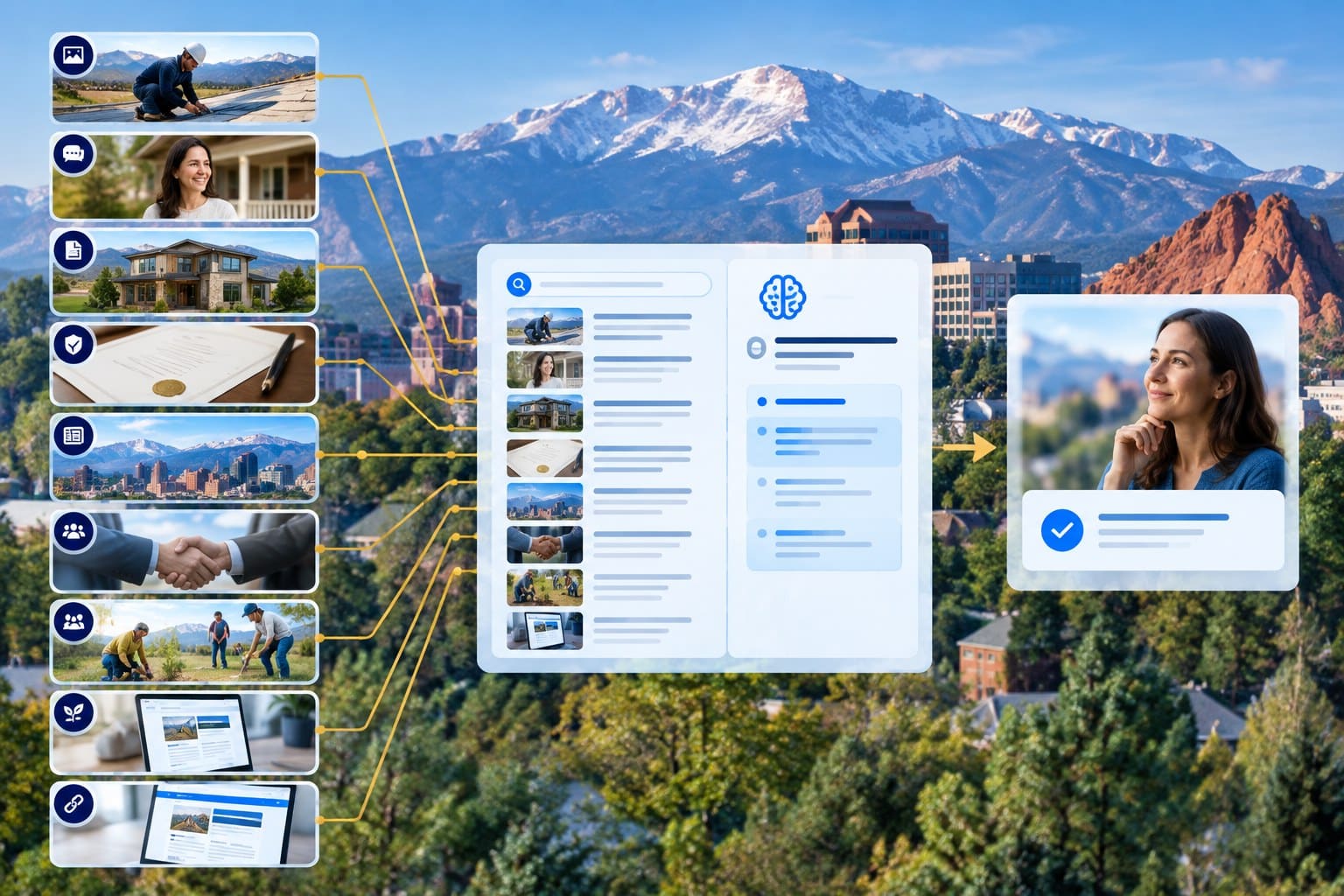
The company website is expected to say positive things about the company. Independent evidence makes those claims easier to trust.
Evidence may include:
- Legitimate customer reviews
- Detailed project case studies
- Original project photographs
- Professional licenses and certifications
- Awards with accurate names and dates
- Local news coverage
- Industry publications
- Association memberships
- Supplier or manufacturer relationships
- Community participation
- Relevant backlinks
- Interviews, podcasts, and expert contributions
The previous article explained how online reviews influence local rankings, AI recommendations, and customer trust. Reviews can help confirm recurring themes about services, locations, communication, reliability, and outcomes. They should be earned honestly and evaluated alongside other evidence.
Prefer Specific Proof Over Promotional Adjectives
“Experienced Colorado Springs contractor” is a claim.
A case study that explains the customer’s problem, property type, service performed, constraints, process, photographs, and outcome provides evidence. A licensing page maintained by a government agency is independent corroboration. A detailed customer review may add another perspective.
Specific proof gives an AI-assisted system more useful material to compare and summarize.
Correct Contradictory Information
Conflicts weaken confidence. Common examples include:
- Different founding dates
- Former addresses presented as current
- Disconnected phone numbers
- Services listed in directories but absent from the website
- Credentials that have expired
- Awards described inaccurately
- Location pages for offices that do not exist
- Multiple biographies with conflicting experience claims
The safest correction is the truthful one.
Strengthen the Sources Around the Website
ChatGPT search can use information beyond the company’s own domain. A business should therefore evaluate broader public evidence about it.
Maintain Accurate Local Profiles and Citations
Review major business profiles, industry directories, professional associations, local chambers, licensing resources, supplier listings, and community organizations relevant to the company.
Prioritize sources that customers or researchers would reasonably trust. Submitting the same paragraph to hundreds of questionable directories may create activity for a monthly report. It does not automatically create authority.
Earn Relevant Local and Industry Mentions
Useful mentions may come from:
- Local news coverage
- Community partnerships
- Trade associations
- Industry interviews
- Expert commentary
- Project collaborations
- Sponsorships with genuine local relevance
- Educational contributions
- Supplier and manufacturer directories
- Awards and professional recognition
The objective is not to manufacture a footprint. It is to create legitimate public evidence of what the company does and why it matters.
Make Important Updates Discoverable
When a page is added or materially updated, ordinary crawling may take time. Bing’s URL-submission guidance recommends IndexNow as a way to notify participating search engines when URLs are added, changed, or deleted.
IndexNow does not guarantee inclusion in ChatGPT, and it does not replace crawlable architecture or quality content. It can, however, be part of a broader process for making updated public information discoverable.
Optimize for Citation Without Writing for a Robot
Citation-friendly content is easy to identify, understand, and support.
That usually means:
- The page has a clear purpose
- The heading accurately describes the section
- The answer appears near the question
- Important claims include context and evidence
- Dates and qualifications are explicit
- Tables are used for real comparisons
- Lists organize processes or criteria
- The author and organization are identifiable
- Sources are linked when outside evidence is used
- The page does not bury the useful answer beneath a sales pitch
This is not a reason to turn every page into 75 shallow questions followed by repetitive two-sentence answers. That approach creates the appearance of helpfulness without much substance.
Write Extractable Passages With Complete Meaning
A useful passage should make sense when separated from the surrounding page.
For example, a short definition can state what a service is, who needs it, and what outcome it supports. A comparison can clearly distinguish two options. A process can identify its stages in order. A factual claim can include its timeframe and source.
Clarity helps people first. It also makes the content easier for search and AI systems to interpret.
Keep Expertise Visible
When expertise matters, identify who wrote or reviewed the content and why that person is qualified. Use accurate biographies, credentials, dates, and source references.
Anonymous content making high-stakes claims gives customers little basis for evaluating reliability.
Connect ChatGPT Visibility to Local SEO
ChatGPT visibility does not replace conventional search optimization.
Many of the same foundations support both:
- Crawlable website pages
- Clear service information
- Accurate business identity
- Useful location context
- Descriptive titles and headings
- Logical internal links
- Relevant backlinks
- Legitimate reviews
- Structured information
- Original evidence
- Strong conversion paths
The difference is often in how the customer asks the question and how the answer is assembled.
Traditional keyword research may focus on a phrase such as “Colorado Springs basement remodeling.” ChatGPT research should also examine natural prompts such as, “Which Colorado Springs remodeling companies handle basement planning, permits, construction, and finishing?”
Both expressions involve the same market. The second makes the required evidence more explicit.
Organizations building a broader strategy can review Elite SEO Consulting’s AI search optimization approach, which connects technical access, entity clarity, content, source evidence, prompt testing, and business measurement.
Test Visibility With a Repeatable Prompt Set
One favorable answer is not a measurement system.
ChatGPT responses may vary with prompt wording, user context, location, search behavior, available sources, and platform changes. Testing should therefore use a documented set of prompts and repeatable evaluation criteria.
Build Prompts Around Real Customer Intent
Start with a manageable set of themes:
- Broad service discovery
- Specific service discovery
- Location-specific needs
- Qualification or credential questions
- Comparison questions
- Problem-based questions
- Urgent or time-sensitive needs
- Brand and reputation questions
For each theme, use several natural variations. Customers don’t all phrase the same need the same way.
Record Separate Outcomes
For each test, track:
- Prompt
- Date
- Whether web search occurred
- User or test location when relevant
- Business mention
- Citation
- Link
- Recommendation language
- Position within the response
- Competitors mentioned
- Description accuracy
- Supporting sources
- Important omissions
Do not combine these into one mysterious “AI score” unless the method and weighting are transparent.
Evaluate the Sources, Not Just the Answer
When ChatGPT cites a source, examine why that source may have been useful.
Questions to ask include:
- Did it answer the prompt directly?
- Was it more specific than the company’s page?
- Did it contain recent information?
- Did it offer independent evidence?
- Did it explain a service or comparison clearly?
- Did it identify the business and location accurately?
- Was the page easier to crawl or understand?
The citation pattern often reveals a more useful action than the answer alone.
Measure Referrals, Leads, and Revenue
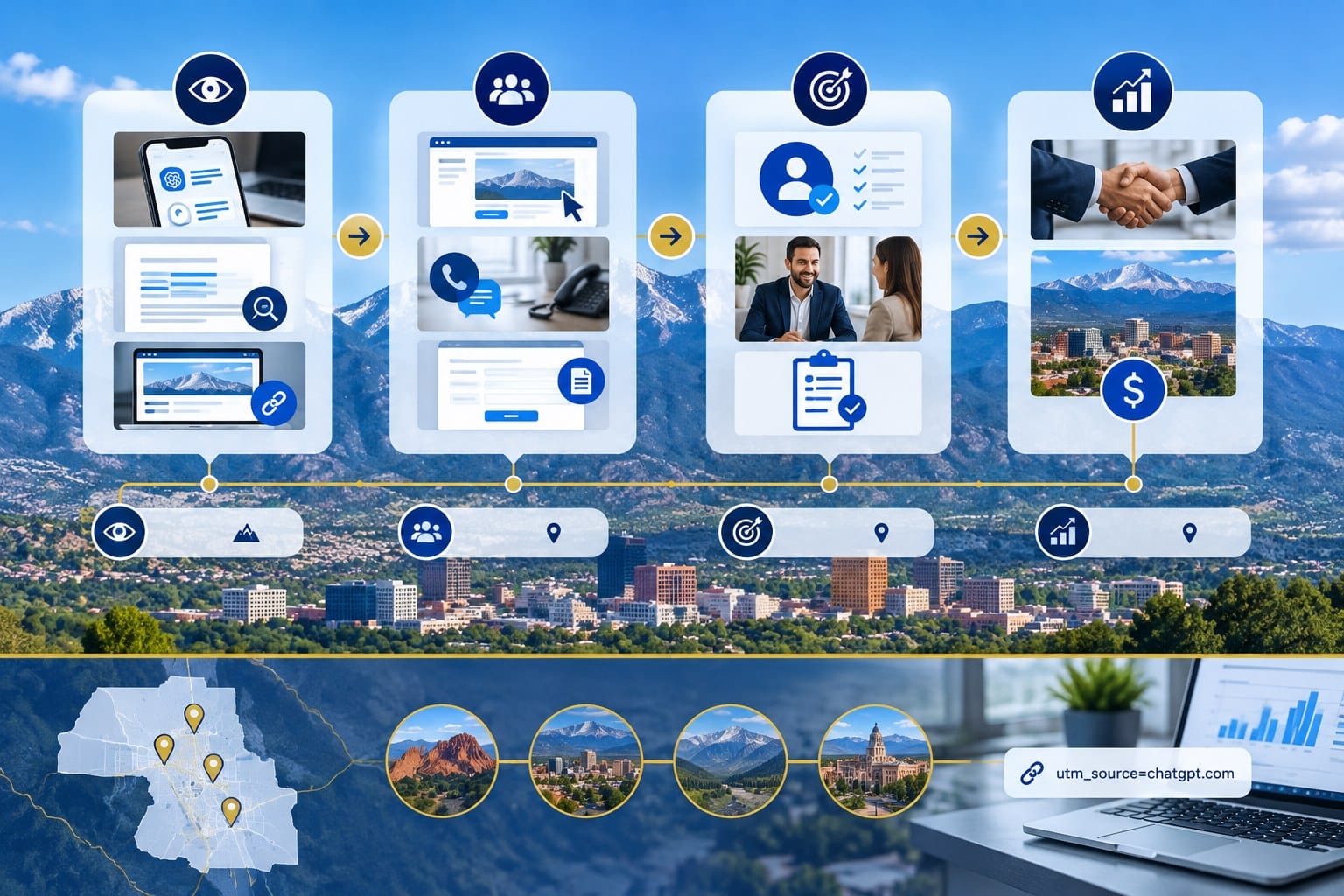
Visibility testing shows whether the business appears. Analytics and business records show whether that visibility matters.
OpenAI’s publisher and developer guidance states that referral links from ChatGPT search include utm_source=chatgpt.com, allowing publishers to identify inbound traffic in analytics platforms.
That is a useful starting point, not complete attribution.
Track ChatGPT Referral Activity
Analytics reporting may include:
- Sessions referred by ChatGPT
- Landing pages receiving visits
- Engagement with service and contact pages
- Calls and forms associated with those visits
- Conversion rate
- Services requested
- Customer location
- Qualified-lead rate
- Sales and revenue when available
Ask Customers How They Found the Business
Not every AI-influenced customer clicks a tracked link. Someone may see a recommendation, later search the brand in Google, and call from the Business Profile.
Add a simple intake question and train the team to record specific answers. “Internet” is not a particularly ambitious attribution category.
Useful responses might include:
- ChatGPT
- Google Search
- Google Maps
- Another AI assistant
- Referral from a customer
- Social media
- Industry directory
- News or article mention
Connect Visibility to Qualified Outcomes
The practical sequence is:
- Visibility
- Accurate presentation
- Website or profile visit
- Call or form
- Qualified lead
- Estimate, consultation, or appointment
- Customer
- Revenue
Each stage can fail independently. More mentions will not help if the business is described inaccurately, the website doesn’t build trust, or calls go unanswered.
Prioritize the Improvements Closest to Business Value
An AI-visibility review can identify dozens of potential tasks. Not all should receive equal priority.
The Quickest Path to ROI SEO approach starts with opportunities that offer the strongest reasonable business value relative to time, effort, and risk.
For ChatGPT visibility, high-priority work may include:
- Removing an accidental OAI-SearchBot block
- Correcting inaccurate business information
- Building a missing page for a profitable service
- Improving a service page already receiving qualified traffic
- Adding proof to a page making unsupported claims
- Correcting conflicting location information
- Strengthening a weak conversion path
- Publishing an important case study
- Earning a relevant association or supplier listing
- Measuring ChatGPT referrals and assisted leads
- Fixing response and follow-up problems
The correct order depends on the business. A technically invisible site needs access work before another thought-leadership article. A visible business with weak evidence may need case studies and reviews. A company already earning AI referrals may need better conversion and attribution.
Common ChatGPT Visibility Mistakes
Several mistakes can waste substantial time while producing attractive but unreliable reports.
Treating One Prompt as a Market Test
One response from one account at one moment cannot represent the entire Colorado Springs market. Use several intent themes, natural variations, dates, and locations where relevant.
Inventing an AI Ranking Formula
OpenAI does not publish a universal checklist assigning weights to schema, reviews, backlinks, citations, word count, or brand mentions for every ChatGPT answer.
Testing can identify patterns. It should not be presented as access to a secret score.
Publishing Generic AI Content at Scale
Hundreds of lightly edited location or question pages can create duplication, thin content, and wasted crawl budget. Volume is not the same as usefulness.
Adding Schema That Does Not Match the Page
Structured data should clarify visible, accurate information. Marking up services, reviews, locations, or credentials the page doesn’t legitimately support creates risk rather than authority.
Relying Only on the Company Website
Self-published claims are only one part of the evidence system. Reviews, citations, professional records, news, associations, and relevant third-party mentions can provide corroboration.
Chasing Mentions Without Checking Accuracy
A business can be mentioned with the wrong services, old address, or misleading description. Evaluate accuracy separately from visibility.
Ignoring the Customer Journey After the Mention
If the website is slow, confusing, unconvincing, or hard to contact, AI visibility may attract attention without delivering business value.
Guaranteeing ChatGPT Recommendations
No agency controls ChatGPT’s answers. You can improve visibility through better access, content, evidence, and measurement, but you can’t responsibly guarantee recommendations.
A Practical ChatGPT Visibility Plan for Colorado Springs Businesses
A defensible process connects technical access, clear information, public evidence, testing, and conversion.
- Define the services, locations, and customer types that matter most.
- Document natural prompts reflecting real customer intent.
- Establish a baseline for mentions, citations, accuracy, and source patterns.
- Verify OAI-SearchBot access and technical indexability.
- Correct inconsistent business facts across important sources.
- Improve core service, location, About, and contact pages.
- Add specific project evidence, credentials, and case studies.
- Strengthen legitimate reviews and relevant third-party mentions.
- Use accurate structured data to clarify visible information.
- Improve calls, forms, booking, and other conversion paths.
- Track ChatGPT referrals and ask leads how they found the business.
- Retest the same prompt set and compare results over time.
- Prioritize the next actions according to qualified leads and business value.
This is an ongoing process. Services change. Competitors publish new evidence. Business information moves. Reviews accumulate. Platforms update their search and answer systems. The measurement plan should be stable enough to reveal meaningful change while remaining flexible enough to reflect the market.
Frequently Asked Questions
Can a Colorado Springs business pay to rank organically in ChatGPT answers?
Organic mentions and citations are not guaranteed placements a business can purchase. Paid products, if presented, should be evaluated separately from organic ChatGPT search visibility. A business can improve accessibility, clarity, evidence, and conversion, but it cannot buy a guaranteed organic recommendation.
Does ChatGPT use Google Business Profile information?
ChatGPT search may encounter business information from multiple accessible web sources. A Google Business Profile is an important part of a local company’s public identity, but businesses should not assume that every ChatGPT answer uses it directly or gives it the same role it has in Google Maps. Maintain accurate information across the broader local ecosystem.
Should a website allow OAI-SearchBot?
OpenAI says OAI-SearchBot surfaces websites in ChatGPT search. Businesses seeking visibility should review whether the crawler can access their intended public pages. Legal, privacy, licensing, or strategic requirements may justify restrictions, so make the decision deliberately.
Does schema markup guarantee ChatGPT visibility?
No. Accurate structured data can clarify business and page information, but it doesn’t guarantee ChatGPT will mention, cite, or recommend the company. It should support visible content rather than substitute for it.
How long does it take to become more visible in ChatGPT?
There is no universal timeline. Results depend on technical access, crawl and discovery timing, existing authority, source availability, content quality, competition, prompt intent, location, and platform behavior. Some technical corrections may be recognized sooner than the work required to build meaningful third-party evidence.
Build a Local Presence ChatGPT Can Verify
Becoming more visible in ChatGPT is not about writing for a machine or repeating “Colorado Springs” until the page sounds unnatural.
It is about making the business understandable and supportable: accessible pages, consistent facts, focused services, useful local context, real expertise, independent evidence, clear conversion paths, and measurement tied to business outcomes.
Elite SEO Consulting helps Colorado Springs businesses evaluate AI-assisted discovery, organic search, Google Maps visibility, website content, entity clarity, third-party evidence, conversion paths, and revenue attribution as one connected system.
Call 719-474-9404 to schedule an AI and local visibility review and identify which improvements may offer the clearest path from discovery to qualified business opportunities.