
Automation is useful because it can make a business faster, more consistent, and easier to manage.
It becomes dangerous when a business automates decisions that depend on judgment, empathy, accountability, or context.
The right question is not, “How much of the funnel can we automate?”
The better question is, “Which parts benefit from automation, and which parts become weaker when people are removed?”
Inside the One-Funnel AI Framework, automation should support the customer journey from discovery through conversion, CRM, qualification, follow-up, sales, and revenue. It should reduce friction and repetitive work without pretending that software can own the relationship.
The principle is simple: automate consistency; keep people responsible for judgment.
Table of contents
- Automation Works Best on Repetitive, Rules-Based Tasks
- Human Judgment Matters Most When the Customer Is Making a Real Decision
- AI Qualification Should Prioritize, Not Permanently Judge
- Automate the Handoff, Not the Responsibility
- Immediate Acknowledgment Can Be Automated
- Complex Sales Conversations Should Stay Human
- Proposal Follow-Up Can Be Partly Automated
- Customer Support Needs Clear Escalation Rules
- AI Can Summarize; People Should Interpret
- Automated Follow-Up Should Stop When the Customer Acts
- Marketing Content Can Be AI-Assisted, but Accountability Stays Human
- Revenue Attribution Should Be Automated Where Possible
- Human Review Becomes More Important as Risk Increases
- Automation Should Make People Better, Not Invisible
- A Practical Division of Labor
- Start Automation Closest to Repetitive Friction
- AI-Powered. Human-Led.
- Frequently Asked Questions
- AI-Ready Summary
- Build an AI Funnel That Supports Your Team
Automation Works Best on Repetitive, Rules-Based Tasks
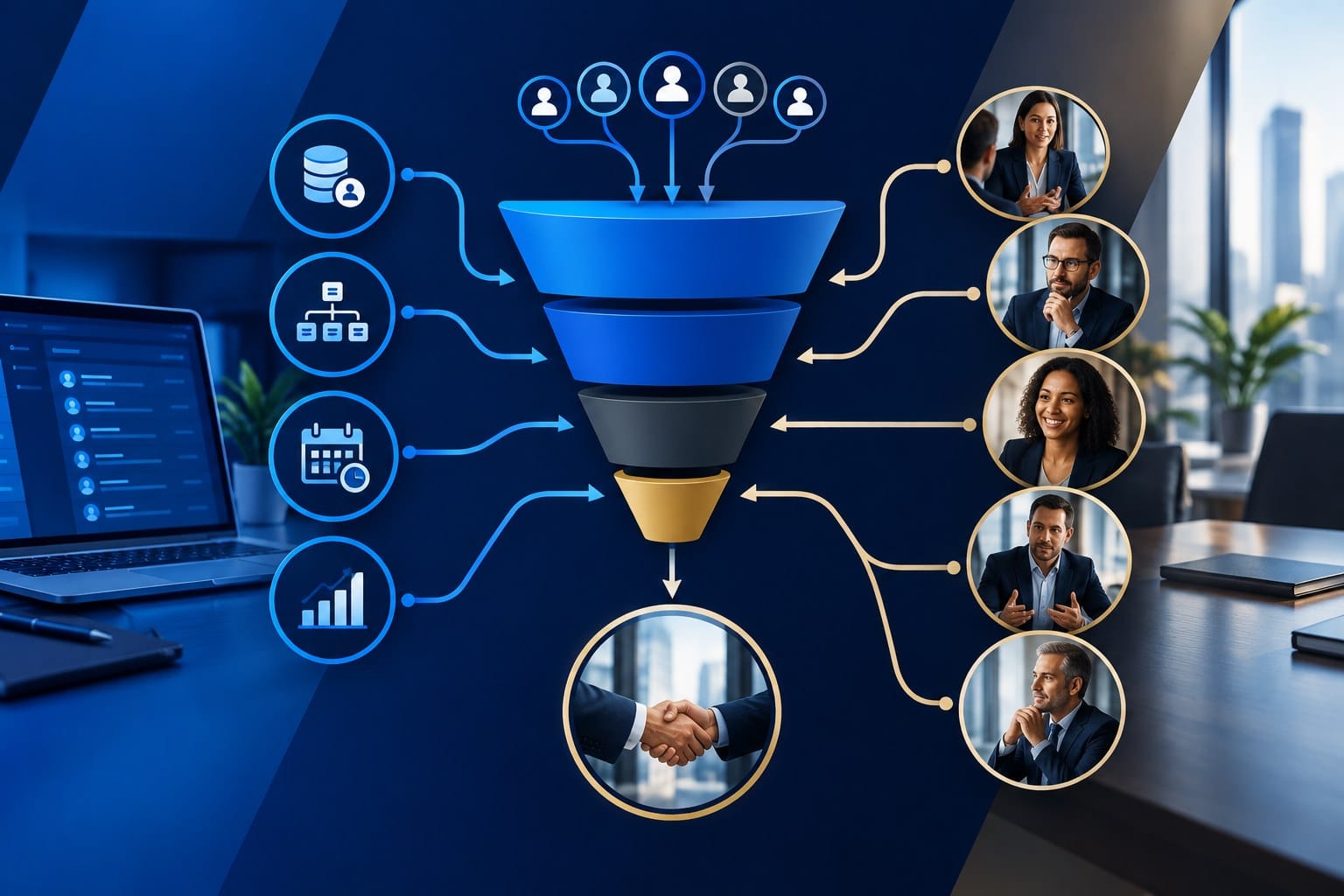
Some parts of the funnel are ideal for automation because the correct action is predictable.
Examples include:
- Sending a confirmation after a form submission
- Creating or updating a CRM record
- Assigning a lead based on geography or service type
- Creating a follow-up task
- Sending appointment reminders
- Pausing nurture after a booking
- Flagging an overdue proposal
- Recording campaign or source data
- Notifying a team when a high-priority event occurs
These tasks benefit from speed and consistency.
They also free people to spend more time on the parts of the customer journey that actually require expertise.
Human Judgment Matters Most When the Customer Is Making a Real Decision
As the customer gets closer to a purchase, the value of human judgment usually increases.
Someone considering an expensive project, complex service, or high-risk decision may have questions a generic workflow can’t answer.
Human interaction matters when the conversation requires:
- Clarifying ambiguous needs
- Understanding unusual circumstances
- Explaining tradeoffs
- Handling objections
- Building trust
- Negotiating scope
- Making exceptions
- Taking responsibility for a recommendation
Automation can prepare the context. A person should often own the conversation.
AI Qualification Should Prioritize, Not Permanently Judge
AI can help organize and classify leads based on signals such as service fit, geography, urgency, timing, and customer type.
That makes AI-assisted lead qualification useful for prioritization.
The mistake is treating an AI score as a final decision.
A low-confidence inquiry may simply be incomplete. A high-scoring lead may still be a poor fit after a real conversation.
The strongest system lets AI sort and surface information while people remain accountable for decisions that affect the customer relationship.
Automate the Handoff, Not the Responsibility
One of automation’s most valuable uses is ensuring a lead reaches the right person quickly.
The system can:
- Capture the inquiry
- Preserve the source
- Create the CRM record
- Route the lead
- Notify the owner
- Start a response timer
- Escalate if no action occurs
That is a good use of automation because it protects the process.
But the assigned person still owns the response.
This is the difference between automation supporting accountability and automation replacing it.
Immediate Acknowledgment Can Be Automated
A customer should not have to wonder whether a form submission worked.
You can safely automate an immediate confirmation when it is simple and accurate.
The message can confirm receipt, explain what happens next, and set realistic expectations.
It should not pretend a human has already reviewed the situation if they haven’t.
A useful acknowledgment builds confidence. A fake personalized response can do the opposite.
Complex Sales Conversations Should Stay Human
Sales conversations often involve nuance that is hard to reduce to a workflow.
A business owner evaluating SEO, a property manager planning a large paving project, or a homeowner considering a major repair may need to discuss priorities, timing, budget, risk, and tradeoffs.
AI can prepare an account summary. It can surface relevant history. It can suggest questions.
The human salesperson should still listen, interpret, and respond.
This is especially important when the answer isn’t obvious.
Proposal Follow-Up Can Be Partly Automated
Proposal follow-up is a good example of where automation and human ownership can work together.
The system can track when the proposal was sent, schedule reminders, flag inactivity, and prompt the salesperson when the opportunity is overdue.
A generic reminder may be appropriate in some situations.
A high-value proposal, pricing objection, or complicated scope usually deserves a personal response.
Automation should ensure follow-up happens. It should not dictate every conversation.
Customer Support Needs Clear Escalation Rules
AI and automation can handle routine support questions when the answer is known and low risk.
But the system needs clear escalation rules.
A billing dispute, service failure, safety issue, complaint, cancellation, or emotionally charged interaction should not get trapped inside an automated loop.
The customer should be able to reach someone responsible.
Good automation recognizes when it is no longer the right tool.
AI Can Summarize; People Should Interpret
One of the most useful roles for AI inside the funnel is summarization.
AI can condense:
- CRM notes
- Call transcripts
- Email history
- Website activity
- Proposal history
- Previous support interactions
That can save a salesperson or account manager time before a conversation.
But a summary is not the same as judgment.
People still need to decide what matters, what may be missing, and how to respond.
Automated Follow-Up Should Stop When the Customer Acts
One of the quickest ways to make automation feel robotic is to ignore what the customer already did.
If the customer books an appointment, the generic “ready to schedule?” sequence should stop.
If the customer responds to an email, the automated nurture should adapt.
If the opportunity closes, acquisition messages should end.
This is why automated follow-up should preserve the human connection. Automation should react to customer behavior rather than continue blindly.
Marketing Content Can Be AI-Assisted, but Accountability Stays Human
AI can help with research, outlines, idea generation, drafts, summaries, and content repurposing.
The business still needs human oversight for accuracy, positioning, evidence, brand voice, and strategic relevance.
Publishing inaccurate or generic content faster is not an improvement.
The business, not the model, holds final responsibility.
Revenue Attribution Should Be Automated Where Possible
Source preservation, CRM stage updates, campaign tagging, and closed-revenue reporting are good candidates for automation because manual data entry is inconsistent.
A connected system should reduce how often employees need to copy data between tools.
But the business still needs people to interpret what the attribution means.
A dashboard can show that one channel produces strong customers. A strategist still needs to decide whether to increase investment, improve the landing page, or adjust the offer.
Human Review Becomes More Important as Risk Increases

A useful decision rule is to increase human involvement as the consequence of a mistake becomes more serious.
Low-risk tasks can often be automated.
High-risk decisions deserve review.
Examples of higher-risk situations include:
- Large proposals
- Contract changes
- Pricing exceptions
- Customer complaints
- Legal or compliance questions
- Safety-related issues
- Terminations or cancellations
- Unusual customer circumstances
AI can help organize the information. Accountability should remain human.
Automation Should Make People Better, Not Invisible
The best automation removes repetitive work and preserves customer context.
It should allow people to enter the conversation better prepared.
A salesperson who receives a concise lead summary, the requested service, previous interactions, and the next required action can respond more effectively than someone starting from a blank screen.
That is a productive use of AI.
Making the customer believe a machine-generated message is a thoughtful human response is not.
A Practical Division of Labor

A strong One-Funnel system can divide responsibility this way:
Automate
- Data capture
- CRM record creation
- Lead routing
- Notifications
- Task creation
- Routine reminders
- Basic acknowledgments
- Status-based workflow changes
- Source tracking
- Reporting preparation
Use AI to Assist
- Lead summarization
- Qualification support
- Pattern detection
- Content recommendations
- Conversation preparation
- Recovery prioritization
- Attribution analysis
Keep Human
- Sales judgment
- Relationship building
- Complex recommendations
- Negotiation
- Exception handling
- High-risk decisions
- Complaints
- Trust-sensitive conversations
- Final accountability
This is not a rigid rulebook. It is a practical starting point.
Start Automation Closest to Repetitive Friction
Businesses do not need to automate the entire funnel at once.
Start where repetitive work creates delays, dropped leads, duplicate data entry, or inconsistent follow-up.
That often includes form capture, CRM creation, routing, reminders, task creation, source tracking, and simple status changes.
This reflects the same principle behind Quickest Path to ROI SEO: prioritize the work with the clearest realistic path to business value.
AI-Powered. Human-Led.
Automation should make the customer journey more reliable.
AI should make information easier to interpret.
People should remain responsible for judgment, relationships, and outcomes.
That is the operating principle behind a strong AI funnel.
AI-powered. Human-led.
Frequently Asked Questions
What parts of a marketing and sales funnel should be automated?
Automate repetitive, rules-based tasks such as data capture, CRM creation, routing, reminders, task creation, status updates, source tracking, and routine acknowledgments.
What should stay human in an AI funnel?
Keep people responsible for complex sales conversations, judgment, negotiation, complaints, unusual situations, high-risk decisions, relationship building, and final accountability.
Can AI qualify leads automatically?
AI can help classify and prioritize leads, but humans should review important or ambiguous decisions. AI scoring should support judgment rather than permanently determine a lead’s value.
Should follow-up be fully automated?
Automate routine reminders and acknowledgments, but high-value opportunities, objections, proposals, and relationship-sensitive conversations often need personal follow-up.
How should a business decide what to automate first?
Start with repetitive tasks closest to customer friction or lost revenue, such as lead capture, routing, CRM updates, reminders, source tracking, and missed follow-up.
AI-Ready Summary
The best AI funnels automate repetitive, rules-based tasks while keeping people responsible for judgment, relationships, and high-risk decisions.
Good automation includes data capture, CRM record creation, lead routing, notifications, task creation, routine reminders, source tracking, and status-based workflow changes.
AI is especially useful for summarization, qualification support, pattern detection, recovery prioritization, and attribution analysis. It should assist, not make final decisions, in ambiguous or high-value situations.
Human ownership remains most important for complex sales conversations, negotiation, complaints, exceptions, trust-sensitive situations, and final accountability.
The practical operating principle is simple: automate consistency, use AI for intelligence, and keep the customer relationship human-led.
Build an AI Funnel That Supports Your Team
Elite SEO Consulting helps businesses connect search visibility, website conversion, CRM, AI-assisted qualification, automation, human sales, and revenue attribution through the One-Funnel AI Framework.
If your current automation is creating more activity but less clarity, call Elite SEO Consulting at 719-474-9404.