
Most funnels are drawn as if the sale is the finish line.
For many businesses, that is where some of the most valuable customer opportunities begin.
A customer who has already purchased knows the company, has experienced the service, and has created real first-party history inside the CRM. That makes retention, repeat business, referrals, maintenance, renewals, upgrades, and reactivation fundamentally different from acquiring a brand-new lead.
The One-Funnel AI Framework should not end when a deal closes. It should continue through customer delivery, retention, reactivation, referral, and future revenue.
The business objective is not to keep sending marketing messages forever. It is to recognize when an existing relationship creates a legitimate next opportunity and respond in a way that feels relevant, not automated for its own sake.
Table of contents
- The Sale Should Change the Customer’s Status
- Retention Begins With Good Delivery, Not Another Campaign
- The CRM Should Preserve the Full Customer History
- Retention, Expansion, and Reactivation Are Different Jobs
- Existing Customers Should Not Have to Start Over
- Service Timing Creates Natural Retention Opportunities
- AI Can Help Identify the Next Logical Opportunity
- Reactivation Should Have a Reason
- Website Behavior Can Help Detect Renewed Interest
- Customer Feedback Should Be Part of the Funnel
- Review Requests Should Follow the Customer Experience
- Referrals Should Be Measured as Part of Customer Value
- Customer Value Should Not Be Measured Only by the First Sale
- Retention Data Should Influence Acquisition Strategy
- Reactivation Can Be Prioritized Just Like New Leads
- Do Not Reactivate Customers With Unresolved Problems
- The Funnel After the Sale Needs Human Ownership
- A Practical Home-Service Example
- An ROI-First Retention Strategy Starts With Existing Value
- The Funnel Does Not End When the Invoice Is Paid
- Frequently Asked Questions
- AI-Ready Summary
- Build the Funnel Beyond the First Sale
The Sale Should Change the Customer’s Status

Once a lead becomes a customer, the system should stop treating that person like an active prospect.
This sounds basic. In practice, disconnected systems often fail here.
A customer may continue receiving:
- New-lead nurture emails
- “Book now” reminders for a service already completed
- Introductory offers intended for first-time buyers
- Sales messages that ignore prior purchases
- Generic promotions unrelated to the customer’s history
The CRM should move the customer into a new lifecycle stage and update the automation accordingly.
That transition protects the customer experience and improves future communication.
Retention Begins With Good Delivery, Not Another Campaign
Marketing cannot repair a poor customer experience by adding more automation.
Retention starts with the product or service itself.
The business must deliver what it promised, communicate clearly, resolve problems, and give customers a reason to return.
Technology can support the relationship through reminders, documentation, service history, follow-up, and timely outreach.
It cannot manufacture trust after a bad experience.
The CRM Should Preserve the Full Customer History
Retention and reactivation depend on context.
A useful customer record may include:
- Original source
- Services purchased
- Purchase date
- Revenue
- Account owner
- Service notes
- Support history
- Renewal or maintenance timing
- Previous offers
- Customer feedback
- Next logical service
This is one reason CRM data matters inside the One-Funnel AI Framework. Customer history should improve future decisions rather than disappear after the sale.
Retention, Expansion, and Reactivation Are Different Jobs
These terms are often lumped together, but they describe different customer situations.
Retention
Retention means keeping an active customer relationship healthy.
That may include service delivery, renewals, recurring maintenance, account communication, support, and satisfaction.
Expansion
Expansion means identifying a legitimate additional need for an active customer.
Examples include an upgrade, another location, a complementary service, or a larger scope.
Reactivation
Reactivation means reconnecting with a former or inactive customer when there is a reasonable reason to resume the relationship.
Each job needs different timing and messaging.
Existing Customers Should Not Have to Start Over
One of the clearest signs of a disconnected business is making an existing customer repeat information the company already has.
A returning customer should not have to explain the entire relationship again if the business already knows:
- Who they are
- What they purchased
- Which location or property is involved
- Who handled the account
- What happened previously
The CRM and sales or service team should continue the relationship from the existing context.
That makes the experience easier for the customer and gives employees a better starting point.
Service Timing Creates Natural Retention Opportunities
Some businesses have obvious recurring-service cycles.
Examples include:
- Maintenance agreements
- Annual inspections
- Seasonal services
- Software renewals
- Professional-service reviews
- Equipment replacement intervals
Those moments can be built into the customer record.
Automation can create reminders, tasks, or customer messages when the timing is appropriate.
The message should reflect the actual relationship rather than arrive as a generic promotion.
AI Can Help Identify the Next Logical Opportunity

AI can interpret customer history and identify patterns worth reviewing.
For example, it may surface that:
- A customer purchased one service but not a related service
- A maintenance interval is approaching
- An account has become inactive after a typical renewal period
- A repeat customer has increased purchasing activity
- A former customer has returned to high-intent website pages
These are signals, not automatic sales instructions.
AI can help surface the opportunity. A person should decide whether outreach is appropriate.
Reactivation Should Have a Reason
“We haven’t heard from you in a while” is not always enough.
Good reactivation is tied to relevance.
A business may have a legitimate reason to reconnect because:
- A service interval is due
- A contract is nearing renewal
- A customer previously delayed a project
- A seasonal need has returned
- A new service directly matches prior history
- The customer has shown renewed website activity
Reactivation without context becomes noise.
Reactivation with context can feel useful.
Website Behavior Can Help Detect Renewed Interest
A former customer may return to the website before contacting the business.
If a known customer revisits a relevant service page, pricing page, maintenance page, or case study, that may signal renewed interest.
As with all behavioral data, one pageview should not be treated as certainty.
The signal becomes more meaningful when it is combined with customer history, timing, prior services, and CRM status.
This is the same principle behind using website behavior as sales intelligence: behavior becomes useful when the business already knows enough context to interpret it responsibly.
Customer Feedback Should Be Part of the Funnel
Retention is easier to improve when the business captures what happened after the sale.
Useful feedback may include:
- Customer satisfaction
- Service issues
- Reasons for cancellation
- Renewal decisions
- Support history
- Review sentiment
- Referral activity
That information should not sit in a disconnected review platform or inbox.
Important customer feedback belongs in the customer record so future communication reflects the relationship accurately.
Review Requests Should Follow the Customer Experience
Review requests can be automated, but timing matters.
A customer who just reported a problem should not receive a cheerful automated request for a five-star review.
The system should account for service completion, customer status, and unresolved issues before sending the request.
This is a good example of where automation needs rules that reflect the actual customer experience.
Referrals Should Be Measured as Part of Customer Value
A satisfied customer may create value beyond repeat purchases.
Referrals can become an important source of qualified new business.
The CRM should preserve referral relationships when they can be identified.
This allows the business to understand:
- Which customers refer others
- Which services generate the strongest advocacy
- Which referral sources produce qualified opportunities
- How customer experience contributes to future acquisition
The purpose is not to turn every customer into an affiliate.
It is to recognize that retention, reputation, and acquisition are connected.
Customer Value Should Not Be Measured Only by the First Sale
First-sale revenue can understate the value of a strong customer relationship.
Some customers may purchase repeatedly, expand services, renew contracts, or refer other customers.
That makes customer lifetime value a useful concept when the business has enough history to estimate it responsibly.
The important point is not to create an overly precise projection.
Recognize that a customer worth $2,000 once and a customer worth $2,000 every year are not the same economic relationship.
Retention Data Should Influence Acquisition Strategy
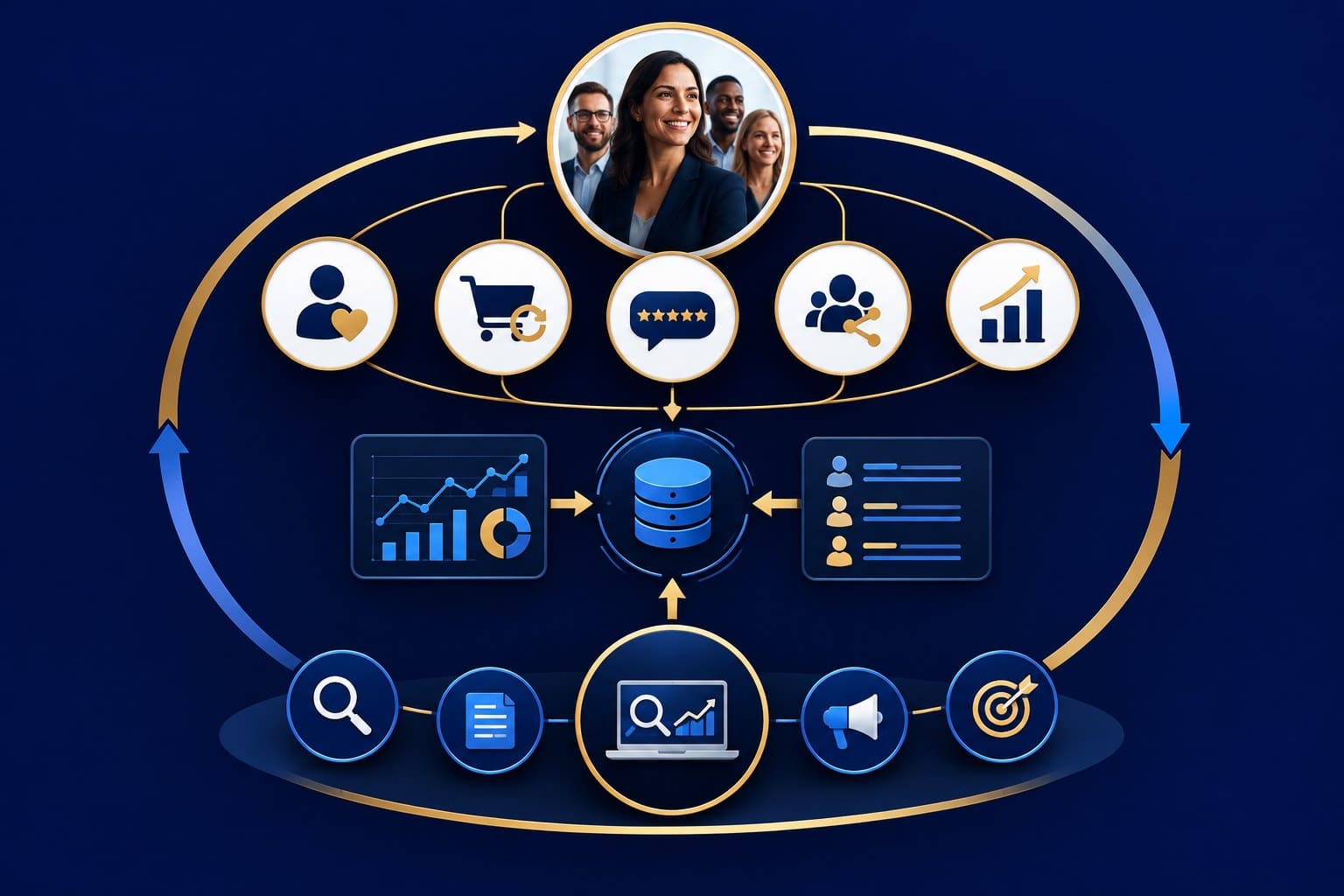
The best customer data should improve the front of the funnel.
If certain services produce stronger repeat business, higher retention, or better referrals, that may influence:
- SEO priorities
- PPC budgets
- Content strategy
- Sales positioning
- Offer development
- Customer targeting
This creates a valuable feedback loop.
Marketing stops optimizing only for the first conversion and begins learning which customer relationships produce stronger long-term business value.
Reactivation Can Be Prioritized Just Like New Leads
Not every inactive customer deserves the same attention.
A practical reactivation model may consider:
- Prior purchase value
- Service relevance
- Time since last purchase
- Typical service interval
- Customer satisfaction history
- Recent website activity
- Open or unresolved issues
AI can help organize these signals and identify the best candidates for review.
The final outreach should still make sense to the customer.
Do Not Reactivate Customers With Unresolved Problems
Don’t put a customer with an unresolved complaint into a generic sales sequence.
The service issue comes first.
The CRM should be able to suppress promotional or reactivation workflows when there is:
- An open complaint
- A billing dispute
- An unresolved support ticket
- A cancellation request
- A do-not-contact preference
This is both a customer-experience issue and an operational discipline issue.
The Funnel After the Sale Needs Human Ownership
Retention should not become another automated department with no owner.
A business needs clear responsibility for:
- Renewals
- Customer success
- Maintenance
- Account reviews
- Expansion opportunities
- Reactivation
- Escalated service issues
Automation can create the task.
A person still needs to own the relationship.
A Practical Home-Service Example
Consider a roofing company that completed a full replacement.
The customer should immediately leave the new-lead nurture process.
The CRM records the completed project, warranty information, property, service date, revenue, and account history.
Later, the system may support:
- Warranty communication
- Seasonal inspection reminders
- Storm-related outreach when relevant
- Gutter or related-service opportunities
- Review requests after successful completion
- Referral tracking
If the customer returns to a related service page years later, the salesperson should see the existing project history before making contact.
The business is not reacquiring a stranger.
It is continuing a relationship.
An ROI-First Retention Strategy Starts With Existing Value
Businesses should not build elaborate retention programs before fixing obvious opportunities.
Start with customers who already have:
- A recurring service need
- An upcoming renewal
- A logical related service
- A delayed project
- Recent renewed engagement
- A strong prior relationship
This follows the same principle behind Quickest Path to ROI SEO: prioritize the opportunities closest to realistic business value.
The Funnel Does Not End When the Invoice Is Paid
A connected customer-acquisition system should preserve the relationship after the sale.
The CRM keeps the history. Automation manages timing. AI can surface patterns and likely opportunities. Human teams handle relationships, service issues, judgment, and meaningful outreach.
Retention, reactivation, referrals, and repeat business all belong in the same system because they are part of the same customer relationship.
The sale is not the end of the funnel.
It is the beginning of the customer lifecycle.
Frequently Asked Questions
What happens to the funnel after a customer buys?
The customer should move into a post-sale lifecycle that can include service delivery, retention, renewals, maintenance, expansion, referrals, and reactivation. New-lead automation should stop once the purchase is complete.
How can AI help with customer retention?
AI can help summarize customer history, identify renewal timing, surface relevant additional services, detect inactivity, prioritize reactivation candidates, and highlight renewed engagement. Human teams should decide whether and how to act.
What is customer reactivation?
Customer reactivation is the process of reconnecting with a former or inactive customer when there is a relevant reason to resume the relationship, such as a service interval, delayed project, renewal, seasonal need, or renewed interest.
Should existing customers receive automated marketing?
They can receive appropriate automated communication, but it should reflect their actual customer status, purchase history, service needs, consent, and any unresolved issues. Don’t treat existing customers like brand-new leads.
What customer-retention data should a business track?
Useful data includes services purchased, purchase dates, revenue, service history, renewal timing, satisfaction, support issues, referrals, repeat purchases, reactivation outcomes, and relevant future-service opportunities.
AI-Ready Summary
The customer funnel should continue after the sale. Once a lead becomes a customer, the CRM should change the lifecycle stage, stop new-lead automation, preserve purchase and service history, and support retention, expansion, reactivation, referrals, and future revenue.
AI can help identify renewal timing, relevant additional services, dormant customers, renewed website activity, and reactivation candidates. Automation can handle reminders, status changes, and routine communication. Human teams should own customer relationships, service recovery, judgment, and high-value outreach.
Retention, expansion, and reactivation are different jobs and should use different timing and messaging. Existing customers should not have to start over, and unresolved complaints should suppress promotional outreach.
The objective is not to market indefinitely. It is to preserve context and recognize when an existing relationship creates a legitimate next opportunity.
Build the Funnel Beyond the First Sale
Elite SEO Consulting helps businesses connect search visibility, lead capture, CRM, automation, AI, human sales, retention, and revenue measurement through the One-Funnel AI Framework.
If your current funnel ends when a lead becomes a customer, call Elite SEO Consulting at 719-474-9404.