

The future of customer acquisition will not belong to the business with the largest collection of AI tools.
It will belong to the business that can connect customer intent, marketing context, human response, sales activity, and revenue into one accountable system.
Customers already move across search engines, Google Maps, AI-generated answers, websites, reviews, social platforms, advertising, email, phone calls, text messages, referrals, and offline conversations. They do not experience those interactions as separate departments. They experience one relationship with a company.
Inside the business, however, the journey is often split across systems that don’t share enough information. Marketing sees impressions, traffic, and leads. Sales sees contacts and opportunities. Operations sees customers. Accounting sees revenue. Each group holds part of the truth.
AI makes that fragmentation more consequential. It can help analyze demand, organize customer data, personalize communication, prioritize leads, monitor workflows, and surface performance patterns. It can also accelerate weak processes, repeat inaccurate information, and create more activity without improving the customer experience.
A connected AI funnel can outperform disconnected marketing because it preserves context, coordinates action, returns outcomes to earlier stages, and helps the business learn from the full customer journey. That is a structural advantage, not a guarantee. Results still depend on strategy, demand, execution, offer quality, sales ability, capacity, and responsible use of technology.
This final article in the One-Funnel AI content cluster explains where customer acquisition is moving, why disconnected channel optimization will become less useful, what a connected system does differently, and what businesses should build now.
Table of contents
- Customer Acquisition Is Becoming More Distributed
- Customers Will Expect One Continuous Relationship
- Disconnected Marketing Creates a Structural Disadvantage
- One Connected Funnel Changes the Operating Model
- Connected Data Creates the Competitive Advantage
- AI Will Improve Decisions Across the Complete Journey
- The Website Will Become a Revenue Operating Layer
- Speed and Relevance Will Matter More Than Automation Volume
- Revenue Feedback Will Reshape Marketing Strategy
- Human Judgment Will Remain the Trust Layer
- What Connected-Funnel Outperformance Actually Means
- How Businesses Should Prepare Now
- 1. Define the Shared Business Outcome
- 2. Map the Complete Journey
- 3. Audit the Existing Funnel
- 4. Create Shared Definitions
- 5. Establish One Customer Record
- 6. Connect the Highest-Value Handoffs
- 7. Add AI Where the Process Is Defined
- 8. Return Outcomes to Earlier Stages
- 9. Implement in Practical Phases
- 10. Continue the Improvement Cycle
- Common Future-of-Acquisition Mistakes
- Collecting More AI Tools Without Connecting the Journey
- Creating a Separate AI Strategy for Every Channel
- Automating Before Defining Ownership
- Training Systems on Weak Data
- Personalizing Without Permission or Purpose
- Measuring Leads Instead of Customers
- Treating AI Output as Verified Fact
- Replacing Human Contact Where It Creates Trust
- Expecting Technology to Fix a Weak Offer
- Frequently Asked Questions
- Build the Connected System the Customer Already Expects
Customer Acquisition Is Becoming More Distributed
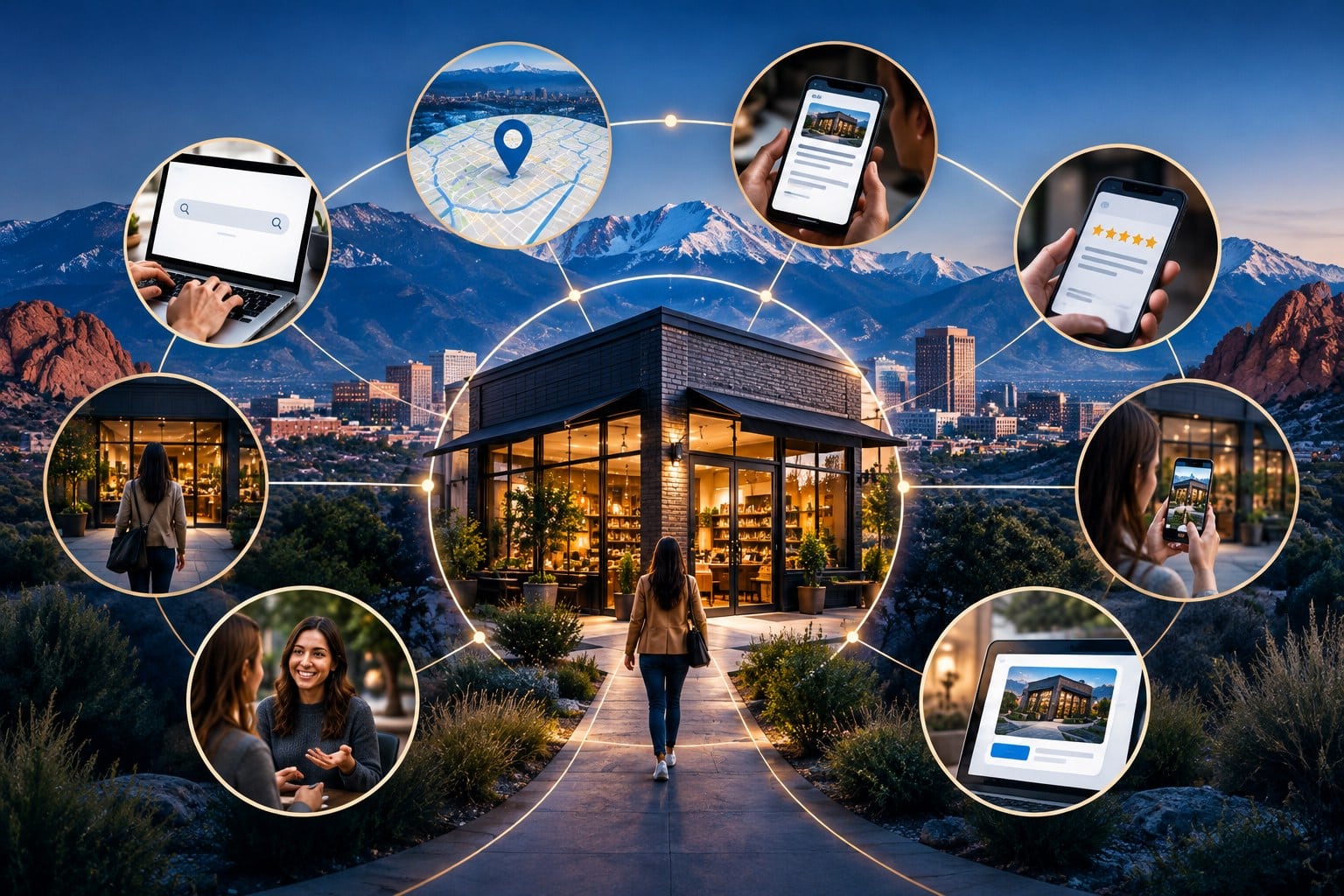
Discovery no longer begins in one predictable place.
A customer may type a service query into Google, review a local Map Pack, ask an AI assistant for options, watch a video, notice a social post, read third-party reviews, visit the website, leave, receive a referral, return through a branded search, and finally call.
The number of possible entry points is expanding while the customer’s expectation remains simple: provide a relevant answer and make the next step clear.
Search Is Becoming More Varied
Traditional organic results remain important, but search experiences increasingly include local results, product and service modules, video, images, AI-assisted summaries, conversational follow-up, and other formats.
Google currently states that foundational SEO practices remain relevant to its AI features and that pages must still be indexed and eligible for Search with a snippet. It does not describe a special shortcut that replaces useful, accessible, reliable content. Google Search Central guidance for AI features
The practical implication is not that every business needs a separate strategy for every interface. The business needs clear information, credible evidence, technical accessibility, and a customer journey that can accept demand from several discovery environments.
Our article on how AI search is changing the top of the marketing funnel explains how customers may encounter a business, compare options, and form preferences before a traditional website visit is recorded.
Local Discovery Will Remain Geographically Uneven
Local visibility will continue to depend on relevance, distance, prominence, competition, customer location, and query intent. A service-area setting will not create physical offices throughout a city. One ranking position will not represent an entire market.
Connected customer acquisition uses geographic visibility together with lead quality, service demand, travel time, capacity, customer value, and close outcomes. It asks not only where the business appears, but where the business can serve customers profitably and consistently.
Referrals and Offline Influence Will Still Matter
Not every customer journey can be reconstructed from a click.
A customer may hear about a business from a neighbor, see a vehicle, recognize a sponsorship, remember a prior project, or ask an employee for a recommendation. The future funnel must allow honest “offline,” “referral,” and “unknown” categories rather than forcing every customer into a digital attribution model that did not cause the decision.
Better connected data improves attribution. It does not eliminate uncertainty.
Customers Will Expect One Continuous Relationship
Customers do not care which department owns the CRM or which vendor sends the text message.
They expect the business to remember what they asked, avoid requesting the same information repeatedly, respond within a reasonable time, honor communication preferences, and continue the conversation with context.
A continuous relationship might look like this:
- 1. The customer discovers a relevant service.
- 2. The website confirms fit, location, proof, and next steps.
- 3. The customer calls or submits information.
- 4. The business acknowledges the inquiry accurately.
- 5. A responsible person receives the full context.
- 6. The response reflects the actual need.
- 7. Qualification, appointments, estimates, and follow-up remain connected.
- 8. The customer’s decision and value return to the record.
- 9. Post-sale communication reflects the completed relationship.
The customer may move backward, pause, switch channels, or speak with several people. Continuity does not require a perfectly linear journey. It requires one shared understanding of the relationship.
The One-Funnel AI Framework provides that operating structure across visibility, website engagement, lead capture, CRM records, qualification, follow-up, human sales, attribution, revenue, retention, and reactivation.
Disconnected Marketing Creates a Structural Disadvantage
Disconnected marketing can still produce leads and customers. The problem is that it learns slowly, loses context, and lets failures between systems go unnoticed.
Channels Optimize for Their Own Metrics
SEO may report rankings and traffic. Paid search may report conversions and cost per lead. Social may report reach and engagement. Email may report opens and clicks. Sales may report pipeline. Accounting may report revenue.
Each report can be accurate while the business still cannot determine:
- Which sources generate qualified opportunities
- Which services and locations produce valuable customers
- Which website experiences contribute to sales
- Whether lead response affects outcomes
- Which estimates receive effective follow-up
- Why qualified opportunities are lost
- Which customers return or refer others
- Where marketing investment should increase or decrease
Channel metrics remain useful. They become more valuable when they connect to downstream outcomes.
Customer Context Disappears at Handoffs
A lead may enter the CRM with only a name and phone number. Sales then loses the requested service, landing page, location, original question, campaign, and prior interactions.
The salesperson must reconstruct the journey or begin again. The customer experiences repetition. Marketing receives a generic outcome such as “bad lead.” Nobody learns enough to improve the system.
Automation Conflicts With Human Activity
Disconnected automation can send a promotional email after a complaint, continue estimate reminders after the customer declined, request a review before the work is complete, or message a lead after a salesperson already made contact.
The technology performed exactly as configured. The customer still received a poor experience.
Revenue Cannot Inform Acquisition
When customer value and revenue never return to marketing, acquisition decisions rely on surface-level conversion counts.
The least expensive lead may not be the most valuable. The channel with the most calls may produce the lowest qualified rate. A low-traffic service page may contribute to high-value customers. Disconnected reports can’t reliably show those differences.
One Connected Funnel Changes the Operating Model
One connected funnel does not mean one software platform, one marketing channel, or one rigid customer path.
It means the systems share the information required to support one customer journey and one set of business outcomes.
| Disconnected model | Connected One-Funnel model |
|---|---|
| Channels pursue separate conversion goals | Channels support shared customer and revenue outcomes |
| Forms and calls create isolated notifications | Every meaningful inquiry creates or updates one customer record |
| Marketing sends leads without context | Marketing sends source, service, location, intent, and journey context |
| Sales records activity inconsistently | Sales returns qualification, appointment, estimate, win, loss, and revenue outcomes |
| Automation follows a fixed schedule | Automation responds to current lifecycle stage and stops appropriately |
| AI operates as separate tools | AI assists defined processes using governed data and human review |
| Reporting ends at leads | Reporting distinguishes visibility, leads, opportunities, customers, and revenue |
| Each team improves its own dashboard | The business improves the complete customer journey |
This change is operational before it is technological.
The business must define lifecycle stages, required fields, owners, response standards, decision rules, outcomes, and feedback loops. Integrations and AI then support those definitions.
Our guide explains why businesses must connect SEO, AEO, GEO, CRM, and sales, showing how visibility disciplines, websites, customer data, and human sales each serve different functions within the same revenue system.
Connected Data Creates the Competitive Advantage

AI is only as useful as the context, definitions, permissions, and feedback it has.
Disconnected tools provide narrow snapshots. Connected customer data can show relationships across discovery, behavior, conversion, qualification, response, sales activity, customer value, and revenue.
The Customer Record Becomes the Shared Operating Memory
A useful central record may include:
- Original source and recent source
- Landing page or campaign
- Service or product interest
- Customer location
- Contact method
- Submitted questions or call summary
- Consent and communication preferences
- Qualification status
- Assigned owner
- Next action and due date
- Response history
- Appointment, estimate, or proposal status
- Win, loss, or disqualification reason
- Customer value and revenue
- Review, referral, retention, and reactivation status
The objective is not to store every available data point. The objective is to preserve the information required for the next responsible action and the next useful decision.
The guide on how AI can connect marketing, sales, and customer data explains why one customer record bridges channel performance and revenue performance.
Feedback Creates Compounding Improvement
A connected system can return outcomes to earlier stages:
- Sales results refine audience and keyword priorities
- Disqualification reasons improve targeting and forms
- Customer questions improve service pages and follow-up
- Loss reasons identify pricing, scheduling, trust, or sales problems
- Geographic outcomes guide local visibility investment
- Customer value changes campaign priorities
- Reviews and service feedback strengthen proof and operations
- Repeat purchases and referrals change lifetime-value assumptions
The advantage compounds because each completed journey can improve the next decision.
Disconnected systems repeatedly attract, convert, and handle customers without retaining enough learning. The organization stays busy and remains strangely surprised by the same problems.
Data Quality Will Matter More Than Data Volume
AI can process a large quantity of customer information. It cannot make inaccurate definitions, missing outcomes, duplicate records, or careless notes become reliable merely by processing them faster.
Future-ready businesses will place greater value on:
- Consistent lifecycle definitions
- Required but reasonable fields
- Accurate timestamps
- Specific loss and disqualification reasons
- Duplicate management
- Source preservation
- Permission and access controls
- Data retention rules
- Routine quality audits
- Clear ownership
The businesses with the most data will not necessarily have the strongest system. Businesses with the most decision-useful data will be better positioned.
AI Will Improve Decisions Across the Complete Journey
AI’s value will move beyond isolated content creation and chatbots.
Within a connected funnel, AI can assist at several stages while remaining subordinate to business rules and human accountability.
Discovery and Demand Analysis
AI can help organize search patterns, customer questions, service relationships, local demand, content gaps, competitive themes, and conversational queries.
It should not decide which markets or services matter without business context involving profitability, capacity, geography, regulation, and strategy.
Website and Conversion Analysis
AI can help identify message mismatches, recurring exit points, unanswered questions, form friction, content gaps, and opportunities to present more relevant proof.
It should not replace direct testing, accessibility, analytics verification, customer research, or conversion judgment.
Lead Organization and Qualification
AI can summarize inquiries, categorize services, identify missing information, detect urgency, flag potential fit, and recommend priority for human review.
It should not invent customer facts, make unsupported high-impact eligibility decisions, or silently disqualify people.
Follow-Up and Sales Support
AI can draft contextual communication, prepare conversation summaries, suggest questions, identify overdue actions, group objections, and surface stalled opportunities.
It should not send sensitive or consequential communication without appropriate controls.
Attribution and Performance Analysis
AI can compare source, service, location, lead quality, response, sales activity, customer value, and revenue patterns.
It should not convert correlation into causation or present uncertain attribution as precise fact.
The Website Will Become a Revenue Operating Layer
The website will remain more than a place to publish information.
It is where discovery context becomes first-party engagement, customer intent becomes measurable action, and the business begins preserving the relationship.
A future-ready website should:
- Explain services, audiences, and locations clearly
- Provide useful, credible, accessible content
- Support traditional and AI-assisted discovery
- Match landing experiences to customer intent
- Present relevant proof
- Offer appropriate calls, forms, bookings, chats, or visits
- Capture only the information needed for the next step
- Preserve source and journey context
- Create or update the customer record
- Trigger responsible acknowledgment and ownership
- Support measurement beyond the initial conversion
The website shouldn’t become a complicated software product just to look advanced. A fast, clear service page with a working call button and reliable CRM handoff may create more business value than a theatrical AI interface that cannot answer a basic customer question.
Speed and Relevance Will Matter More Than Automation Volume
Customers increasingly expect prompt acknowledgment and relevant response. They do not necessarily want more automated communication.
The connected funnel separates:
- Time to acknowledgment
- Time to first human attempt
- Time to meaningful human contact
- Response relevance
- Resolution or next-step quality
The speed-to-lead process benefits from automation when it creates records, assigns ownership, alerts the right person, and escalates overdue action. It fails when the automated email becomes an excuse for no human response.
Future systems will become better at selecting the appropriate next action, channel, timing, and message based on current context.
That improvement requires:
- Accurate lifecycle stages
- Current ownership
- Communication preferences
- Stop conditions
- Business-hour rules
- Service and urgency context
- Prior contact history
- Human escalation
More messages are not the goal. Better continuity is.
Revenue Feedback Will Reshape Marketing Strategy
The connected funnel changes what marketing teams optimize.
Instead of stopping at traffic or lead volume, the business can examine:
- Qualified leads by source
- Disqualification reasons by campaign
- Customer location and service fit
- Response outcomes by lead type
- Appointment and estimate progression
- Win and loss reasons
- Customer value by service and channel
- Revenue by source where supportable
- Repeat and referral activity
- Acquisition cost using complete expenses
Google Analytics recommends lead-generation events that can distinguish generated, qualified, disqualified, working, converted, and unconverted leads. That measurement model reflects the direction acquisition systems need to move: beyond the initial form submission and toward the complete lead lifecycle. Google Analytics recommended lead-generation events
For appropriate advertising use cases, Google describes enhanced conversions for leads as a privacy-conscious method using hashed first-party customer data to improve the accuracy of offline conversion imports. Such systems still require correct consent, configuration, governance, and event definitions. Google Ads enhanced conversions for leads
The future report will not ask only, “How many leads did marketing generate?”
It will ask:
- Which customer problems created profitable demand?
- Which journeys produced qualified opportunities?
- Which handoffs helped or hurt the outcome?
- Which customers produced value?
- What should the business change next?
Human Judgment Will Remain the Trust Layer

The more connected and capable the system becomes, the more important accountability becomes.
AI can recommend, summarize, classify, monitor, and draft. People must define the purpose, approve the boundaries, review consequential decisions, resolve exceptions, and take responsibility for the customer experience.
NIST’s voluntary AI Risk Management Framework organizes risk work around governing, mapping, measuring, and managing AI systems. These concepts directly support customer acquisition: define ownership, understand the use context, measure performance and risk, and manage problems throughout the system’s lifecycle. NIST AI Risk Management Framework
Governance Should Be Operational
Maintain an AI-use register containing:
- The business purpose
- Data sources involved
- System owner
- Human reviewer
- Approved actions
- Prohibited actions
- Customer disclosure when appropriate
- Testing procedure
- Error and escalation process
- Access controls
- Retention requirements
- Monitoring schedule
Sensitive Decisions Need Stronger Controls
Human review is especially important for:
- Eligibility or qualification with consequential effects
- Legal, medical, financial, employment, housing, or safety matters
- Pricing exceptions
- Complaints and disputes
- High-value proposals
- Communications involving sensitive customer information
- Decisions based on incomplete or uncertain data
Trust Is Part of Conversion
Customers evaluate whether a business is accurate, responsive, respectful, transparent, and capable.
An automated system can support those qualities. It can’t indefinitely compensate for misleading information, poor service, careless data handling, or nobody accepting responsibility.
What Connected-Funnel Outperformance Actually Means
Measure the word outperform, don’t celebrate it in advance.
A connected funnel may create an advantage by improving:
Context Preservation
The responsible person receives the service, location, source, customer question, prior activity, and promised next step.
Response Reliability
Leads receive acknowledgment, ownership, coverage, escalation, and a meaningful human response, all according to defined standards.
Qualification Quality
The business applies consistent criteria and distinguishes poor fit from poor handling.
Customer Experience
The customer does not need to repeat the journey at every channel change or department handoff.
Sales Execution
Appointments, estimates, proposals, and follow-up remain visible and accountable.
Measurement Quality
The business distinguishes visibility, conversions, leads, qualified opportunities, customers, revenue, and ROI.
Learning Speed
Customer and sales outcomes return to targeting, content, website, advertising, automation, and operational decisions.
Resource Allocation
Investment can move toward the services, locations, audiences, pages, channels, and process improvements with stronger demonstrated business value.
These advantages do not guarantee a particular result. They improve the system’s ability to make informed decisions and reduce preventable losses.
How Businesses Should Prepare Now
The transition does not require replacing every platform.
It requires a disciplined sequence.
1. Define the Shared Business Outcome
Choose the customer and revenue outcomes the system should improve. Do not begin with “use more AI.”
2. Map the Complete Journey
Document discovery, website engagement, lead capture, CRM records, response, qualification, appointments, estimates, sales outcomes, revenue, and post-sale activity.
3. Audit the Existing Funnel
Use a structured marketing funnel audit to test conversion paths, handoffs, ownership, measurement, and revenue leaks before adding new activity.
4. Create Shared Definitions
Agree on inquiry, lead, qualified lead, opportunity, customer, loss, disqualification, and revenue.
5. Establish One Customer Record
Preserve the context needed by marketing, sales, service, and reporting. Define how duplicates, repeat customers, permissions, and source history are handled.
6. Connect the Highest-Value Handoffs
Begin with calls, forms, CRM creation, ownership, response, qualification, estimates, and closed outcomes.
7. Add AI Where the Process Is Defined
Use AI for organization, analysis, drafting, monitoring, and recommendations within documented boundaries.
8. Return Outcomes to Earlier Stages
Feed qualification, losses, customers, revenue, retention, and referrals back into acquisition decisions.
9. Implement in Practical Phases
The 90-day One-Funnel AI roadmap provides a sequence for mapping and stabilizing the foundation, connecting high-value handoffs, then improving AI assistance, automation, and revenue measurement.
10. Continue the Improvement Cycle
Strategize, implement, analyze, report, and reprioritize. Customer behavior, platforms, markets, staff, and business capacity will keep changing.
Common Future-of-Acquisition Mistakes
Collecting More AI Tools Without Connecting the Journey
Several intelligent tools can still create one unintelligent customer experience.
Creating a Separate AI Strategy for Every Channel
Search, Maps, social, advertising, email, CRM, and sales have different functions. They still need shared customer and revenue outcomes.
Automating Before Defining Ownership
Automation cannot replace one accountable person responsible for the next action.
Training Systems on Weak Data
Missing outcomes, duplicated contacts, vague notes, and inconsistent definitions produce unreliable analysis.
Personalizing Without Permission or Purpose
Personalization should help the customer make a better decision. It should not become invasive simply because the system can assemble more data.
Measuring Leads Instead of Customers
Lead volume can hide poor fit, slow response, weak follow-up, low close rates, and limited customer value.
Treating AI Output as Verified Fact
AI can be wrong, incomplete, biased, or out of context. Verification and human responsibility remain necessary.
Replacing Human Contact Where It Creates Trust
Complex, expensive, sensitive, urgent, and exception-heavy decisions often benefit from a capable person.
Expecting Technology to Fix a Weak Offer
A connected funnel cannot make an irrelevant service, unclear value, poor reputation, or weak customer experience compelling on its own.
Frequently Asked Questions
What is a connected AI marketing funnel?
A connected AI marketing funnel coordinates discovery, website engagement, lead capture, CRM records, qualification, follow-up, human sales, revenue attribution, retention, and reactivation. AI assists defined processes, while customer context and outcomes move across the complete journey.
Why can a connected funnel outperform disconnected marketing?
A connected funnel can preserve customer context, reduce failed handoffs, improve response reliability, return sales outcomes to marketing, and support decisions using qualified leads, customers, and revenue. Those structural advantages can improve performance, but they do not guarantee results.
Does a business need one software platform to build one funnel?
No. A business may use several specialized platforms. The requirement is that a shared operating model and reliable integrations keep critical information, ownership, actions, and outcomes connected.
Will AI replace marketing and sales employees?
AI can automate repetitive actions and assist with analysis, organization, drafting, prioritization, and monitoring. People remain responsible for strategy, verification, sensitive communication, exceptions, consequential decisions, relationships, and accountability.
What should a business connect first?
Start with the well-supported failure closest to qualified demand or revenue. Common priorities include broken conversion paths, missed calls, incomplete CRM records, unassigned leads, slow response, inconsistent qualification, unfollowed estimates, and missing customer or revenue attribution.
Build the Connected System the Customer Already Expects
Customers already experience your marketing, website, sales process, and service as one relationship.
The business can choose whether its systems reflect that reality.
Disconnected marketing can continue producing activity. It will also continue losing context between channels, teams, tools, and outcomes. AI may make each isolated component faster without making the complete journey more coherent.
One connected AI funnel offers a better operating model:
- Multiple discovery paths
- One continuous customer relationship
- One usable customer record
- Clear ownership
- Relevant human response
- Controlled automation
- AI-assisted decisions
- Sales feedback
- Customer and revenue measurement
- Continuous learning
That is the future of customer acquisition: not automation for its own sake, but a more connected, measurable, and responsible path from customer need to business value.
Elite SEO Consulting helps businesses connect search and AI visibility, websites, lead capture, CRM records, follow-up, sales activity, attribution, and revenue measurement through one accountable customer-acquisition system.
Call 719-474-9404 or contact Elite SEO Consulting to assess where your current marketing is disconnected and build a practical path to a connected AI funnel.


